alligatortower says: I don’t want to vote on which stories you write. I want you to write the stories that you think are important, and I want to judge whether I follow you or not based on whether I agree with you often enough.
» SFB says: And we want to listen to our readers and best focus our resources so that we can tell better stories! That’s why we created The Pitch. Writing longer stories takes a larger amount of resources than posting short items — and by doing it this way, we know where to put those resources so that you guys can read interesting stories, and we hear from our readers at the same time. And, a general thought: Read things you disagree with! It expands your worldview, dang it! Don’t get tunnel vision. You’ll learn more about how the world works. — Ernie @ SFB
What’s up folks? Here’s the latest entry in our weekly post series, “The Pitch.” This post, written by SFB editor Ernie Smith and researched by Seth Millstein, analyzes the current crisis facing the corn industry, and its larger ripple effects. Find Ernie on Twitter over here, and Seth over here.
Think beyond the cob: We’ve come a long way from the pilgrims and the first Thanksgiving, folks. Corn is used in an embarrassing amount of products — from popcorn to soda to Hot Pockets to fuel — and a recent drought that’s covering as much as 60 percent of the country could mean higher prices for you at the grocery store. But how bad is it? SFB’s very own Ernie Smith analyzes. (Oh, with an assist on the research from Seth Millstein.) Read more after the jump.
What i’m hearing is that this is the worst, most SEVERE drought we’ve had since 1988. There’s not really much we can do except sell our animals, because we don’t have enough proper hay to feed them.
Creston, Iowa resident Anna Welcher • Discussing the drought in Iowa, and how it’s affecting her family’s farm. Welcher says corn yields are down 30 percent and it’s having a ripple effect on the farm as a whole, as well as a number of nearby farmers. “It hurts everyone: The farmer, the pork and beef producers, and the consumer,” she continues. “Once the farmers start selling their cattle, we’re hoping the prices in the grocery store go down, but when there is no cattle left, we’ll all have to become vegetarians.” How did we get to this point? And what does this mean for you, consumer that lives nowhere near a family farm? Let’s analyze.
Breakdown: The current yield level, compared
172the number of bushels per acre Iowa corn farmers produced last year, on average
117the number of bushels per acre Iowa corn farmers are expected to produce this year
80the number of bushels per acre produced in 1993, the last time the level was so low source
» And 1988 really was a bad year, too: During the 1988 drought, Iowa corn production hit a mere 84 bushels per acre, though the production level was much lower 24 years ago. The current situation is nonetheless fairly dire, according to Bill Nelson, a Senior Economist at Doane Advisory Services, who came up with the recent yield estimate. “You could see very few ears filled to the tip,” Nelson said. “And the kernel counts are way below average.” Iowa is the state that produces the most corn, with other Midwestern states directly behind.
Why this affects you, dear consumer
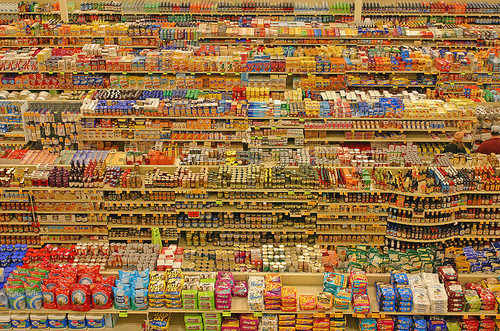
This may not be a surprise to you, but … Corn is a key ingredient of your grocery store experience — outside of the produce aisle, many processed products use corn or soy to improve the texture of (or sweeten) the foods you eat. So, even foods which seem miles away from what you consider to be “corn” rely on that little pop to create the overall effect. There was even a movie about this a few years ago called Food, Inc. To give you an idea, all five of the items below use corn ingredients in some way, shape or form:
» So if there’s a corn shortage … That means prices across your local grocery store could go up as a result. (Soybeans, another key ingredient of processed foods, have also been affected by the drought.) But, due to corn’s low costs compared with other parts of production, processed foods are less likely to be affected by the drought. The real issue? Foods created indirectly by corn — such as livestock, milk or poultry, all three of which rely on corn for feed. So basically, this drought is hitting the grocery store in multiple ways. (photo by lyzadanger)
But how much will prices rise?
3%the minimum grocery price increase expected in 2013 source
45%the increase in the price of corn this summer, on average; the price is nearing last summer’s records
1%the amount a 50% increase in the price of corn would boost the average grocery bill source
>4%the increase in the price of beef as a result of the shortage
>3.5%the increase in the price of dairy products (milk, etc.) next year
>3%the increase in the price of poultry and eggs; pork will also rise source
» Food price inflation is common. But this? In an average year, food prices increase at a 2.8 percent clip. But with increases as high as 4 percent possible, it could prove to have a real effect on consumer decisions. “In 2013 as a result of this drought we are looking at above-normal food price inflation. … Consumers are certainly going to feel it,” says USDA economist Richard Volpe. But don’t expect the effects to show up right away — you’ll likely see the effects first with poultry, which takes a relatively short time to raise. Beef may not show a significant price increase for another year or two.
Finally: A world reliant on American corn
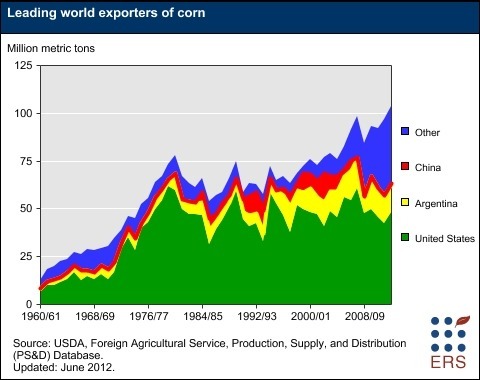
You know who uses American corn? Everyone.Roughly half of the world’s exported corn comes from the United States, exported to all parts of the world. Japan, Taiwan and Korea alone are responsible for roughly a quarter of the world’s corn imports, and corn is a key building block for the developing world. That makes rising corn prices an issue that touches multiple parts of the world. “So we have an issue here where we have been feeding the world, but we’re going to have to slowly but surely dampen down those exports,” notes commodities trader Scott Shellady. So, in other words, all that corn has a wide reach and major ripple effect, effects you probably don’t consider when you nosh down on Hot Pockets without thinking about what’s inside. (Image via USDA)
Ernie Smith the editor of ShortFormBlog and a social media journalist for TMG Custom Media. He likes “The Room.” Reach him at @ShortFormErnie.
The Pitch’s four-week-aversary: Last week, SFB editor Ernie won The Pitch; have you read his piece on journalism outsourcing? Because you should. Voting has opened this week for our latest round! From tech companies’ legal troubles to Bachmann’s “Islamophobic” witch hunt, there are five awesome stories for you to choose from. The story with the most votes by Friday evening wins, so head over to SFB’s FB so you can get in on this sweet action. source
Even in the wake of all the controversy surrounding Journatic, a number of papers, including the Chicago Tribune, are sticking with the service. In the end, Journatic’s model of outsourcing local news is rooted in an industrial vision of journalism that equates newsrooms to assembly lines. The linear assembly line model doesn’t work anymore. Newsrooms need to become more like networks that provide a service to local communities. As such, we need newsrooms to invest in local communities, building deeper engagement and collaborating to strengthen the information infrastructure around them.
Our piece ended on a question. This seems like an attempt to answer that question. Great stuff.
Hey hey! Here’s the latest entry in our weekly post series, “The Pitch.” This post, written by SFB editor Ernie Smith, analyzes the larger implications around the Journatic journalism scandal in wider context. Find him on Twitter over here.
Journatic is only the tip of the iceberg. In recent weeks, the scandal with Journatic, a company that outsources the work of individual stories to people outside of a given community, has drawn scorn and shocked reaction from media pundits and readers alike. But let’s think about this a little more. There’s a root issue here that often gets ignored by outsiders — newspapers have slowly been trimming the edges in every way possible. What does that mean? Let’s analyze after the jump. (image by Free Press, a group running a campaign against Journatic)
Preface: How Journatic surfaced
My stomach turned and my guilt grew. The company I was working for was harming journalism: Real reporters were getting laid off and were being replaced by overseas writer-bots.
Journatic employee Ryan Smith • Discussing why he went public with his story about the company, first to the Chicago Reader, then to This American Life, then to Poynter, and then in this first-person piece from The Guardian, which is where we pulled the quote. Smith’s work on the front lines of both Journatic and sister company BlockShopper revealed a level of outsourcing that newspapers had never tried before — to the point where a single company was trying to create hyperlocal content for local communities across the country, at prices journalists might never agree to otherwise, and in ways which would have never been possible ever a couple of decades ago — in some cases, outsourced literally halfway around the world. So why this race to the bottom? Let’s analyze.
The top layer: Economic realities
49%drop in ad revenue between 2003 and 2011 alone source
41,344+job cuts recorded by media site Paper Cuts since 2007 alone — the darkest years were 2008 and 2009
$46Bthe size of the newspaper industry’s total ad revenue in 2003
$24Bthe size of the newspaper industry’s total ad revenue in 2011
13%the share of total ad revenue that newspapers made online in 2011
» Trimming at every corner: With newspaper journalism facing a crisis of declining fortunes (brought about in part by the gradual decimation of their target ad market), it’s becoming all the more clear that current methods simply aren’t working. Resources are shrinking — and as a result, layoffs have become more and more common in the U.S. newspaper industry in recent years. (Want to depress yourself? Look at the maps Paper Cuts has put together showing these layoffs.) Newspapers, to put it simply, are in need of a re-invention — or at least a re-distribution of resources. Which is where outsourcing comes in.
Below the surface: “Good” outsourcing
It’s worth keeping in mind that newspapers in fact have for decades “outsourced” much of their content. The thing is, it’s not called “outsourcing” generally. They’ve pooled their resources together to create these things called wire services and content syndicates to expand the reach of newspapers around the world. Together, all this stuff helps make a newspaper feel more like, well, a newspaper. Here’s what this means:
benefits The fact is, not everything needs to be produced in-house, and sometimes it helps to take off the load. As many papers use similar tropes — many have editorial pages and national news, for example — this helps keep costs down while giving readers access to a wider variety of content.
downsides Simply put, this content isn’t as necessary for general readers in the age of the internet, when national or international news is much easier to find online. This is a prime spot for newspapers to trim back, and in recent years, some papers have considered dropping the Associated Press altogether.
Wire copy For most newspapers, the goal is to run as much original copy as possible, but the world is big, and unless you’re the New York Times, you probably can’t cover everything in-house. That’s where Reuters, AP and Getty Images come in. Wire copy is outsourced work, but it’s also something you’d never think of as “outsourced.”
Freelancers Sometimes, someone owns a voice so unique and worthy of your publication that you’ll ask them to help. Or you have a project that needs doing, and even if you can’t handle the work on your end, an outside person can. That’s where a freelancer comes in. Plus, they generally aren’t paid benefits — a way to cut costs.
Syndication This is the columnist’s dream gig — if they’re clever enough, they might be able to take their soapbox and run it in papers across the country — and a few have. Know Dave Barry? There’s a guy who’s benefited from mass syndication. And all those comics you love? Also syndicated. That is technically outsourced work, friends.
» What the difference is: Dignity. This is quality content, and it’s paid for at quality prices and given play similar to if you were paying these journalists top-dollar. Wire copy was never intended to replace content — but to expand reach. This is not the same as local content by any stretch, and shouldn’t be treated as such.
Digging deeper: Outsourcing basic functions
In recent years, though, the outsourcing has become more pronounced. Now, essential functions of journalism which often require a deft, direct touch are becoming the targets of newspapers’ continued consolidation efforts. Admittedly, they’re struggling — major companies like Tribune Corp. have had to declare bankruptcy in recent years, and even well-regarded newspapers like the New York Times have held on mainly thanks to help from major outside investors and by selling off some of their smaller products. Here are just a few examples of newspapers taking functions traditionally handled locally and doing them remotely:
Layout & page Design With the rise of desktop publishing programs, one of the most intensive processes in newspaper publishing — the layout — has become more of a commodity, with many major newspaper chains, including Gannett and Tribune Corp. designing large swaths of their newspapers hundreds or thousands of miles away — and cutting back on overall staff in the process.
Copy-editing Hate errors? If so, copy editors are your final line of defense. They cross the t’s and dot the i’s, but they also edit reports and check for errors. The job often requires extensive knowledge of a community, so publishers have been loath to outsource this function, though it has happened — and some publications have also passed on using copy editors altogether.
Web design One approach which has become common for major newspaper chains is to standardize the look of the various newspaper sites in the chain, to emphasize consistency across the board. Newhouse, for example, uses this process extensively, hiring an outside company to work on its sites and making them lookessentially the same in multiple markets.
» The pitfalls: Let’s say you’re editing a story from afar, and the story takes place near a certain river. If you don’t live in a town, you may be unfamiliar with this river, and may even subconsciously think that it’s a river in the town in which you’re currently living. So readers get the wrong river, and may get upset. This actually happened in 2010, when a copy editor working remotely on a Media General paper accidentally did this in a story about a drowning. That, of course, is very bad.
Reaching bottom: What Journatic did & why it’s worse
The business of outsourcing the local content itself: The reason something like Journatic exists is because so many layers of content have already been trimmed back that the next logical place to cut is the content itself. Now, granted, some of that content is not super-exciting — there are only so many ways you can cover a school lunch menu, for example, and town hall meetings are necessary to cover but often have limited reach. This is not the stuff of big-city front pages — this is stuff that gets buried in most newspapers, but makes a newspaper local. Journatic’s move into newspapers reflects a certain financial reality, but in the process, they did three things which constitute major ethical violations:
distance By covering local journalism from a distance and packaging it for audiences who didn’t know any better, there was a basic lie being told — to the point where reporters' phone numbers were faked to have local area codes. That is not transparent.
bylines There was significant evidence that the company was using fake bylines on numerous stories — including hundreds found on the Houston Chronicle site alone — in a possible effort to hide that the stories were created overseas. That is bad.
secrecy Journatic had so little respect for the people it was serving — not the companies, the readers — that it went out of its way to hide its Web site from prying Google users. That’s not just deception — that’s complete disrespect for communities.
» The fallout: Tribune Company, one of the major backers of Journatic which made a major strategic investment in the firm back in April, briefly suspended its use of the content, though it said recently that it would not stop, and instead plans to work with the firm on a reinvention of the model. Other major news companies, meanwhile, have stopped using Journatic, and reports have surfaced about ethical scandals Brian Timpone, the company’s CEO, had previously been involved in.
The bottom line
Is faking hyper-local content the answer? Probably not. But it’s also true that most newspapers can’t afford to continue producing a lot of the kind of content that Journatic generated.
GigaOm writer Matthew Ingram • Arguing a key point that people might be missing in the wake of the Journatic mess — the company is a symptom of a larger newspaper-industry decline, but not the cause of it. There are serious questions to be raised by the existence of Journatic, but most of the answers exist outside of that company’s confines. We scold companies like Newhouse for cutting away at the New Orleans Times-Picayune, but offer no answers as to how they can recoup the declining ad revenues that paid for all those jobs. There are tough issues that need to be answered for, but here’s a good one: How are we going to prevent our newspapers from becoming miniature Demand Media-style content farms? Print revenue has slowly disappeared, and with Journatic, we’ve found how far newspapers are willing to go to save money. How do we prevent a further sliding scale? Good local journalism is still needed, but what will keep it safe?
Ernie Smith the editor of ShortFormBlog, who until recently worked at the Washington Post Express. He starts a new job tomorrow at TMG Custom Media. (Hooray!) Reach him at @ShortFormErnie.
Make the SFB writers work for you! It’s Week 3 in our Facebook project, The Pitch! So far we’ve tackled the Supreme Court and Seventeen Magazine. Now we need your votes to determine what story we need to delve deeper into. You have until Friday evening to like the photo of the story you want to win. source
Here’s the second entry in our weekly post series, “The Pitch.” This post, written by our very own Sami Main, analyzes the broader impact of Seventeen Magazine’s recent “Body Peace Treaty.” Find her on Twitter over here.
It happened once. Can it happen again? It’s the stuff of really great TV shows: A few months ago, 14-year-old Julia Bluhm led a petition against Seventeen, a magazine whose audience is primarily young girls. She wanted editors at the magazine to adopt healthier Photoshopping habits and to use models that look more “realistic” to actual people. What happened next (hint: look at the picture above) has some wondering if Bluhm may have started a real trend. ShortFormBlog’s Sami Main analyzes the cultural impact of Bluhm’s simple idea with a wide reach. Read more after the jump.
A simple petition, a big impact
84,000signatures on Bluhm’s petition
» The end result: The magazine’s editor-in-chief Ann Shoket effectively gave into the petition — while claiming “we never alter the way the girls on our pages really look,” the person in charge of the magazine made a promise to her readers. “Our Body Peace Project is one of the cornerstones of our mission,” she wrote in a note responding to the petition. “We want every girl to stop obsessing about what her body looks like and start appreciating it for what it can do! And while we work hard behind the scenes to make sure we’re being authentic, your notes made me realize that it was time for us to be more public about our commitment.”
The reaction to the message
Now, it’s great that Seventeen has come forward, after some pressure, in order to be more open and honest about its policies. (It’s also a big victory for an activist group, SPARK, which has been fighting to limiting sexualized images of young girls in mainstream culture.) Magazines that have a younger audience have more of a responsibility to their readers who are still developing their self-image. Overall, reaction to the message has been positive, though some cultural commentators disagree with the motivations behind the idea. “If you want to use ‘real girls,’ Shoket, go for it,” argues Slate writer Hanna Rosin, citing the model used in the photo accompanying the “Body Peace Treaty” image. "That might make for a really cool photo shoot. But this is not it.“
Previous cultural context, in Barbie form
While Barbie’s trademark nipple-less, mountainous, hard-plastic breasts are being cut down to size and that itty-bitty waist is getting bigger, her hips are also set to slim down with the new model, making her not so much more healthy and realistic as simply pubescent.
Mother Jones writer Lisa Jervis • Discussing a 1997 change to Mattel’s iconic Barbie dolls, which changed their waists and bust size. But the changes Mattel made didn’t come from the same motivations as Seventeen Magazine’s recent changes: Mattel’s change to conform to the “reality of fashion,” where Seventeen’s change came more from a place of compassion and understanding. source
The next target: Teen Vogue
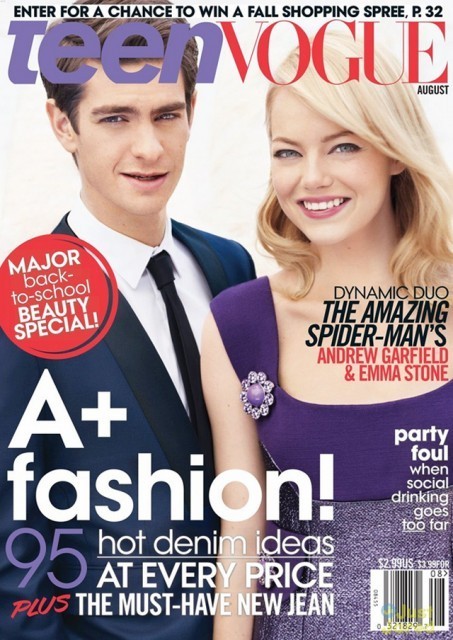
Next up? Another magazine: With one victory past them, another petition was started by Carina Cruz and Emma Stydahar, two of Bluhm’s friends, against Teen Vogue. “It’s time for an end to the digitally enhanced, unrealistic ‘beauty’ we see in the pages of magazines,” reads the petition. “We are demanding that teen magazines stop altering natural bodies and faces so that real girls can be the new standard of beauty.” Teen Vogue, however, might be a tougher nut to crack.
» The magazine’s reaction: It looks like Teen Vogue might be a tougher nut to crack. "Teen Vogue makes a conscious and continuous effort to promote a positive body image among our readers. We feature healthy models on the pages of our magazine and shoot dozens of non-models and readers every year and do not retouch them to alter their body size,” Erin Kaplan, the magazine’s PR rep, said to AdWeek. Some media outlets, like Gawker’s female-oriented Jezebel, reacted to the magazine’s statement negatively.
So what’s the next step, anyway?
One step forward, one step back. It seemed like there was a good amount of momentum toward a healthier age of magazines when Seventeen announced its support. Teen Vogue may not be as body conscious as other publications, but young readers still look to its pages for advice and guidance; that’s something that shouldn’t be taken lightly. The fact that it has ignored such a request from its readers is a little disheartening. Maybe once it sees the effects of the positive press Seventeen received, Teen Vogue will change its tune. Beyond the magazine world, is there something popular culture can learn from Seventeen?
Here’s the first entry in our weekly post series, “The Pitch.” This post, written by our very own Seth Millstein, analyzes the Supreme Court’s recent decision on the Affordable Care Act in wider historical context. Find him on Twitter over here.
Stepping back and looking in wider context: Conservatives were very upset with Chief Justice John Roberts last month when he provided the tie-breaking vote to uphold the Affordable Care Act. That anger grew exponentially when reports surfaced that Roberts had originally voted to overturn the law, but then switched his vote to side with the court’s liberals. Why did Roberts flip-flop? How common is vote switching on the Supreme Court? And how often has a single justice’s indecisiveness significantly affected the law of the land? ShortFormBlog reports. (Read more after the jump.)
Preface: How justices think
These are not nine all-wise people who retire to a secret room and come up with the answer that nobody else can figure out. They’re nine human beings who are trying to wrestle with the problem the way the rest of us do.
Former SCOTUS clerk Bill McDaniel • Discussing the nature of Supreme Court justices changing their minds. The Court has a very heavy case-load in a given year, and the June period is especially heavy. WIth much wheeling and dealing taking place behind the scene, especially among moderates, it’s very likely that nobody’s mind is made up on any individual case immediately.
Some notable historical swaps
11decision-changing swaps made between 1991 and 1994 alone
Abortion rights In 1992, a last-minute vote switch prevented the overturning of Roe v. Wade. A case involving a highly-restrictive Pennsylvania abortion law made its way to the Supreme Court. Advocates of the legislation argued that, while the law did indeed violate Roe, Roe itselfwas unconstitutional, and should thus be overturned. During the first vote, the court ruled 5-4 in favor of overturning Roe …but then, at the last minute, Justice Kennedy changed his mind, voting with the liberal wing of the court instead.
VCRs (seriously) Do VHS machines violate copyright law? That was the question before the court in 1983, when the entertainment industry argued that, because the devices enable people to record and pirate copyrighted material, they should be outlawed. The initial vote was 5-4 against the video cassette recorder, but Justice Sandra Day O’Conner switched her vote after the majority opinion was written, thus protecting the rights of future nine-year-olds to tape The Mighty Ducks when it came on TV. A single tear for Emilio Estevez.
Homosexuality In 1986, the court debated whether or not anti-sodomy laws were constitutional. Justice Lewis Powell had originally agreed that “homosexual acts,” as they were ominously referred to back then, were permissible in the privacy of one’s home, but then changed his mind, keeping the ban on sodomy in place. This decision was ultimately less influential than Kennedy’s vote-switch, however: Three years later, the court overturned the ruling, and now gay sex is constitutionally-protected.
Reasons for vote swapping
To put it simply: It’s not always what you think it might be. There are several reasons a justice might change their vote midway through the process (although of course, plebes like us will never know for sure):
image Many people suspect that Roberts switched his vote to protect the court from being seen as an overly-partisan institution — an understandable fear, considering that the court had recently made high-profile decisions that proved very unpopular, such as Citizens United.
roots In the sodomy case, Powell’s decision was reportedly influenced by the fact that the plaintiff in the suit, a gay bartender who had been “caught” having sex with another man in his own bedroom, hadn’t actually been prosecuted, but rather filed a civil suit against the state.
effects The VHS case is an interesting one: While O’Connor agreed that VHS violated copyright law, the majority opinion also overturned a lower court’s ruling (on a different, but related question) that she agreed with. Apparently, it was more important to her to uphold that decision.
» Something to keep in mind: Finally, when discussing the ACA ruling, it’s important to keep some perspective. A lot has been made about how the amount of detail that leaked about the court’s internal deliberations was unprecedented — but that’s what they said in 1986 about the Powell case. (“Such information rarely reaches the public,” the LA Times wrote of the leak.) And the theory that Roberts switched his vote to preserve the integrity of the court as an institution? That’s what they said about Kennedy with regard to the abortion case. In short, while the behind-the-scenes maneuvering of the various justices is no doubt fascinating, the process by which the court upheld the ACA wasn’t as anomalous as a lot of the reporting is suggesting.
Seth Millstein is a writer for ShortFormBlog and The Daily. Reach him at @SethMillstein.
 ShortFormBlog