ShortFormBlog
It’s not just Journatic: A breakdown of journalism and outsourcing
- Hey hey! Here’s the latest entry in our weekly post series, “The Pitch.” This post, written by SFB editor Ernie Smith, analyzes the larger implications around the Journatic journalism scandal in wider context. Find him on Twitter over here.
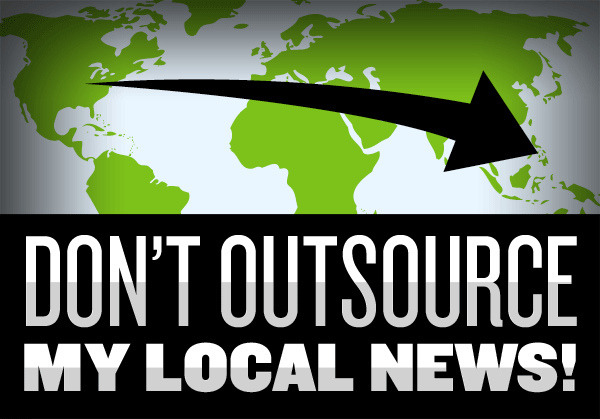
- Journatic is only the tip of the iceberg. In recent weeks, the scandal with Journatic, a company that outsources the work of individual stories to people outside of a given community, has drawn scorn and shocked reaction from media pundits and readers alike. But let’s think about this a little more. There’s a root issue here that often gets ignored by outsiders — newspapers have slowly been trimming the edges in every way possible. What does that mean? Let’s analyze after the jump. (image by Free Press, a group running a campaign against Journatic)
Preface: How Journatic surfaced
My stomach turned and my guilt grew. The company I was working for was harming journalism: Real reporters were getting laid off and were being replaced by overseas writer-bots.
Journatic employee Ryan Smith • Discussing why he went public with his story about the company, first to the Chicago Reader, then to This American Life, then to Poynter, and then in this first-person piece from The Guardian, which is where we pulled the quote. Smith’s work on the front lines of both Journatic and sister company BlockShopper revealed a level of outsourcing that newspapers had never tried before — to the point where a single company was trying to create hyperlocal content for local communities across the country, at prices journalists might never agree to otherwise, and in ways which would have never been possible ever a couple of decades ago — in some cases, outsourced literally halfway around the world. So why this race to the bottom? Let’s analyze.
The top layer: Economic realities
- 49% drop in ad revenue between 2003 and 2011 alone source
- 41,344+ job cuts recorded by media site Paper Cuts since 2007 alone — the darkest years were 2008 and 2009
- 26% the decline in overall full-time newspaper employment between 2000 and 2009 alone
- $46B the size of the newspaper industry’s total ad revenue in 2003
- $24B the size of the newspaper industry’s total ad revenue in 2011
- 13% the share of total ad revenue that newspapers made online in 2011
- » Trimming at every corner: With newspaper journalism facing a crisis of declining fortunes (brought about in part by the gradual decimation of their target ad market), it’s becoming all the more clear that current methods simply aren’t working. Resources are shrinking — and as a result, layoffs have become more and more common in the U.S. newspaper industry in recent years. (Want to depress yourself? Look at the maps Paper Cuts has put together showing these layoffs.) Newspapers, to put it simply, are in need of a re-invention — or at least a re-distribution of resources. Which is where outsourcing comes in.
Below the surface: “Good” outsourcing
- It’s worth keeping in mind that newspapers in fact have for decades “outsourced” much of their content. The thing is, it’s not called “outsourcing” generally. They’ve pooled their resources together to create these things called wire services and content syndicates to expand the reach of newspapers around the world. Together, all this stuff helps make a newspaper feel more like, well, a newspaper. Here’s what this means:
- benefits The fact is, not everything needs to be produced in-house, and sometimes it helps to take off the load. As many papers use similar tropes — many have editorial pages and national news, for example — this helps keep costs down while giving readers access to a wider variety of content.
- downsides Simply put, this content isn’t as necessary for general readers in the age of the internet, when national or international news is much easier to find online. This is a prime spot for newspapers to trim back, and in recent years, some papers have considered dropping the Associated Press altogether.
- Wire copy For most newspapers, the goal is to run as much original copy as possible, but the world is big, and unless you’re the New York Times, you probably can’t cover everything in-house. That’s where Reuters, AP and Getty Images come in. Wire copy is outsourced work, but it’s also something you’d never think of as “outsourced.”
- Freelancers Sometimes, someone owns a voice so unique and worthy of your publication that you’ll ask them to help. Or you have a project that needs doing, and even if you can’t handle the work on your end, an outside person can. That’s where a freelancer comes in. Plus, they generally aren’t paid benefits — a way to cut costs.
- Syndication This is the columnist’s dream gig — if they’re clever enough, they might be able to take their soapbox and run it in papers across the country — and a few have. Know Dave Barry? There’s a guy who’s benefited from mass syndication. And all those comics you love? Also syndicated. That is technically outsourced work, friends.
- » What the difference is: Dignity. This is quality content, and it’s paid for at quality prices and given play similar to if you were paying these journalists top-dollar. Wire copy was never intended to replace content — but to expand reach. This is not the same as local content by any stretch, and shouldn’t be treated as such.
Digging deeper: Outsourcing basic functions
- In recent years, though, the outsourcing has become more pronounced. Now, essential functions of journalism which often require a deft, direct touch are becoming the targets of newspapers’ continued consolidation efforts. Admittedly, they’re struggling — major companies like Tribune Corp. have had to declare bankruptcy in recent years, and even well-regarded newspapers like the New York Times have held on mainly thanks to help from major outside investors and by selling off some of their smaller products. Here are just a few examples of newspapers taking functions traditionally handled locally and doing them remotely:
- Layout & page Design With the rise of desktop publishing programs, one of the most intensive processes in newspaper publishing — the layout — has become more of a commodity, with many major newspaper chains, including Gannett and Tribune Corp. designing large swaths of their newspapers hundreds or thousands of miles away — and cutting back on overall staff in the process.
- Copy-editing Hate errors? If so, copy editors are your final line of defense. They cross the t’s and dot the i’s, but they also edit reports and check for errors. The job often requires extensive knowledge of a community, so publishers have been loath to outsource this function, though it has happened — and some publications have also passed on using copy editors altogether.
- Web design One approach which has become common for major newspaper chains is to standardize the look of the various newspaper sites in the chain, to emphasize consistency across the board. Newhouse, for example, uses this process extensively, hiring an outside company to work on its sites and making them look essentially the same in multiple markets.
- » The pitfalls: Let’s say you’re editing a story from afar, and the story takes place near a certain river. If you don’t live in a town, you may be unfamiliar with this river, and may even subconsciously think that it’s a river in the town in which you’re currently living. So readers get the wrong river, and may get upset. This actually happened in 2010, when a copy editor working remotely on a Media General paper accidentally did this in a story about a drowning. That, of course, is very bad.
Reaching bottom: What Journatic did & why it’s worse
- The business of outsourcing the local content itself: The reason something like Journatic exists is because so many layers of content have already been trimmed back that the next logical place to cut is the content itself. Now, granted, some of that content is not super-exciting — there are only so many ways you can cover a school lunch menu, for example, and town hall meetings are necessary to cover but often have limited reach. This is not the stuff of big-city front pages — this is stuff that gets buried in most newspapers, but makes a newspaper local. Journatic’s move into newspapers reflects a certain financial reality, but in the process, they did three things which constitute major ethical violations:
- distance By covering local journalism from a distance and packaging it for audiences who didn’t know any better, there was a basic lie being told — to the point where reporters' phone numbers were faked to have local area codes. That is not transparent.
- bylines There was significant evidence that the company was using fake bylines on numerous stories — including hundreds found on the Houston Chronicle site alone — in a possible effort to hide that the stories were created overseas. That is bad.
- secrecy Journatic had so little respect for the people it was serving — not the companies, the readers — that it went out of its way to hide its Web site from prying Google users. That’s not just deception — that’s complete disrespect for communities.
- » The fallout: Tribune Company, one of the major backers of Journatic which made a major strategic investment in the firm back in April, briefly suspended its use of the content, though it said recently that it would not stop, and instead plans to work with the firm on a reinvention of the model. Other major news companies, meanwhile, have stopped using Journatic, and reports have surfaced about ethical scandals Brian Timpone, the company’s CEO, had previously been involved in.
The bottom line
Is faking hyper-local content the answer? Probably not. But it’s also true that most newspapers can’t afford to continue producing a lot of the kind of content that Journatic generated.
GigaOm writer Matthew Ingram • Arguing a key point that people might be missing in the wake of the Journatic mess — the company is a symptom of a larger newspaper-industry decline, but not the cause of it. There are serious questions to be raised by the existence of Journatic, but most of the answers exist outside of that company’s confines. We scold companies like Newhouse for cutting away at the New Orleans Times-Picayune, but offer no answers as to how they can recoup the declining ad revenues that paid for all those jobs. There are tough issues that need to be answered for, but here’s a good one: How are we going to prevent our newspapers from becoming miniature Demand Media-style content farms? Print revenue has slowly disappeared, and with Journatic, we’ve found how far newspapers are willing to go to save money. How do we prevent a further sliding scale? Good local journalism is still needed, but what will keep it safe?
Ernie Smith the editor of ShortFormBlog, who until recently worked at the Washington Post Express. He starts a new job tomorrow at TMG Custom Media. (Hooray!) Reach him at @ShortFormErnie.