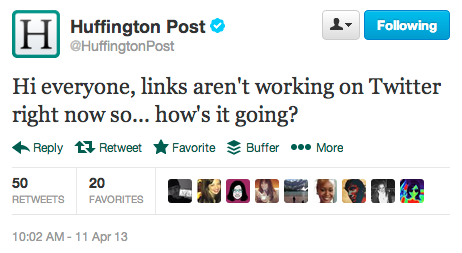
Congratulations, Twitter. You finally figured out a way to silence HuffPo’s Twitter account. More info here. (BTW, if you use an old client, the links still work.)
EDIT: The links are working again on Twitter.
 ShortFormBlogRead a little. Learn a lot. • Now Mullenweg-free! • Since 2009
46 posts
Congratulations, Twitter. You finally figured out a way to silence HuffPo’s Twitter account. More info here. (BTW, if you use an old client, the links still work.)
EDIT: The links are working again on Twitter.
Posted by Ernie Smith • Permalink
The common refrain this morning on AOL’s good day was that advertising is leading the company back. This is true, kind of. It is true that revenue at AOL sites (like HuffPo, AOL.com, and Moviefone) is up, but profit for AOL’s online brands is actually down for the year by 34 percent. The new profit engine, not only for the quarter but also the year, has been advertising on AOL’s third-party network, the company’s ad market for other online publishers.
But it’s the old profit engine that is still driving the company. AOL’s subscription business (the evolution of that gargling symphony of squeaks and whistles from the 1990s) is still more profitable than AOL as a company.
This is good news and bad news, as Henry Blodget observes. It’s good news because the profits from subscription services can be used to smooth AOL’s transition to a modern media and advertising company, and subscription cancellations are slowing down. But it’s also bad news because any company that relies on the inertia of septuagenarians who haven’t figured out how to get Internet without paying AOL for the privilege does not sound like a magnet for the sort of talent that drives long-term growth.
“What exactly is AOL?” you might ask yourself. As a consumer product, it’s a bunch of websites. As a business strategy, it’s an ad company. As a growth business, it’s a third-party digital advertising network. And as a profitable business, it’s mostly none of those things but rather, overwhelmingly, an anachronistic online membership service. Great stock. Weird company.
Basically, AOL is a key example of a company that’s changed its focus more than a few times. So as a result, they have a lot of legacy. Which isn’t necessarily a bad thing. Even though Apple hitched its wagon on the Mac in 1984, it still sold Apple ][ models until 1992. The legacy gave way to the new business. Smaller companies do the same thing. They’re called pivots. Big companies have the benefit of being able to pivot while keeping the legacy business active. That’s why AOL can sell memberships to a service nobody has actually used earnestly since 2003.
Posted by ShortFormBlog • Permalink

To Live And Die In America
HuffPo with a powerful statement on its front page. The NRA’s reaction to Newtown is below the “fold.”
Posted by Ernie Smith • Permalink
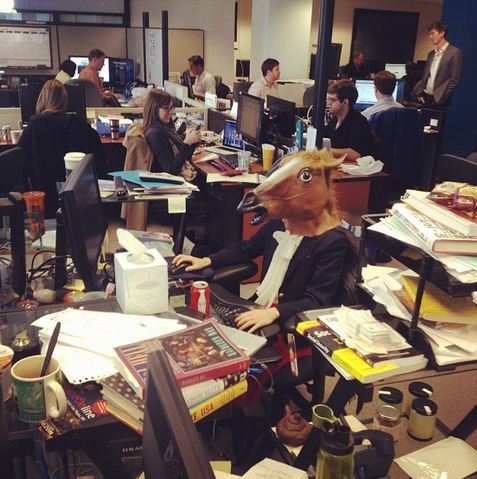
The office. One day to go. (photo by @aterkel)
Note to self for bucket list: Get hired, and then work at the Huffington Post just long enough so I can say I worked next to whomever is wearing that horse mask.
Posted by Ernie Smith • Permalink
Datagram, the ISP whose Manhattan servers host BuzzFeed, Huffington Post, Gawker, and other sites, has lost power, an official there told us via text this evening.
“Basement flooded, fuel pump off line - we got people working on it now. 5 feet of water now,” the official wrote.
BuzzFeed’s site and story page are back online, thanks to a Content Delivery Network, Akamai, which hosts the content at servers distributed around the world.
FIVE FEET OF WATER took down three of the biggest new-media sites on the internet. At the same time. Think about how crazy that is.
Posted by Ernie Smith • Permalink

One year ago, journalist Jose Antonio Vargas revealed to the world that he was an undocumented immigrant — building his entire career, which included time at The Washington Post and The Huffington Post, on a lie. Vargas looks back at the past year in an interview with BuzzFeed, where he considers the weirdness of becoming an activist, his friends lost (many in the news industry), and his friends gained (Mark Zuckerberg, Aaron Sorkin). Great piece.
Posted by ShortFormBlog • Permalink
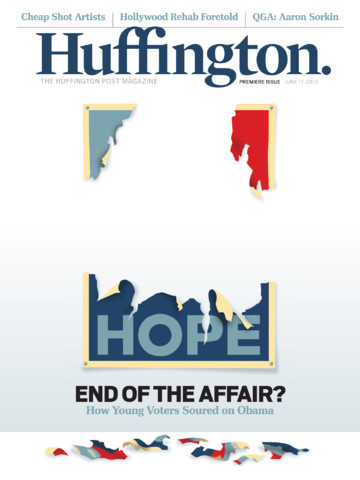
HuffPo’s new weekly iPad magazine, "Huffington.“, just launched today. It’s a free download, though issues cost 99 cents a piece. Check it out if you ever wondered what HuffPo would be like with more in-depth stories and better design.
Posted by ShortFormBlog • Permalink
musingsbymattheous says: Can you please stop acting like The Huffington Post is a legitimate news source? They’re worst than Fox News.
Posted by ShortFormBlog • Permalink
TechCrunch’s history since AOL bought it in 2010 has been as turbulent as the private roller coasters many Facebook employees will likely install in their Silicon Valley mansions post-IPO.
— Gawker’s Adrian Chen • Commenting on AOL’s reported plans to sell TechCrunch, Engadget and most of its other tech-related properties in a single package. One amazing line really says it all.
Posted by ShortFormBlog • Permalink

Posted by ShortFormBlog • Permalink