Read a little. Learn a lot. • Now Mullenweg-free! • Since 2009
☰

Tag: newspapers

158 posts

Sep 17 2019t

Last week, I wrote about the demise

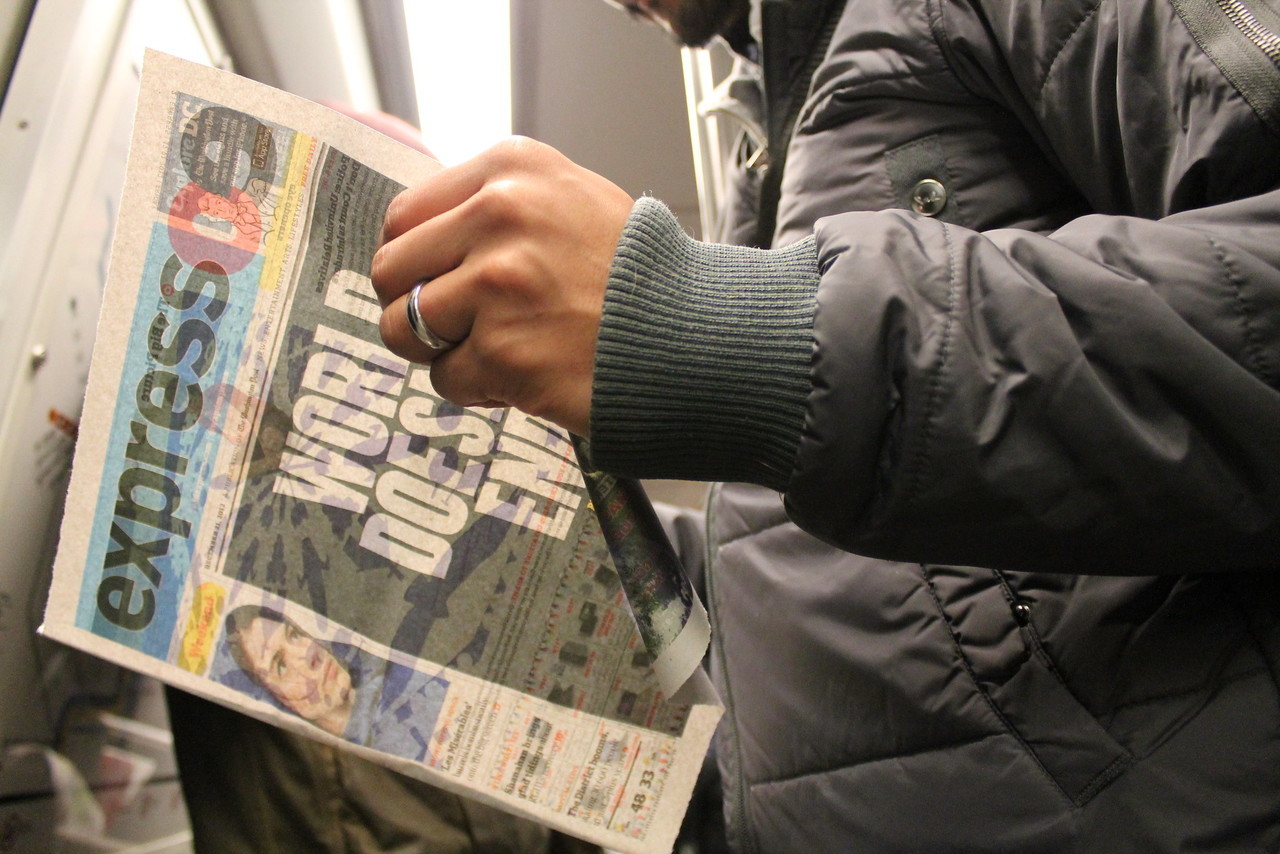
Last week, I wrote about the demise of the Washington Post Express, a paper I worked at for three and a half years, but also the free daily newspaper, a concept that picked up steam about two decades ago as a potential savior for dead trees. My roots are with these things—I worked at three.

When I took the jump into purely digital pursuits in 2012, a big reason for that was because I knew this day would come, not because free dailies aren’t great—they are, and plenty of people enjoyed them over the years—but because the tide was slowly turning.

But I do not regret my time in tabloid-land, because it taught me a lot about the way that readers think about news. It was focused on an equation: If you had 10 minutes to read the news of the day, given access to both a wire and a larger newspaper that your target audience isn’t reading anyway, how could you present it that maximized the amount you could learn?

Sure, this required flash, and more than a little Photoshop. But it also required editing, and more than a little cleverness.

Be sure to read the whole thing.

Posted by Ernie Smith • Permalink

Apr 16 2014t

New LA newspaper embraces print in digital world

Aaron Kushner believes he can launch and grow a print newspaper in a world gone digital.

The former greeting card executive is trying to turn the Orange County Register into a media giant in southern California, largely driven by paper and ink. The unconventional effort gets a jolt Wednesday when Freedom Communications Inc., the company Kushner bought with other investors two years ago, launches the Los Angeles Register.

The daily newspaper will be available at 5,500 locations around L.A. — at many newsstands and vending boxes where the 132-year-old Los Angeles Times is found. It’s the first direct challenge on the Times’ home market since the Herald-Examiner folded in November 1989.

Kushner hopes to build the newspaper’s readership by differentiating it from the Times with deep coverage of local news and a political stance that’s center-right.

Read more here: http://www.sanluisobispo.com/2014/04/15/3022516/new-la-newspaper-embraces-print.html#storylink=cpy

Kushner is an interesting fellow, and I hope that his experiment is successful. Also in a similar vein is the Boston Globe’s recent energy boost under new owner John Henry.

(ht waterman12053)

Posted by Ernie Smith • Permalink

Jan 1 2014t

Former newspaper guy falls on hard times

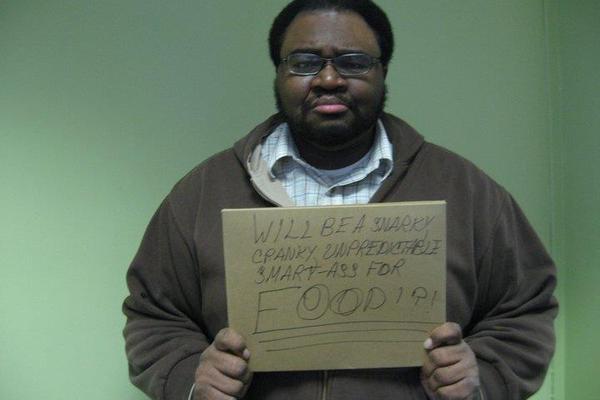
Former newspaper guy falls on hard times: Craig D. Lindsey, a former staff writer for the Raleigh News and Observer, has been out of a regular paycheck for three years now—so long that he’s raised concerns about going homeless. His solution: Start an Indiegogo campaign to pay his rent. (It’s working; he’s got three months covered already.) The newspaper industry sucks.

Posted by Ernie Smith • Permalink

Nov 15 2013t

In an unprecedented move,

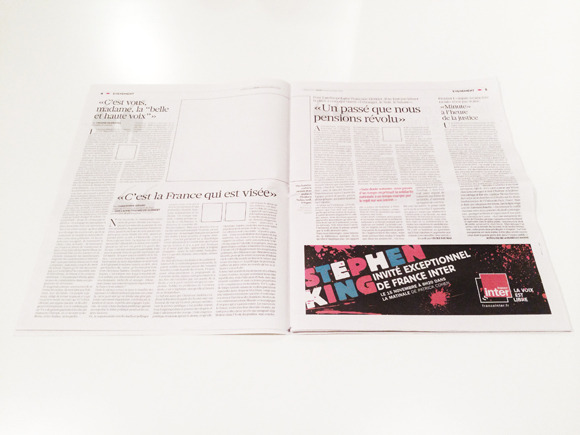
In an unprecedented move, the French newspaper Libération ran an entire issue without photos today, placing them instead in the back spread so people can see the art that’s missing. Its reason? It was trying to draw attention to the plight of photojournalists worldwide—timing the issue around Paris Photo, the world’s largest photography fair. “It’s not a wake, we’re not burying the photographic art […] Instead we give photography the homage it deserves,” the paper explains. “Yet, no one can ignore the calamitous situation press photographers now find themselves in, especially war photographers who risk their lives while barely making a living.”

Your move, Chicago Sun-Times.

Posted by Ernie Smith • Permalink

Nov 8 2013t

Bad news, Onion fans: The iconic satirical newspaper is ditching its print edition.

The Onion is halting its print version in Chicago and its two other remaining markets with its Dec. 12 issue. The newsweekly was 25 years old and is survived by its website and a new creative service for advertisers.

“It’s sad to see a print edition no longer exist, but it’s important to see the Onion succeed,” Mike McAvoy, president of Chicago-based Onion Inc., said in an interview.

The satiric newspaper, available at its peak in 17 markets, is now given away in just three cities: Chicago, Milwaukee and Providence, R.I. It is known for headlines such as “Giant burrito to solve all of area man’s problems for six precious minutes.” and “New documentary reveals SeaWorld forced orca whales to perform nude.”

That stinks for print readers, but on the plus side, the company itself is doing well. Problem is, nearly all of its successes are online these days.

Posted by Ernie Smith • Permalink

Oct 26 2013t

Hear about the story where three AP employees got fired for screwing up a 112-word story?

Faced with the mistake, AP moved swiftly to rectify the error. It sent out a “mandatory kill” notification 98 minutes after distributing [reporter Bob] Lewis’s item on its state wire Oct. 9. It then sent out a longer story under Lewis’s byline that recounted events accurately.

Then it turned inward.

After several days of deliberations, AP fired Lewis on Monday, followed by his immediate editor in Richmond, Dena Potter. On Tuesday, regional editor Norm Gomlak confirmed that he, too, had been fired over the story. Gomlak, who is based in Atlanta, was the primary editor of Lewis’s story because Potter was tied up with an unrelated story Oct. 9.

Lewis, 57, makes no excuses about the mistake. But, he said Tuesday, he feels “stunned and hurt” by his firing after 28 years of “unblemished” service to the AP. “I still can’t really wrap my head around it,” he said by phone from Richmond. “The only blessing out of this has been the expressions of support” from friends, colleagues and many of the officials he has covered over his career, including Virginia’s two senators and former governors, Timothy M. Kaine (D) and Mark R. Warner (D), and the state’s current governor, Robert F. McDonnell ®.

As the Post notes, an error of this nature rarely leads to a full-on firing. Let alone three. “If everyone who made a mistake was fired for it, we’d have empty newsrooms,” noted University of Oregon professor Scott Maier. Lewis and the others are getting petitions of support encouraging the AP to rehire them, which some analysts note was likely caused by the sensitivity of the subject—a highly-watched Virginia gubernatorial campaign—rather than the error itself.

Posted by Ernie Smith • Permalink

Aug 19 2013t

Well, this is different

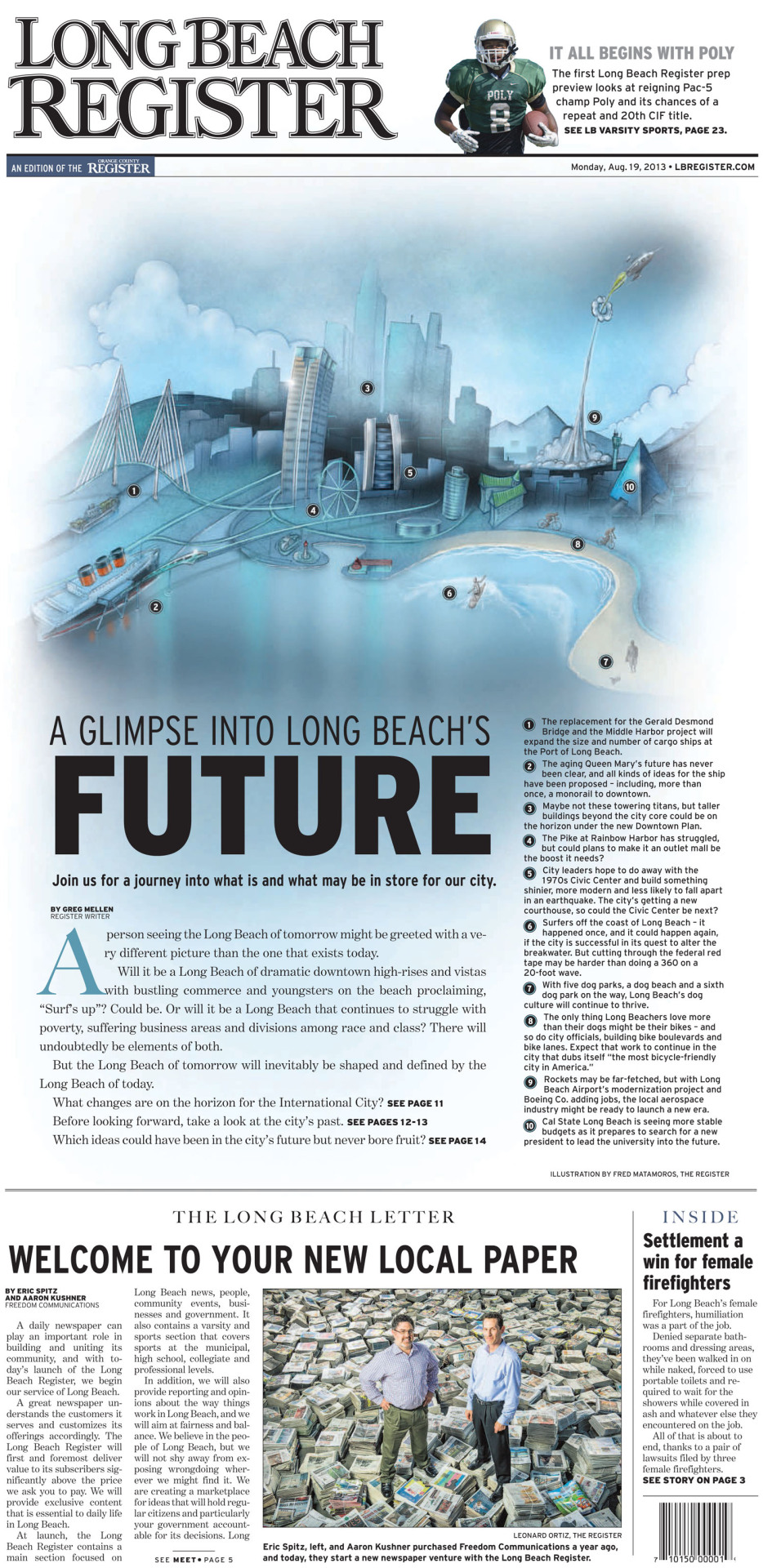
Well, this is different: A new local daily newspaper just launched today. Meet the Long Beach Register, which may the first big-city daily newspaper launch in a long time. Long Beach, California is now a two-paper town, in an era when most towns are having trouble supporting one paper. (via Charles Apple; thanks waterman12053 for the reminder)

Posted by Ernie Smith • Permalink

Aug 17 2013t

A good response to our last post, and some good feedback

in-convenient-ruth:

I don’t think that messes up his point at all.

You can collect a paycheque from a place that is firing people on the print side and still be concerned about the product, in both print and online.

I work at a major daily newspaper. I’m being laid off (for the third time in ten years) and I’m very concerned about the quality of the print product (which will still exist in my case, but my job will be outsourced to somebody with less experience who will get paid less and be in a different location) AND the product online and how things will change as we go behind a paywall while laying off editors.

With fewer editors, errors are much more likely to creep into copy, especially online.

Because, FACT IS, newspaper copy on the print side is FREQUENTLY cleaner and tighter than online copy simply by virtue of the fact that there are more sets of eyes looking at it.

A reporter writes an article. Two or more editors read it, do fact-checking and makes suggestions and changes to angles, order and style. Maybe it goes back to the reporter for some rewriting. After that, a line editor goes through the story and edits it by fact-checking, reading for grammar, spelling and style, writes a headline and posts it online. Online stories are rarely edited for length and reporters, in my opinion, often believe they can write as much as they want for online. But just because you can doesn’t mean you should. Few people read it all and it’s been my experience that copy I read online at newspapers would probably benefit from being tightened up a bit.

If a story goes into the print edition, a page editor takes the story as it stands after having gone online, puts the story on the page, reads it, writes display copy, then sends it to a copy editor to trim it for space if needed. When the story fits the space, the page editor prints a copy and gives it to a proofer. A proofreader reads a hard copy of the page and the page editor makes any changes caught by the proofer. The page editor sends the final page to a more senior editor who may request changes to display copy (headlines, subheads or cutlines) or even a lede before the page is sent to the press.

Copy in a newspaper gets AT LEAST two more reads than a story that goes online only and there are at least three more people looking at the display.

And we STILL make mistakes.

As editors leave the building (either by taking buyouts or being laid off), there are fewer experienced eyes on the copy, both online and in print. How do you ask people to pay for an experience online they’ve been getting for free while also increasing the opportunities to let more errors slip into copy?

I don’t have the answers, but I do know that the content suffers and when you offer people a diluted product that they’ve been getting for free, they’ll either find a way around your paywall or worse, just stop reading entirely.

The answer certainly isn’t less informed journalism graduates who don’t know anything about the industry they’re going into. I know the way we get our news is changing (I get a lot of my news online, even though I work for a paper and read it and several other papers in my city on a daily basis) but there’s a huge benefit to reading newspapers that you cannot get online.

I’m sure I’m in the minority for my age, but I believe newspapers are FAR superior to online news in many respects. That may well change and I welcome the day that online copy is as good as the stuff I read in print.

First up, in the case of the Examiner, the situation with the print publication getting pushed to the back is a much different situation than that of a lot of papers. The Examiner likely could have gone on for years in its daily newspaper form, but the owners decided that they really just wanted to have a tentpost in national politics, so they switched over to a weekly magazine—which makes sense, really, because the newspaper was full of syndicated columnists on conservative issues. Columnists like Bedard didn’t lose their jobs, but if you were running a local news section, that was where you felt the pressure point.

That said, my take on this: If tighter writing and editing is the reason print is better at this juncture, that’s not good enough for me. Most of our readers are moving online, particularly younger ones. We need to raise standards for those readers. Our editing processes need to improve on this kind of content. Likewise, I think readers understand that a story is a living, breathing document and it evolves over time. We need to take advantage of the fact that nothing ever has to be final, like Fast Company does here.

The reason why print articles have that tighter writing and editing is because of the way the publication itself works. Too many newspapers see online as an extra burden on top of the print product. We have to change this mindset. Print has to become the last function of an online media outlet that could live without it. We’re deluding ourselves if we don’t think that’s the way things are going. Our processes have to match our readers, or we’ll become irrelevant to their needs.

My point was not strictly about the quality of the writing and the editing. Rather, with a story, you can simply do more with it online as far as shape and interactivity. Our approach is maturing. Hyperlinks, which I think don’t get used enough in traditional news stories, are massive. The opportunity to work with interactive data is huge. But the thing is, if you want to do more with these sorts of things, the mentality has to change. These kinds of elements give online content a distinct advantage that print cannot touch. We should be playing that up, not just worrying that we missed a comma or two.

I come at this from the perspective of a longtime newspaper guy. I spent eight years hitting at it, and I just sort of feel like the issues we’re seeing now are problems of a failure to adapt just as much as a failure to monetize. Too many media outlets are looking at online as a way to save money (by laying people off rather than bolstering online offerings) rather than something that still needs the resource push that the original product has always had. The outlets doing the best are the ones that haven’t forgotten this.

Anyway, that’s my take. Sorry it’s a little long-form. — Ernie @ SFB

Posted by Ernie Smith • Permalink