Read a little. Learn a lot. • Now Mullenweg-free! • Since 2009
☰

Tag: corn

7 posts

Jul302012t

Think beyond the cob

The corn crisis: What a drop in a key crop’s production means for you

  • What’s up folks? Here’s the latest entry in our weekly post series, “The Pitch.” This post, written by SFB editor Ernie Smith and researched by Seth Millstein, analyzes the current crisis facing the corn industry, and its larger ripple effects. Find Ernie on Twitter over here, and Seth over here.
  • Think beyond the cob: We’ve come a long way from the pilgrims and the first Thanksgiving, folks. Corn is used in an embarrassing amount of products — from popcorn to soda to Hot Pockets to fuel — and a recent drought that’s covering as much as 60 percent of the country could mean higher prices for you at the grocery store. But how bad is it? SFB’s very own Ernie Smith analyzes. (Oh, with an assist on the research from Seth Millstein.) Read more after the jump.

Preface: What it’s like on the farm

What i’m hearing is that this is the worst, most SEVERE drought we’ve had since 1988. There’s not really much we can do except sell our animals, because we don’t have enough proper hay to feed them.

Creston, Iowa resident Anna Welcher • Discussing the drought in Iowa, and how it’s affecting her family’s farm. Welcher says corn yields are down 30 percent and it’s having a ripple effect on the farm as a whole, as well as a number of nearby farmers. “It hurts everyone: The farmer, the pork and beef producers, and the consumer,” she continues. “Once the farmers start selling their cattle, we’re hoping the prices in the grocery store go down, but when there is no cattle left, we’ll all have to become vegetarians.” How did we get to this point? And what does this mean for you, consumer that lives nowhere near a family farm? Let’s analyze.

Breakdown: The current yield level, compared

  • 172 the number of bushels per acre Iowa corn farmers produced last year, on average
  • 117 the number of bushels per acre Iowa corn farmers are expected to produce this year
  • 80 the number of bushels per acre produced in 1993, the last time the level was so low source
  • » And 1988 really was a bad year, too: During the 1988 drought, Iowa corn production hit a mere 84 bushels per acre, though the production level was much lower 24 years ago. The current situation is nonetheless fairly dire, according to Bill Nelson, a Senior Economist at Doane Advisory Services, who came up with the recent yield estimate. “You could see very few ears filled to the tip,” Nelson said. “And the kernel counts are way below average.” Iowa is the state that produces the most corn, with other Midwestern states directly behind.

Why this affects you, dear consumer
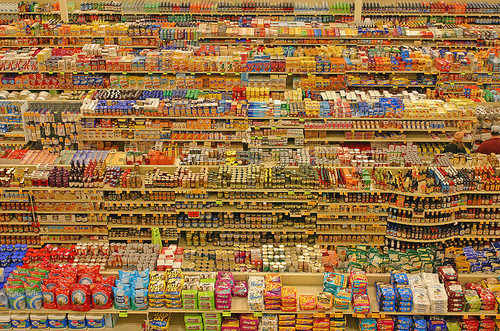
  • This may not be a surprise to you, but … Corn is a key ingredient of your grocery store experience — outside of the produce aisle, many processed products use corn or soy to improve the texture of (or sweeten) the foods you eat. So, even foods which seem miles away from what you consider to be “corn” rely on that little pop to create the overall effect. There was even a movie about this a few years ago called Food, Inc. To give you an idea, all five of the items below use corn ingredients in some way, shape or form:
  • » So if there’s a corn shortage … That means prices across your local grocery store could go up as a result. (Soybeans, another key ingredient of processed foods, have also been affected by the drought.) But, due to corn’s low costs compared with other parts of production, processed foods are less likely to be affected by the drought. The real issue? Foods created indirectly by corn — such as livestock, milk or poultry, all three of which rely on corn for feed. So basically, this drought is hitting the grocery store in multiple ways. (photo by lyzadanger)

But how much will prices rise?

  • 3%the minimum grocery price increase expected in 2013 source
  • 45% the increase in the price of corn this summer, on average; the price is nearing last summer’s records
  • 1% the amount a 50% increase in the price of corn would boost the average grocery bill source
  • >4% the increase in the price of beef as a result of the shortage
  • >3.5% the increase in the price of dairy products (milk, etc.) next year
  • >3%the increase in the price of poultry and eggs; pork will also rise source
  • » Food price inflation is common. But this? In an average year, food prices increase at a 2.8 percent clip. But with increases as high as 4 percent possible, it could prove to have a real effect on consumer decisions. “In 2013 as a result of this drought we are looking at above-normal food price inflation. … Consumers are certainly going to feel it,” says USDA economist Richard Volpe. But don’t expect the effects to show up right away — you’ll likely see the effects first with poultry, which takes a relatively short time to raise. Beef may not show a significant price increase for another year or two.

Finally: A world reliant on American corn
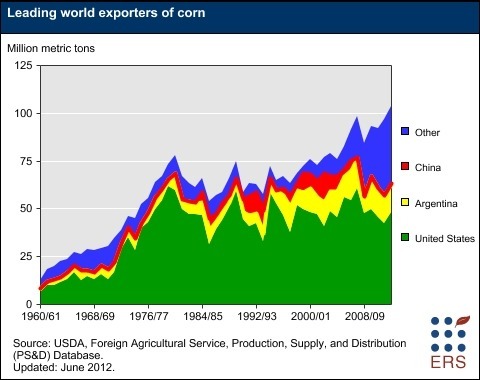
  • You know who uses American corn? Everyone. Roughly half of the world’s exported corn comes from the United States, exported to all parts of the world. Japan, Taiwan and Korea alone are responsible for roughly a quarter of the world’s corn imports, and corn is a key building block for the developing world. That makes rising corn prices an issue that touches multiple parts of the world. “So we have an issue here where we have been feeding the world, but we’re going to have to slowly but surely dampen down those exports,” notes commodities trader Scott Shellady. So, in other words, all that corn has a wide reach and major ripple effect, effects you probably don’t consider when you nosh down on Hot Pockets without thinking about what’s inside. (Image via USDA)

Ernie Smith the editor of ShortFormBlog and a social media journalist for TMG Custom Media. He likes “The Room.” Reach him at @ShortFormErnie.
Posted by ShortFormBlog • Permalink

Jun132012t

California voters will decide on labeling genetically-modified foods

  • 70% of foods in supermarkets in the U.S. are estimated to have genetically-modified organisms
  • 5% of foods in supermarkets in Europe are estimated to have GMOs; it’s way more controversial there
  • 51% of Americans say they would not buy genetically-modified food if it was labeled
  • 89% of Republicans polled want such food to be labeled as genetically modified
  • 90% of Democrats polled want their GMO food labeled as such; well, it’s unanimous source
  • » Nearly one million signatures in California: In a fairly unprecedented move, voters — not politicians — will get to decide on the issue of genetically-modified food. This has food producers, who previously could deal with politicians without too much issue, freaked out. The result? Lately, lobbying groups with such names as the “Coalition Against the Costly Food Labeling Proposition (CACFLP)” and the “California Citizens Against Lawsuit Abuse (CALA)” have been ratcheting up their fight against these bills — and some of the lobbyists behind them have worked for the tobacco industry. Hey lobbyists! If you need some help fighting this, we have an idea for another organization: “California Citizens Against Organizations With Unwieldy Scary Names To Convince You Not To Vote For This Bill We Don’t Like (CCAOWUSNTCYNTVFTBWDL).” You’re welcome, guys.

Posted by ShortFormBlog • Permalink

Mar302012t

That’s a lot of freaking corn

Maize days: U.S. corn crop expected to be biggest in 75 years

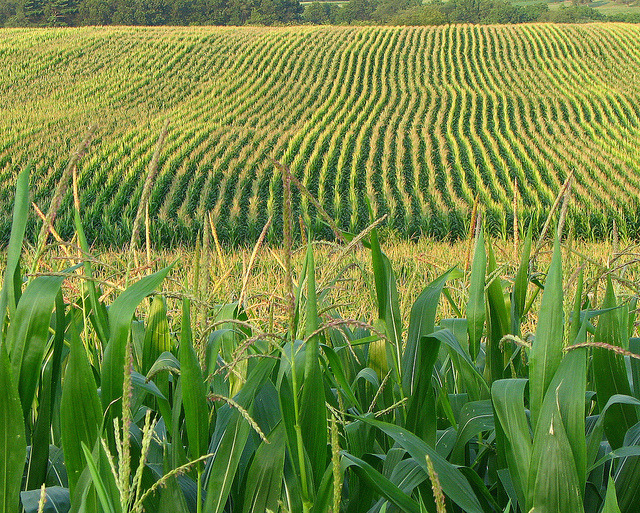
  • That’s a lot of freaking corn: Back in 1937, an estimated 97.2 million acres of corn were planted. This year, in an effort to take advantage of higher prices, lower standing supply, and weaknesses in other base crops like soybeans, the corn total is expected to top analysts expectations of 94.72 million acres — as long as the weather holds up and the yield stays high. Said corn will be used in every single product known to man. Including some varieties of forks. (photo by fishhawk on Flickr) source

Posted by ShortFormBlog • Permalink

Jun172011t

The best way for ethanol to survive is to stand on its own two feet, without spending something we don’t have…

The best way for ethanol to survive is to stand on its own two feet, without spending something we don’t have to get something we’re going to have anyway.

— Sen. Tom Coburn • Making an argument against handing out ethanol subsidies — which cut gas prices but also cost the federal government $6 billion per year. An amendment to kill the subsidies passed both the House and Senate. In the case of the Senate, it was a straight-up bipartisan vote: 73-27. And a number of groups — including environmental groups — note that the subsidies are no longer needed because the federal government already requires refineries to mix ethanol and gasoline. However, don’t get too excited, budget hounds: The amendment is tied to an economic development bill that likely will not pass. source (via • follow)

Posted by ShortFormBlog • Permalink

Jun162011W

U.S.: Amendment killing ethanol subsidies passes — but bill may not

The best way for ethanol to survive is to stand on its own two feet, without spending something we don't have to get something we're going to have anyway.

Sen. Tom Coburn • Making an argument against handing out ethanol subsidies — which cut gas prices but also cost the federal government $6 billion per year. An amendment to kill the subsidies passed both the House and Senate. In the case of the Senate, it was a straight-up bipartisan vote: 73-27. And a number of groups — including environmental groups — note that the subsidies are no longer needed because the federal government already requires refineries to mix ethanol and gasoline. However, don't get too excited, budget hounds: The amendment is tied to an economic development bill that likely will not pass. source

Posted by Ernie Smith • Permalink

Jan142011t

Could food prices be a root cause of Tunisia's unrest?

  • 32% increase in food prices in 2010’s second half source
  • » How does this matter? We’re at a record with food prices, making it hard for people to live in third-world countries. With quick growth in countries such as China, reserves are becoming harder to keep, and the supplies of basic crops like corn and soybeans (which also get used in vast quantities for such things as ethanol) are down significantly. And since Americans tend to eat more processed foods (which use fewer raw materials), price increases aren’t felt in the developed world as much as they are in the third world. "In this country, a much higher proportion of your food dollar is spent on processing, advertising and promotion and marketing,“ said Global Insight economist Tom Jackson. "There’s not really that margin built in between the farmer and the consumer in the developing countries.”

Posted by ShortFormBlog • Permalink

Sep142010W

Culture: High-fructose corn syrup is so last decade

  • newIf the Corn Refiners Association has its way, high-fructose corn syrup will be replaced with "corn sugar" within the next few years.
  • old "Corn sugar" is actually the same thing as HFCS. They're just trying to change the name to counteract HFCS's bad reputation. source
  • what do you do when everyone realizes that your product contributes to one of the leading causes of preventable death worldwide? You change it's name, of course, so people won't know what they're eating! That, and you launch a PR campaign to convince people that it's actually not that bad for you. In related news, it's not TV, it's HBO! source

Posted by Seth Millstein • Permalink