Read a little. Learn a lot. • Now Mullenweg-free! • Since 2009
☰

Tag: john roberts

14 posts

Jun262013t

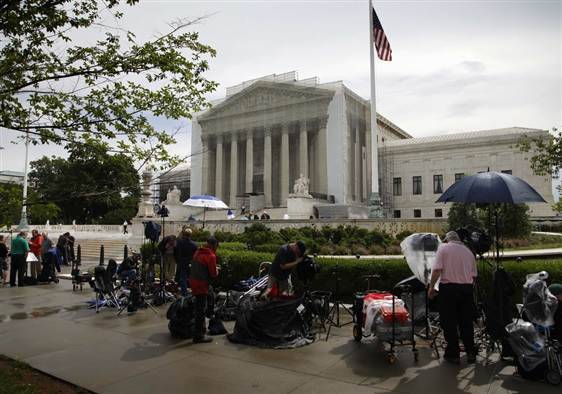
Some important context from Justice Roberts' opinion on the Prop 8 case.

Federal courts have authority under the Constitution to answer such questions only if necessary to do so in the course of deciding an actual “case” or “controversy.” As used in the Constitution, those words do not include every sort of dispute, but only those “historically viewed as capable of resolution through the judicial process.” This is an essential limit on our power: It ensures that we act as judges, and do not engage in policymaking properly left to elected representatives.

For there to be such a case or controversy, it is not enough that the party invoking the power of the court have a keen interest in the issue. That party must also have “standing,” which requires, among other things, that it have suffered a concrete and particularized injury. Because we find that petitioners do not have standing, we have no authority to decide this case on the merits, and neither did the Ninth Circuit.

Bolded for emphasis.
Posted by Ernie Smith • Permalink

Jun252013t

BREAKING: Supreme Court strikes down a key part of 1965 Voting Rights Act

nbcnews:

BREAKING: Supreme Court strikes down a key part of 1965 Voting Rights Act

(Photo: Jonathan Ernst / Reuters, file)

Live SCOTUSblog offers latest details.

Continue reading

Chief Justice John Roberts, in his opinion on the case: “Nearly 50 years later, [the rules laid out by the Voting Rights Act] are still in effect; indeed, they have been made more stringent, and are now scheduled to last until 2031. There is no denying, however, that the conditions that originally justified these measures no longer characterize voting in the covered jurisdictions.”

Thoughts?

Posted by Ernie Smith • Permalink

Jan12013t

Now as then, the Judicial Branch continues to consume a miniscule portion of the federal budget. In fiscal…

Now as then, the Judicial Branch continues to consume a miniscule portion of the federal budget. In fiscal year 2012, the Judiciary, including the Supreme Court, other federal courts, the Administrative Office of the United States Courts, and the Federal Judicial Center, received a total 4 appropriation of $6.97 billion. That represented a mere two-tenths of one percent of the United States’ total budget of $3.7 trillion. Yes, for each citizen’s tax dollar, only two-tenths of one penny go toward funding the entire third branch of government! Those fractions of a penny are what the courts need to keep court facilities open, pay judges and staff, manage the criminal justice system (including pre-trial, defender, and probation services), process civil disputes ranging from complex patent cases to individual discrimination suits, and maintain a national bankruptcy court system. Those fractions of a penny are what Americans pay for a Judiciary that is second to none.

— Supreme Court Chief Justice John Roberts • Pitching the federal judiciary as an example of fiscal efficiency in the midst of the current fiscal crisis in his year-end report. “No one seriously doubts that the country’s fiscal ledger has gone awry. The public properly looks to its elected officials to craft a solution. We in the Judiciary stand outside the political arena, but we can continue to do our part to address the financial challenges within our sphere,” he also said in his statement. (ht Scotusblog)

Posted by Ernie Smith • Permalink

Jul192012t

I don’t think any of my colleagues on any cases vote the way they do for political reasons,“ he said. "They…

I don’t think any of my colleagues on any cases vote the way they do for political reasons,“ he said. "They vote the way they do because they have their own judicial philosophy.

— Supreme Court Justice Antonin Scalia • During an interview with Piers Morgan for “Piers Morgan Live” last night, refuting claims that he was feuding with Chief Justice John Roberts. The claims surfaced following the 5-4 upholding of the Affordable Care Act’s individual mandate. Scalia, who is currently touring to promote his new book, also took time to defend the court’s infamous Citizens United decision. “I think Thomas Jefferson would have said the more speech, the better,” said Scalia, adding, “That’s what the First Amendment is all about. So long as the people know where the speech is coming from.” source ( source • source)

Posted by ShortFormBlog • Permalink

Jul92012t

Stepping back and looking in wider context

Supreme Court flip-flops: Health care wasn’t the first. It won’t be the last.

  • Stepping back and looking in wider context: Conservatives were very upset with Chief Justice John Roberts last month when he provided the tie-breaking vote to uphold the Affordable Care Act. That anger grew exponentially when reports surfaced that Roberts had originally voted to overturn the law, but then switched his vote to side with the court’s liberals. Why did Roberts flip-flop? How common is vote switching on the Supreme Court? And how often has a single justice’s indecisiveness significantly affected the law of the land? ShortFormBlog reports. (Read more after the jump.)

Preface: How justices think

These are not nine all-wise people who retire to a secret room and come up with the answer that nobody else can figure out. They’re nine human beings who are trying to wrestle with the problem the way the rest of us do.

Former SCOTUS clerk Bill McDaniel • Discussing the nature of Supreme Court justices changing their minds. The Court has a very heavy case-load in a given year, and the June period is especially heavy. WIth much wheeling and dealing taking place behind the scene, especially among moderates, it’s very likely that nobody’s mind is made up on any individual case immediately.

Some notable historical swaps

  • 11 decision-changing swaps made between 1991 and 1994 alone
  • Abortion rights In 1992, a last-minute vote switch prevented the overturning of Roe v. Wade. A case involving a highly-restrictive Pennsylvania abortion law made its way to the Supreme Court. Advocates of the legislation argued that, while the law did indeed violate Roe, Roe itselfwas unconstitutional, and should thus be overturned. During the first vote, the court ruled 5-4 in favor of overturning Roe …but then, at the last minute, Justice Kennedy changed his mind, voting with the liberal wing of the court instead.
  • VCRs (seriously) Do VHS machines violate copyright law? That was the question before the court in 1983, when the entertainment industry argued that, because the devices enable people to record and pirate copyrighted material, they should be outlawed. The initial vote was 5-4 against the video cassette recorder, but Justice Sandra Day O’Conner switched her vote after the majority opinion was written, thus protecting the rights of future nine-year-olds to tape The Mighty Ducks when it came on TV. A single tear for Emilio Estevez.
  • Homosexuality In 1986, the court debated whether or not anti-sodomy laws were constitutional. Justice Lewis Powell had originally agreed that “homosexual acts,” as they were ominously referred to back then, were permissible in the privacy of one’s home, but then changed his mind, keeping the ban on sodomy in place. This decision was ultimately less influential than Kennedy’s vote-switch, however: Three years later, the court overturned the ruling, and now gay sex is constitutionally-protected.

Reasons for vote swapping

  • To put it simply: It’s not always what you think it might be. There are several reasons a justice might change their vote midway through the process (although of course, plebes like us will never know for sure):
  • image Many people suspect that Roberts switched his vote to protect the court from being seen as an overly-partisan institution — an understandable fear, considering that the court had recently made high-profile decisions that proved very unpopular, such as Citizens United.
  • roots In the sodomy case, Powell’s decision was reportedly influenced by the fact that the plaintiff in the suit, a gay bartender who had been “caught” having sex with another man in his own bedroom, hadn’t actually been prosecuted, but rather filed a civil suit against the state.
  • effects The VHS case is an interesting one: While O’Connor agreed that VHS violated copyright law, the majority opinion also overturned a lower court’s ruling (on a different, but related question) that she agreed with. Apparently, it was more important to her to uphold that decision.
  • » Something to keep in mind: Finally, when discussing the ACA ruling, it’s important to keep some perspective. A lot has been made about how the amount of detail that leaked about the court’s internal deliberations was unprecedented — but that’s what they said in 1986 about the Powell case. (“Such information rarely reaches the public,” the LA Times wrote of the leak.) And the theory that Roberts switched his vote to preserve the integrity of the court as an institution? That’s what they said about Kennedy with regard to the abortion case. In short, while the behind-the-scenes maneuvering of the various justices is no doubt fascinating, the process by which the court upheld the ACA wasn’t as anomalous as a lot of the reporting is suggesting.

Seth Millstein is a writer for ShortFormBlog and The Daily. Reach him at @SethMillstein.

Posted by ShortFormBlog • Permalink

Jul82012t

Into his conference call, the CNN producer says (correctly) that the Court has held that the individual…

Into his conference call, the CNN producer says (correctly) that the Court has held that the individual mandate cannot be sustained under the Commerce Clause, and (incorrectly) that it therefore ‘looks like’ the mandate has been struck down. The control room asks whether they can 'go with’ it, and after a pause, he says yes.

— SCOTUSblog’s Tom Goldstein • Looking back at what caused the mistaken reporting of the Supreme Court’s Affordable Care Act decision, in a minute-by-minute breakdown. In case you need something very epic to read, here you go — Goldstein’s post, which he claims is his first effort at “real journalism,” is 7,000 freaking words long. Or, you know, longer than the usual article we link. (ht Dave Weigel)

Posted by ShortFormBlog • Permalink

Jun302012t

Let’s talk about Roberts. I’m going to tell you something that you’re not going to hear anywhere else, that…

Let’s talk about Roberts. I’m going to tell you something that you’re not going to hear anywhere else, that you must pay attention to. It’s well known that Roberts, unfortunately for him, has suffered from epileptic seizures. Therefore he has been on medication. Therefore neurologists will tell you that medication used for seizure disorders, such as epilepsy, can introduce mental slowing, forgetfulness and other cognitive problems. And if you look at Roberts’ writings you can see the cognitive dissociation in what he is saying.

— Michael Savage • Giving a very curious account of Chief Justice John Roberts’ decision to uphold the individual mandate in Thursday’s ruling on the Affordable Care Act. Savage, a deeply caustic right-wing radio host (Chris @ SFB: In the interest of full and mildly amusing disclosure, Savage and I live in the same town, and when once asked by my best friend to present ID to open a rental account at Blockbuster Video, he called him a “loser,” insisted he “could buy a car for less identification,” and left), is theorizing that John Roberts’ epilepsy medication rendered him cognitively impaired — surely the only possible explanation for not voting to strike down the health care law. This was echoed on Twitter by fundamentalist Christian host Bryan Fischer, and was linked to on Drudge Report. Of course, were this argument made in earnest, Savage and friends would have to concede that every decision Roberts has handed down would be prone to the same unpleasant dismissal — not just the one they find so distasteful. (h/t skghafari) source ( source • source)

Posted by ShortFormBlog • Permalink

Jun282012t

“Because the Constitution permits such a tax, it is not our role to forbid it, or to pass upon its wisdom or…

Because the Constitution permits such a tax, it is not our role to forbid it, or to pass upon its wisdom or fairness.

— Chief Justice John Roberts, writing the opinion that reflected a 5-4 vote on whether the individual mandate is constitutional as a tax. (via usatoday)

Posted by ShortFormBlog • Permalink

Apr182012t

So, the Washington Post’s The Fix

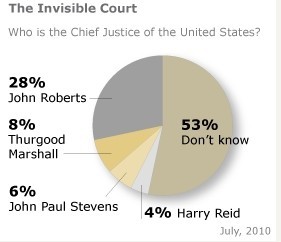
So, the Washington Post’s The Fix uncovered this doozy of a chart from 2010. 28 percent of people get it. 53 percent not knowing, we guess we can understand. And though John Paul Stevens wasn’t chief justice, he was the court’s senior member in 2010, so it was in the ballpark even if it was wrong. But seriously? Thurgood Marshall? 8 percent? Dude hadn’t been on the court in 19 years by the point this survey was taken, and he never was a Chief Justice. Facepalm. (And don’t get us started on Harry Reid. …)

Posted by ShortFormBlog • Permalink