Read a little. Learn a lot. • Now Mullenweg-free! • Since 2009
☰

Tag: civil rights

45 posts

Mar 30 2014t

Reforming the NSA: The rival plans to curb government surveillance

Ten months after Edward Snowden revealed that the NSA was collecting US telephone records in bulk, three sets of proposals have emerged to change the way the agency operates. All would end the data collection program in its current form, but there are crucial differences between the rival plans.

Take a look and compare the plans that could change United States surveillance practices.

Posted by Patrick deHahn • Permalink

Mar 27 2014t

A United Nations panel finds the United States has fallen short of meeting its obligations under an…

A United Nations panel finds the United States has fallen short of meeting its obligations under an international civil rights treaty

— The United Nations raps United States civil rights over drone usage, secret programs and surveillance. source

Posted by Patrick deHahn • Permalink

Feb 24 2014t

And maybe the worst part for Clapper is, he still doesn’t get why Snowden did it. Clapper sees himself as the…

And maybe the worst part for Clapper is, he still doesn’t get why Snowden did it. Clapper sees himself as the man who’s opened up the intelligence community to public scrutiny, who keeps the Constitution on his wall, and who’s endured the endless congressional grillings—all while keeping Americans safe. How could Snowden, a fellow intelligence analyst and contractor, not see that? ‘Maybe if I had I’d understand him better because I have trouble understanding what he did or what he’d do,’ the director said. 'From my standpoint, the damage he’s done. I could almost accept it or understand it if this were simply about his concerns about so-called domestic surveillance programs. But what he did, what he took, what he has exposed, goes way, way, way beyond the so-called domestic surveillance programs.’

— James Clapper, the U.S. Director of National Intelligence who “wakes up and prepares for the worst job in Washington,” explains to The Daily Beast’s Eli Lake why they can’t stop another Snowden.

Posted by Patrick deHahn • Permalink

Dec 8 2013t

The FBI has been able to covertly activate a computer’s camera — without triggering the light that lets users…

The FBI has been able to covertly activate a computer’s camera — without triggering the light that lets users know it is recording — for several years, and has used that technique mainly in terrorism cases or the most serious criminal investigations, said Marcus Thomas, former assistant director of the FBI’s Operational Technology Division in Quantico, now on the advisory board of Subsentio, a firm that helps telecommunications carriers comply with federal wiretap statutes.

— Get enraged. Published at The Washington Post.

Posted by Patrick deHahn • Permalink

Nov 17 2013t

Occupy Phily protesters hit City Hall - with lawsuit

Twenty-six Occupy Philadelphia protesters sued the city in federal court Wednesday, contending that their arrests two years ago after police and city workers dismantled their encampment.

The suit was filed by Center City lawyers Paul J. Hetznecker, Lawrence S. Krasner, and Lloyd Long III, who represented the Occupy protesters at trial. All three were among the charter members of what became known as the Occupy Philadelphia Legal Collective, a group of civil rights and criminal defense lawyers who agreed to represent the Occupy members free of charge.

Krasner called the 26 protesters “American heroes who effectively fought economic inequality for the 99 percent and whose thanks from their government was this bogus arrest.”

Hetznecker said the arrests struck at the “very heart of our democracy.”

“We live in a dangerous time when the right to gather in protest in a collective voice of dissent is criminalized,” he said.

The latest in Occupy Wall Street. Also, last Thursday November 14th marked two years in the eviction of the New York OWS encampment. And here’s what they think of the new mayor, de Blasio

Posted by Patrick deHahn • Permalink

Sep 27 2013t

Judge legalizes same-sex marriage in New Jersey

A state judge today ruled to legalize same-sex marriage in New Jersey, saying gay couples would be denied federal benefits if the state kept allowing only civil unions.

Superior Court Judge Mary Jacobson granted an emergency request by six gay couples, ordering state officials to begin officiating same-sex marriages on Oct. 21.

“Same-sex couples must be allowed to marry in order to obtain equal protection of the law under the New Jersey constitution,” the judge wrote in a 53-page opinion.

This is surely going to be appealed, as these rulings always are, but marriage equality advocates are no doubt thrilled about this. It also puts Governor Chris Christie in a tough spot. How vocal will he be in opposing this decision? He previously vetoed a gay marriage bill; will he take any steps to fight marriage equality this time, knowing that doing so could hurt his chances in 2016? Or might opposing gay marriage actually help his chances in a Republican primary?

Posted by ShortFormBlog • Permalink

Jun 25 2013t

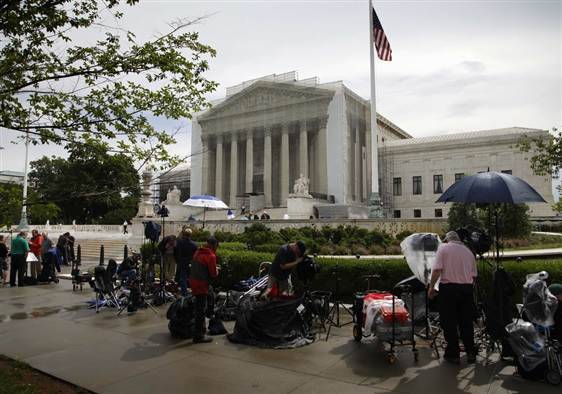
BREAKING: Supreme Court strikes down a key part of 1965 Voting Rights Act

nbcnews:

BREAKING: Supreme Court strikes down a key part of 1965 Voting Rights Act

(Photo: Jonathan Ernst / Reuters, file)

Live SCOTUSblog offers latest details.

Continue reading

Chief Justice John Roberts, in his opinion on the case: “Nearly 50 years later, [the rules laid out by the Voting Rights Act] are still in effect; indeed, they have been made more stringent, and are now scheduled to last until 2031. There is no denying, however, that the conditions that originally justified these measures no longer characterize voting in the covered jurisdictions.”

Thoughts?

Posted by Ernie Smith • Permalink

Jun 25 2013t

Here's what SCOTUS ruled on the Voting Rights Act, in lay terms

  • question The Voting Rights Act mandated that certain jurisdictions in the country with a history of voter disenfranchisement (all in the south) receive pre-clearance from the federal government before enacting any new voting laws. The case on which SCOTUS ruled today questioned whether or not this is constitutional.
  • ruling The court did not strike down the concept of pre-clearance; rather, struck down the specific formula currently used to determine which states require pre-clearance. So, until Congress can agree on and pass a new formula for this determination, no states will require pre-clearance anymore.

It falls upon congress to decide on a new formula–essentially, to figure out which states should still require federal approval to change their voting laws. Given how congress is these days, we’re exceedingly doubtful that any agreement will be reached anytime soon. source

Posted by Seth Millstein • Permalink

Jun 19 2013t

I’d hire a gay guy if I thought he was a good worker. But if he comes into work in a tutu… he’s not producing…

I’d hire a gay guy if I thought he was a good worker. But if he comes into work in a tutu… he’s not producing what I want in my office. If a guy has a particular predilection and keeps it to himself, that’s fine. But if he wants to use my business as a platform for his lifestyle, why should I have to subsidize that? And that’s what these anti-discrimination laws do.

— Cornel Rasor, chair of the Idaho Republican Party’s resolutions committee. In the last year and a half, six Idaho cities have passed ordinances banning workplace discrimination based on sexual orientation; Idaho Republicans aren’t happy with this, and so party officials have passed a non-binding resolution calling on the state’s Republicans to do everything they can to invalidate said ordinances. source

Posted by Seth Millstein • Permalink