Read a little. Learn a lot. • Now Mullenweg-free! • Since 2009
☰

Tag: voting rights act

12 posts

Aug 22 2013t

Politico: DOJ to file suit against Texas over voter ID law

Attorney General Eric Holder will sue to challenge the Texas voter ID law, the Justice Department announced Thursday.

The Justice lawsuit will allege that the Texas law violates Section 2 of the Voting Rights Act, which was among the elements of the law that remains in effect after the Supreme Court invalidated the preclearance requirements in June.

Justice will also seek to intervene in a separate lawsuit against Texas over the state’s redistricting laws, arguing that the state should still be forced to submit to federal preclearance.

Holder says the lawsuits are an effort to prevent states like Texas from suppressing voters’ rights in the wake of the Supreme Court’s Voting Rights Act ruling from a few weeks ago. Neither Texas Governor Rick Perry or state attorney general Greb Abbott have commented on the planned lawsuit at this time.
Posted by Scott Craft • Permalink

Jul 25 2013t

Justice Department to challenge states'€™ voting rights laws

The Justice Department is preparing to take fresh legal action in a string of voting rights cases across the nation, U.S. officials said, part of a new attempt to blunt the impact of a Supreme Court ruling that the Obama administration has warned will imperil minority representation.

The decision to challenge state officials marks an aggressive effort to continue policing voting rights issues and follows a ruling by the court last month that invalidated a critical part of the 1965 Voting Rights Act. The justices threw out a part of the act that determined which states with a history of discrimination had to be granted Justice Department or court approval before making voting law changes.

Attorney General Eric Holder is expected to announce plans to direct the Justice Department to force many states aiming to change their election laws to seek federal approval (commonly known as “pre-clearance”) before doing so. Texas was specifically mentioned in a speech by Holder on Tuesday, which didn’t sit well the Texas GOP.

Posted by Scott Craft • Permalink

Jul 17 2013t

Guardian: Voting Rights Act hearings at the US Senate (live blog)

Today the Senate Judiciary Committee will hold its first hearing on how to “restore the protections of the Voting Rights Act” since the supreme court struck down a key part of the historic 1965 law in late June.

The court's highly controversial 5-4 decision last month invalidated the coverage formula of the law, which determined which states, counties and towns with histories of voting discrimination would have to seek “preclearance” from the federal government before changing their voting laws.

…

The court’s decision did, however, permit congress to work out an updated version of the coverage formula. While many consider the political odds of such a measure moving through both houses of this congress pretty grim, that’s what today’s first hearing, convened by senator Pat Leahy, is here to consider.

The Guardian’s Jim Newell is live-blogging the first of what will hopefully be several Senate hearings as one-half of Congress gets to work on restoring some form of voter protection in the wake of the Supreme Court’s Voting Rights Act ruling. Here’s hoping this becomes one of the few issues that supersedes partisan bickering. We’re not holding our breath though.

Posted by Scott Craft • Permalink

Jul 3 2013t

Poll: Early reactions to last week's headline-grabbing SCOTUS decisions

  • 56% of those who participated in the latest ABC News/Washington Post poll said they approved of the Supreme Court’s decision DOMA ruling.
  • 51% of those polled said they approved of the Court’s Prop. 8 ruling, which cleared the way for state-recognized gay marriage to return to California.
  • 33% of respondents agreed with the Supreme Court’s ruling on the Voting Rights Act, with a 51% majority expressing their opposition to the ruling that portions of the VRA were unconstitutional.

Posted by Scott Craft • Permalink

Jun 25 2013t

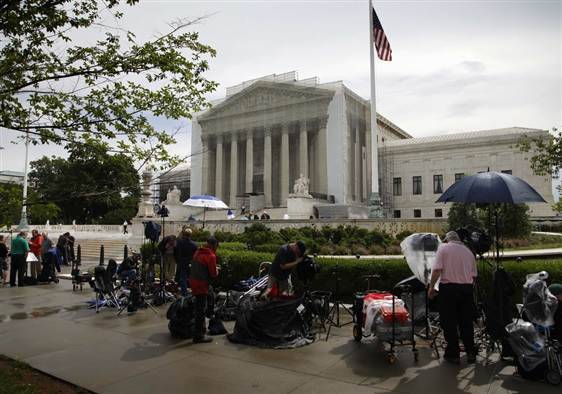
BREAKING: Supreme Court strikes down a key part of 1965 Voting Rights Act

nbcnews:

BREAKING: Supreme Court strikes down a key part of 1965 Voting Rights Act

(Photo: Jonathan Ernst / Reuters, file)

Live SCOTUSblog offers latest details.

Continue reading

Chief Justice John Roberts, in his opinion on the case: “Nearly 50 years later, [the rules laid out by the Voting Rights Act] are still in effect; indeed, they have been made more stringent, and are now scheduled to last until 2031. There is no denying, however, that the conditions that originally justified these measures no longer characterize voting in the covered jurisdictions.”

Thoughts?

Posted by Ernie Smith • Permalink

Jun 25 2013t

Here's what SCOTUS ruled on the Voting Rights Act, in lay terms

  • question The Voting Rights Act mandated that certain jurisdictions in the country with a history of voter disenfranchisement (all in the south) receive pre-clearance from the federal government before enacting any new voting laws. The case on which SCOTUS ruled today questioned whether or not this is constitutional.
  • ruling The court did not strike down the concept of pre-clearance; rather, struck down the specific formula currently used to determine which states require pre-clearance. So, until Congress can agree on and pass a new formula for this determination, no states will require pre-clearance anymore.

It falls upon congress to decide on a new formula–essentially, to figure out which states should still require federal approval to change their voting laws. Given how congress is these days, we’re exceedingly doubtful that any agreement will be reached anytime soon. source

Posted by Seth Millstein • Permalink

Apr 17 2013t

Whenever a society adopts racial entitlements, it is very difficult to get out of them through the normal…

Whenever a society adopts racial entitlements, it is very difficult to get out of them through the normal political processes. Even the name of it is wonderful, the Voting Rights Act. Who’s going to vote against that?

— Supreme Court Justice Antonin Scalia • Expressing his continued disapproval of the Voting Rights Act, which the conservative-leaning judge apparently views as a “racial preferment.” Thankfully, much of the rest of the Supreme Court (and the United States as a whole, we’d wager) doesn’t seem to agree with him. source

Posted by Scott Craft • Permalink

Feb 27 2013t

[A] majority of the Court seems committed to invalidating Section 5 of the Voting Rights Act and requiring…

[A] majority of the Court seems committed to invalidating Section 5 of the Voting Rights Act and requiring Congress to revisit the formula for requiring preclearance of voting changes…It is unlikely that the Court will write an opinion forbidding a preclearance regime. But it may be difficult politically for Congress to enact a new measure.

— SCOTUSblog’s Tom Goldstein earlier this morning. The Supreme Court is hearing arguments today on Section 5 of the Voting Rights Act, which requires certain states with a history of voter disenfranchisement to obtain approval from the federal government before making any changes to their voting laws. One possible outcome: The court strikes down the criteria used in Section 5, but doesn’t strike down the requirement for preclearance itself. If that happens, a new criteria for preclearance would have to be constructed and enacted. And who would be responsible for that? John Boehner and Harry Reid, of course. Sigh. More on today’s arguments here. source

Posted by Seth Millstein • Permalink

Jul 8 2012t

The Voting Rights Act wasn’t designed to be enmeshed in partisan politics. And that’s what is happening now.

The Voting Rights Act wasn’t designed to be enmeshed in partisan politics. And that’s what is happening now.

— Nathaniel Persily, a professor at Columbia Law School • Discussing the sudden legal pressure the Voting Rights Act is facing in states like Texas. The act was introduced in the 1960s to protect African-American voters from disenfranchisement at the polls. But recent state laws have begun to test its legality. Earlier this year, the Obama administration blocked a Texas law that would require voters to show photo ID, saying it was “unfair to minority voters.” Texas says it wants to prevent voter fraud; Georgia and Indiana have passed similar measures. Now, the fight is starting to heat up — with a hearing on Monday in a federal district court on Texas’ law, a possible prelude to a Supreme Court decision. Is it a reflection of the political climate? “Actions and interpretations that previously would not have raised partisan eyebrows are now seen as outrages,” said Persily. source ( source • source)

Posted by ShortFormBlog • Permalink