Read a little. Learn a lot. • Now Mullenweg-free! • Since 2009
☰

Tag: journalism

694 posts

Mar 16 2010W

Biz: The New York Times was taken to the cleaners by Carlos Slim

  • 14.1% the amount of interest on Carlos Slim's $250 million loan, at a time when there was no inflation whatsoever
  • 15.9M number of warrants of stock the Times gave Slim; thanks to a rally, Slim has made $77 million on stock alone
  • $112M amount Carlos Slim has already made back on his journalistic investment in just a year; holy crap source

Posted by Ernie Smith • Permalink

Mar 9 2010W

Biz: Is "I Can Has Cheezburger" the equivalent of Sweatshop 2.0?

  • We like the meme machines that Ben Huh's "I Can Has Cheezburger" network provides. They're goofy, they're funny at times, and they often drive some pretty interesting trends online. What we don't like, however, are his wages. What's essentially a job in a profitable niche media industry is treated as if it's a struggling startup. Gawker has been all over this the last few days, after Huh himself backed his company into a corner thanks to a frank admission.

What "Cheezburger" makes in revenue

  • $4 million in yearly revenue off of user-submitted content source

The "Cheezburger" employee picture

  • 30 employees work for Ben Huh's cat-loving empire source
  • $8.55 the starting rate (40 hr./week, no benefits) at one of Huh's sites for an office admin or a junior designer – that's minimum wage in Washington
  • $17,784 the amount that brings home for potential employees each year, before taxes of any sort – that's just $7,000 above the poverty line source
  • » A notable wrinkle: These jobs are contract jobs without benefits starting out. Contract jobs that don't take out taxes, just an FYI, are the ones that Joe Stack railed against when he crashed that plane into the IRS building. And while Huh claims that people move up in the company, the fact of the matter is that this is a near-poverty level job starting out.

How that compares

  • $30k starting rate for an entry-level office administrator
  • $29k starting rate for a Web-based graphic designer
  • $20k starting rate for a "blogger" – so Huh is even low for that source

Can you live off that? No

  • $17,784the entry-level pay (before taxes) at Cheezburger Network, with the possibility of wage increases
  • $18,337the living wage (after taxes) in the Seattle area, where the network is located source

The justification for low wages

We advertise lower wages for entry-level positions because the worst candidates focus on money the most. Believe it or not, advertising lower-than-market wages actually helped us yield better candidates.

Cheezburger Network CEO Ben Huh • In an article discussing how a recent ad drew candidates who were upset that he was offering so little for what are in reality jobs that require a college education. While passion is one thing, it's another thing entirely to force low wages on college-educated people. He lists three reasons why he feels employees who ask about compensation aren't desirable. The first? "The candidate’s inability to control their personal expenses, which inevitably leads to drama and demands at work." He goes further, noting: "If you have high financial requirements in order to absolutely survive, I don’t really know what to say than go get a job at a bank (you know what I mean)." Know what would help them control personal expenses, Ben? A living wage. Well, maybe they could get one (and health insurance!) if they worked at a Starbucks instead. source

But wait, they're not alone

  • Look, it's easy to focus on them. But the real problem we're starting to see with user-generated content is that nobody's really paying enough, and preying on passion. Lots of companies are guilty of this. Examiner.com is a great example. Journalists have for years been able to make a decent, if not great, wage by working at newspapers and other print publications. Will this go away? Will we even be able to buy cheezburgers? Just a thought.

Posted by Ernie Smith • Permalink

Mar 9 2010W

Biz: Tribune Corp. takes the Clear Channel approach to content

  • We blame Lee Abrams, right. Our friends at the Newport News, Va. Daily Press got some awful news this week, when they found out that much of their paper's copy-editing and design facilities would be outsourced to the Tribune Corp. mothership in Chicago. 10 percent of their newsroom staff will get laid off as a result of this. Lee Abrams, above, is responsible for starting something similar with the radio industry. So, here's a brief explanation of what's up with the Daily Press:
  • Tribune is bankrupt The iconic media company, which owns the Chicago Tribune, the Baltimore Sun, the Hartford Courant and a ton of other major regional newspapers, is trying to cut costs whereever they can. So as a result, they're trying to outsource where they can.
  • slippery slope Tribune has already been down this road with many of their papers – they started doing a modular system for many of the inside pages of their papers last year. The result of what's happening to the Daily Press is something of an extreme case of the process.
  • Abrams is the point guy As the Chief Innovation Officer of Tribune, many of these changes happened due to his influence. He's done this before. He invented the tools used to eventually turn radio into a soulless wasteland. Sure, he has XM under his belt, but his story's already been written.

Turning news into Clear Channel

This is a model that, particularly in smaller markets, although I can see it in larger markets as well, can change the economics of the newspaper business the same way Clear Channel changed the economics of … the radio business.

Daily Press President and Chief Executive Digby Solomon • Regarding the changes, which are in the midst of taking hold. Many of the employees who followed Sam Zell to Tribune used to work for Clear Channel, which should give you an idea of what the company is trying to do. It's everything you hate about radio, in newspaper form. Great. Hope you guys don't succeed at sucking the life out of news. source

Posted by Ernie Smith • Permalink

Mar 5 2010W

Biz: Dear copyright-hounds Attributor: Are you reading our site?

  • Apparently, Attributor plans to go after blogs for copyright usage. Does our blog use more than 80 percent of your average news article? No. In fact, we go to great lengths to rewrite the content and link to everywhere we post about. Which is why we're curious as to how Attributor plans to tackle ShortFormBlog.
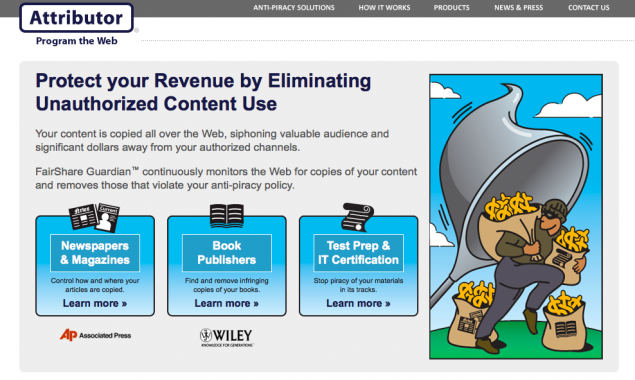
  • What is it? Attributor, if you're not aware, is a Silicon Valley startup whose entire business model is based around going after Web sites posting news or eBook content, forcing them to take it down or pay for a license, pushing ad providers to remove advertising from the site, or even forcing hosts to shut down a site.
  • Sound familiar? If these tactics sound familiar, it's because the exact same kind of tactics were used by the RIAA for years when handling copyright violators. Jammie Thomas-Rasset could tell you a thing or two about how this shakedown model works, and it's not pretty. The only difference is that they aren't suing.
  • wrong approach We feel that Attributor is a bad harbinger for this industry of news. What we'd rather see is a version of the AP and other wire services designed specifically for small-to-mid-sized blogs, with a reasonable cost. Bloggers like us would pay $20 a month for Reuters or AP. Just an idea, dudes. source

Posted by Ernie Smith • Permalink

Mar 5 2010W

Biz: More thoughts on Attributor and the news copyright police

  • After hearing from Rich Pearson of Attributor, we think it's at least fair to articulate what we think a content-licensing agreement should be like for bloggers. Because it seems like, while Attributor has a good point (and is apparently following a don't-be-evil pathos), their business model comes across almost as a debt-collector role regarding the copyright of content. As far as content-charging goes, what we'd like to see is a storefront approach as a way to add value to the proposition. A bit of explanation:

How newspapers get wire content:

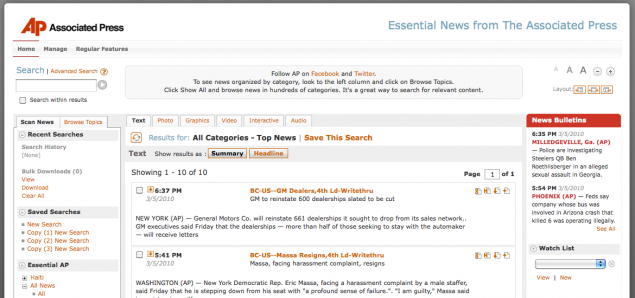
  • This is AP Exchange. We have access to this resource due to the fact that we have a day job. We don't use it (or link to any AP content, preferably) on ShortFormBlog because recent statements from the wire service have raised a lot of red flags for us about the usage of its content on blogs. Anyway, your mom-and-pop bloggers don't have (and may not need) access to something this elaborate, but there are things that many bloggers could really use – budgets of upcoming stories (allowing for planning, not reaction), high-resolution photos, and graphics in vector format which can be easily reworked. Unfortunately, it requires a huge contract and newspapers have to give years-in-advance notices if they choose to quit the wire service. Most blogs aren't that big – unless you're HuffPo, you can't afford it.

Business model points of comparison:

  • » Photoshop Elements: Not everyone needs the full version of Photoshop, an incredibly complex product with a lot of knobs to twiddle. So Adobe created Photoshop Elements, which offers many of the features at a cheaper price. Simpler, cheaper – that's what we'd suggest.
  • » Lala/Spotify: iTunes isn't exactly the model we'd suggest for this. An all-you-can-eat model like Spotify is nice, while an ultra-cheap micropayment distribution model like Lala might be ideal. Many news stories don't have a ton of currency beyond the first day.
  • » Typekit: Typekit, which is trying to do something similar for typography, has a very polished interface on the developer's end which makes it incredibly easy to find the right font to use. Their use of javascript is a little annoying, but ultimately, it strikes a good balance between making rights-holders happy and giving Web site owners more options.

What we'd like to see:

  • one We think bloggers need an interface for content-gathering on a wire service, something that they could use as a resource just like Google News and Twitter.
  • two We think Automattic or Six Apart (or Publish2, even), which already have significant ties to the blogging community, would be great choices to run a site like this.
  • three And – this is the important part – it needs to be done well, in a way that doesn't talk down to them, that emphasizes quality, not assuming the worst of its users.

Why we think Reuters will come up with this:

I believe in the link economy. Please feel free to link to our stories — it adds value to all producers of content. I believe you should play fair and encourage your readers to read-around to what others are producing if you use it and find it interesting.

Thomson Reuters President of Media Chris Ahearn • From an article he wrote back in August. We wrote about it then, too, and we think it suggests that Reuters will figure this out before the Associated Press. The AP is more beholden to its newspaper partners, and companies like News Corp. and Tribune Corp. have too many interests in their own products. We think offering diverse options would be great for bloggers and would help take much of the stigma away from what they do. But not everyone's there, sadly. Fingers crossed that the concept behind Attributor is a good first step, not a bad last one. source

Posted by Ernie Smith • Permalink

Mar 2 2010W

Biz: Rupert Murdoch is an old guy who likes to settle scores

Here he is at the height of his powers, and all anyone wants to talk about is this one quote. He finds that incredibly frustrating.

A senior News Corp. exec • Regarding News Corp chairman Rupert Murdoch and "this one quote" in a New York Times article about Fox News chief Roger Ailes (which we covered here). Murdoch had to do some major spin to stop that quote, from a son-in-law who doesn't like Ailes' politics. Murdoch was covered at length in a recent New York Magazine piece which is worth the read. Synopsis: He's old. He's powerful. He's not going after his son-in-law. He's going after The New York Times (with the Wall Street Journal). source

Posted by Ernie Smith • Permalink

Mar 1 2010W

Biz: News-reading habits: Online already tops newspapers, nearing TV

  • Ah, studies! The things we love! The Pew Internet and American Life project just released a really interesting study about readership habits, with the key point being that online news is a huge chunk of readership nowadays. Here are a few key numbers and points, because we know that you guys like it when we do that for you:

The overall key number from this study:

  • 59%like getting news on AND off the Web

We like mixing mediums:

  • 92% get their news from multiple media platforms daily (as many as six)
  • 2% get their news solely online – we call these people early adopters

Who reads what, where?:

  • 78% like to get news from a local TV station
  • 61% like getting their news on the Internet
  • 50% still like reading news in a local newspaper

Online usage habits:

  • variety Most people don't have favorites. 65 percent don't have a preferred site for their information.
  • national Local news isn't read so much online – weather and national news are much more popular.
  • social Talkers are a big driver of news – three-quarters of people get news via e-mail or social media.

Lessons to take:

  • » Newspapers need to focus on local: Many newspapers already do so. It's their bread and butter, and the journalism they offer is still valuable. Readers agree, which is why they still prefer newspapers and TV for local news.
  • » Can't stop the Web: Online news is already ingrained into the public consciousness, and much of it is grabbed through social media. And it's decentralized reading too. No point trying to plug it up at this point. In fact, it's grabbing a massive hold on mobile phones, too.
  • » People like talking about news: 72 percent of news-readers say that journalism is a social experience – they read because they like talking about it. Online, this means that social media needs to be a huge part of news-distribution efforts. source

Posted by Ernie Smith • Permalink

Mar 1 2010W

Tech: The Associated Press plans to make you pay on the iPad

  • Good news, everyone! Fans of reading Associated Press stories now have a lot to look forward to with the iPad. They plan to charge readers for some stories with an app on the device. If we could make a suggestion: Don't charge for the blades – charge for the razors. And make the razors unlike anything else already on the market. We know it inverts the Gillette model, but it's also the only way anyone's not just going to open up a Web browser and grab your news that way. Unless you have a better idea. source

Posted by Ernie Smith • Permalink

Feb 21 2010W

Politics: "A narrative of impending tyranny" our new favorite phrase

In a word, the Times editors and Barstow know this narrative is nuts, but something stops them from saying so — despite the fact that they must have spent over $100,000 on this one story.

Our boy Jay Rosen • Regarding a recent New York Times article about the Tea Party movement which seemed to accept a seemingly wrong-on-its-face statement about our country – "a narrative of impending tyranny" – as fact. This phrase floored Rosen enough that he wrote a huge blog post about it. The point that he's getting at, and that we completely agree with, is that the need for objectivity doesn't mean you can't consider or critique what's being said. Being impartial is one thing; being oblivious, or repeating what's being said without qualification is another altogether. We owe readers more than that. source

Posted by Ernie Smith • Permalink