Read a little. Learn a lot. • Now Mullenweg-free! • Since 2009
☰

Tag: journalism

694 posts

Apr 9 2010W

Biz: To: Media General, From: Us – Re: Your consolidation efforts

  • You know, people will notice this stuff eventually. Yesterday, newspaper chain Media General announced that it was combining the design and copy-editing efforts of its papers in Richmond, Va., Winston-Salem, N.C., and Tampa, Fla. – three papers that have nothing to do with one another geographically. They're not the first papers to get treated this way, but they are the biggest. And it's completely not fair to the communities. Here's why:
  • These aren't production jobs The nature of moves like these seems to assume that copy-editing and design functions aren't really journalism – at least not in the same way as reporting. It's a fundamental misunderstanding of the editorial process that puts distance between the journalism and the community.
  • Quality will suffer greatly The fact of the matter is, some dude copy-editing a story in Tampa will not understand the nature and nuance of a story in Winston-Salem. Nor will a designer in a similar position. While Media General is playing this as a move to maintain local focus, it won't work. It's a damn shame. source

Posted by Ernie Smith • Permalink

Apr 9 2010W

Biz: We're gonna use this post to link to the Nikkei's home page

  • Why? Because they say we can't. The Japanese business newspaper is following the lead of a lot of newspapers worldwide by adding a paywall, but their paywall is way beyond that of, say, the Wall Street Journal. First, you have to submit a written application to link to the site (which we didn't do). And second, they've gone and disabled the copy function on their site. Why? Because they've seen American papers open the floodgates and lose readership as a result. source

Posted by Ernie Smith • Permalink

Tags for this post

Apr 5 2010W

Politics: The Washington Post wants to hide our mean comments

I like the approach because it doesn't limit speech. Anonymous loudmouths can still shout. But 'trusted commenters' will be easier to hear.

Washington Post Ombudsman Andrew Alexander • Discussing the Post's decision to switch to a tiered commenting system like Gawker. Why? Too many loudmouths who hate the liberal media and everything it represents. With the system, it adds a layer of trust that encourages more good comments by allowing users to promote those and leave the conspiracy theories behind. Seriously, though, they found that a lot of story sources were getting scared off because anonymous commenters were so mean. A new bride, for example, was told to get a life insurance policy for her husband because he was obese and would probably die soon. Yeah, the Post needs to fix that. source

Posted by Ernie Smith • Permalink

Tags for this post

Apr 4 2010W

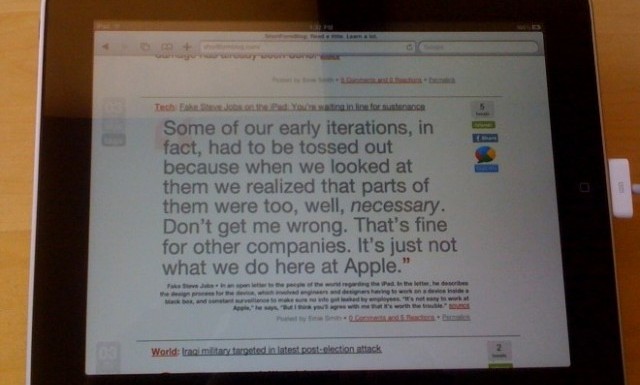
Tech: Early thoughts: The iPad as news curation tool (is it worth it?)

  • Our take? It depends on the app. Right now, the iPad does three things really well. It allows you to surf the Web at nearly the same clip as a laptop, it rules at non-Flash video playback, and it allows you to read the news better than either a newspaper or Web browser. For a 1.0 product, this is polished. But we're journalism nerds that read a lot of links, so let's focus our appeal. How is reading and curating news on this thing, anyway? (Hint: Pretty good.)

First: What a good news app needs

  • one A simple format that makes it easier, not harder, to read the news. It's not a newspaper or a Web site; it's a little of both
  • two An easy way to share content – you should be able to copy quotes, tweet links, and e-mail articles to a friend (or yourself)
  • three A solid offline reading mode – these apps need to be able to work without a wi-fi connection nearby; all of the apps had this

Second: The best news apps

  • best The Reuters app is super-readable, easy to scan, and best-formatted for the iPad. It's also the one that tried to look least like a newspaper.
  • great The USA Today app has a mix of strong readability, easy organization, and smart uses of swiping. It's nearly as good as the Reuters app.
  • eh The New York Times app isn't bad, but its body type isn't on the grid. The Wall Street Journal app tends to overreact to tiny movements.
  • wtf The Associated Press app went all scrapbook with their format, which is OK – for a scrapbook. For reading hard news, it's very annoying.

Third: Twitter on the iPad

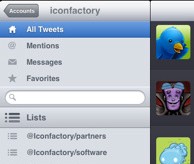
  • Best balance Twitterrific was designed for the iPad the way that one would expect someone to use an iPad Twitter app. The use of Twitter lists, for example, makes for great news-reading. Less is more in this case.

  • Most complex TweetDeck could stand to be a little less complicated right now. It loads too many windows at once and comes across as a bit bloated and overwhelming. A bit more interface furniture to clean up the look would help this greatly.

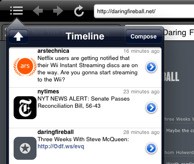
  • Best mashup As many people know, the EchoFon/Firefox setup is hard to top for reading linked tweets, and TweetBrowser goes a long way to replicate that on the iPad. Only issue: We wish we could hide the feed in the horizontal format.
  • » One side note: Webkit's skills at rendering the Twitter web apps are mostly pretty good. The web version of Hootsuite is actually better than the iPad-native version of TweetDeck on the iPad. Threadsy also works great, as does the Web version of Seesmic. You'll have to use a two-finger swipe to navigate, though, which can be cumbersome.

Overall: What did we think?

  • » What we like: It's a good reading format, and Safari could handle nearly everything we threw at it (except the TinyMCE rich-text editor, which means it sucks for blogging because Wordpress uses that). The format is awesome for video and music. Once Hulu and Spotify get apps on here, it's seriously a one-stop shop. Also, being able to load articles on the device and take it on the wi-fi-less D.C. Metro was downright perfect.
  • » What we don't like: It can be hard to hold the device upright, especially if you're not sitting at a table. It's strange that Apple didn't consider putting a kickstand on the back. The keyboard is usable but not heavy-duty. Apple should consider putting in (or allowing) additional keyboard setups that make it more usable for typing in HTML. Right now, it's a serious chore.
  • » What we want to see: Surprisingly, we don't miss multitasking on the iPad – it actually wasn't noticeable for most apps. But we think someone needs to create a single app that mixes social media, web browsing and blogging/word processing. TweetBrowser gets the first two down, but Wordpress' app isn't designed for this at all. We smell opportunity (eh, Tumblr?).

Posted by Ernie Smith • Permalink

Apr 4 2010W

World: The New York Times won't bend to Singapore's will anymore

Google faced a similar painful dilemma in China. With potentially billions of dollars at risk, it stuck to its principles, and The Times applauded editorially. I think Google set an example for everyone who believes in the free flow of information.

New York Times Public Editor Clark Hoyt • Regarding Google's China example for free speech and what that means for the Times and its Singapore interests. The company is considering leaving Singapore, where its International Herald Tribune has a major foothold, due to the government clamping down on their free speech. Why? The IHT dared call the current government a "dynasty." Twelve years ago, the IHT agreed not to do that anymore, but broke their promise when they noted former prime minister Lee Kuan Yew and current prime minister Lee Hsien Loong in an article about dynasties. The Times won't work that way anymore, kids – some are surprised the free-speech defenders did in the first place. source

Posted by Ernie Smith • Permalink

Apr 2 2010W

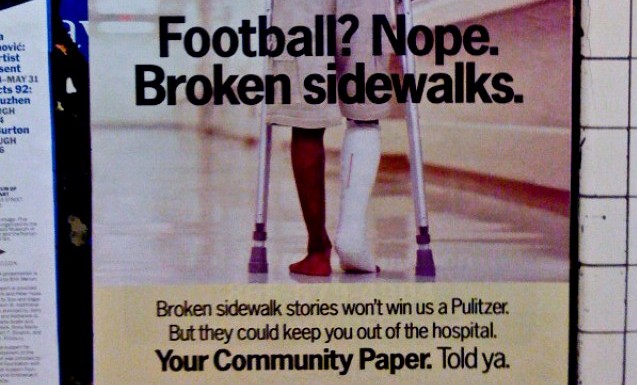
Biz: Newspapers willing to guilt you into reading their articles

  • "If you don't have us around, we'll break your leg." Journalism is an interesting beast these days. There's more of it going on than ever, but not nearly as much of the kind that is truly helpful to the community. But we can probably all agree that scare tactics won't convince people to start reading the paper again. It's journalism's job to innovate, not the other way around.
  • there's a point here As poorly as this ad puts it, it does have a point. The nitty gritty of the journalism process is in severe danger of going away. The low-paid scab reporter who willingly covers boring but necessary city council meetings? There's no equivalent of him or her in the blogosphere (at least not with a paycheck for their work). Local journalism is at a real turning point.
  • proving its worth The problem, though, is local news outlets are generally really bad at explaining this point, and when they do, it's really heavy-handed (see the subway ad above). So, what's next? We're guessing one of two things need to happen: One, it needs to be community-supported on a non-profit basis (see MinnPost), or two, it needs to truly innovate. Or both.
  • will the iPad help? Tomorrow, many large papers, from USA Today to The New York Times, will release apps to coincide with the release of the iPad. From a outsider's standpoint, they look great (especially the USA Today one). But really, we want to see what mid-sized dailies will do. USA Today won't go away. The Kalamazoo Gazette might. And, honestly, we need it more. source

Posted by Ernie Smith • Permalink

Mar 19 2010W

Culture: False advertising: Christiane Amanpour isn't joining ABC this week

  • Actually, she's joining it at the end of April. The longtime CNN anchor, famous for her international coverage, will helm "This Week," replacing George Stephanopoulos. It's a bit of a change, but just look at the comments on this CNN post. Amanpour is universally loved and probably won't damage the "This Week" brand. CNN, on the other hand, is looking like a rickety old ship that just lost its first mate. source

Posted by Ernie Smith • Permalink

Mar 19 2010W

Biz: Gannett rewards its executives for shedding a crapload of jobs

  • Were the job cuts needed? After a report came out yesterday on the unofficial Gannett Blog noting the executive pay of the company's chief executives, there's definitely some deserved anger due to the number of layoffs that the newspaper company had. Truth is, though, their salaries, while high, are only a dent in a much larger pie, and from one perspective, they did their jobs well.

Executive salaries vs. 2009 job cuts

  • 6,000 number of jobs that were lost throughout the company in 2009 through cuts and layoffs; many workers were also furloughed
  • $4.7M the amount Gannett's chairman and CEO, Craig Dubow, made in 2009, up $1.6 million from 2008 (including a $1.5 million bonus)
  • $4M the amount president and COO (and former CFO) Gracia Martore made in 2009, up $2.6 million from 2008 (with a $950,000 bonus)

Would lower executive pay help? Not really

  • $240M the amount the laid-off workers' collective salaries would be if they were each paid $40,000 per year, around average for journalists (though some are paid higher)
  • $700 the amount each laid-off worker would get if that $4.2 million difference between 2008 and 2009 executive pay was spread out evenly amongst them

Where the cuts helped most: Stock prices

  • 907% the increase in stock price since 2009

Uncomfortable reality

  • » The business consideration: Truth of the matter is, from an investing and financial perspective, Craig Dubow and Gracia Martore look very smart for cutting off some of the dead wood, even if it screwed over thousands of journalists as a result.
  • » The real problem? Same as many other newspaper conglomerates: Gannett's simply too big. It holds jurisdiction over many markets large and small, and as a result of heavy debt burdens from the financial crisis, it and companies like it, including McClatchy and Tribune, have had to make some tough decisions to protect the whole beast. Seems like all these mergers and buyouts had the effect of damaging local newspapers and local journalism. Financial sense and editorial sense are two different senses. source

Posted by Ernie Smith • Permalink