Read a little. Learn a lot. • Now Mullenweg-free! • Since 2009
☰

Tag: curation

29 posts

Jan232013t

The Curation Battle: The Verge vs. The Huffington Post

jimmydaly:

Here’s what happened. The Verge wrote this great feature and The Huffington Post “curated” it. Editor-in-Chief of The Verge was not pleased.

Formal public request. @bbosker and @huffingtonpost, please remove the content you’ve scraped from us. huffingtonpost.com/2013/01/21/the… Seriously.

— Joshua Topolsky (@joshuatopolsky) January 23, 2013

What’s most egregious about this @huffingtonpost scrape is its theft of our SEO on title and text. Google “death of the american arcade”

— Joshua Topolsky (@joshuatopolsky) January 23, 2013

@joshuatopolsky that was a story we linked out to on huffpost to drive traffic/readers to The Verge, which it looks like it did ½

— Bianca Bosker (@bbosker) January 23, 2013

@bbosker no it didn’t.

January 23, 2013

Matthew Ingram of GigaOm jumped in to ask this very important question:

@joshuatopolsky: so if Google gives the HuffPo excerpt more prominence than the original Verge piece, is that Google’s fault or HuffPo’s?

January 23, 2013

Huffpo’s one-paragraph pull of a much longer Verge piece full of graphics, visuals and well-considered content doesn’t take away from a transformative original piece. The question is, do people click the link on HuffPo and realize that there’s a much better transformative piece out there?

Posted by ShortFormBlog • Permalink

Dec72012t

Syria Deeply, Beat Page of the Future

poptech:

futurejournalismproject:

Syria Deeply, Beat Page of the Future

It’s an incredible idea: one site, one beat. No front page. No sports, no business or finance, anywhere. It’s called Syria Deeply.

It’s about 25% original content, written by veteran Middle East correspondent Lara Setrakian and friends. The rest is aggregated and includes interactives, maps, and contextual material aimed to catch people up on the story without pointing them off site.

From FastCompany:

From a taxonomy perspective, Syria Deeply is the opposite of most news sites. In a traditional news taxonomy, information is divided by broad topics, like World News. Each topic is divided into subsections, like the Middle East. Each subsection is then often divided into even smaller subsections, like Syria. Each section gets smaller and smaller. Topic pages live in obscure ghettos on many news websites: auto-aggregated and ugly dumping grounds for content that happens to be tagged with particular keywords.

On Syria Deeply (designed by Brock Petrie and developed by Soumyadeep Paul and Arindam Biswas, who runs Collective Zen) the topic page is the homepage. Setrakian’s hope is that this site-wide focus on a single beat will allow for deeper, more thoughtful reporting.

FJP: Looks extremely promising.

Context, context, context. Bravo.

If you have not made it to this site, do so. This is how you cover single-topic news.

Posted by Ernie Smith • Permalink

Jun32012t

On "curation" and getting caught up in terms

idroolinmysleep:

“So like there’s nothing for you to curate without creation? This precious bit of dressing-up what people choose to share on the Internet is, sure, silly, but it’s also a way for bloggers to distance themselves from the dirty blogging masses. You are no different from some teen in Indiana with a LiveJournal about cutting. Sorry folks! You’re in this nasty fray with the rest of us. And your metaphor is all wrong. More likely you’re a low-grade collector, not a curator.” —

Choire Sicha: You Are Not a Curator, You Are Actually Just a Filthy Blogger

Gonna curate some links in the meantime.

Saw this yesterday, found it to be a bit of a talker, wanted to write up a response. First up: Choire has been at this long enough (he worked at Gawker nearly a decade ago) that he’s arguably an elder statesman of blogging, along with folks like Andrew Sullivan, Josh Marshall and a couple of others. That automatically makes his opinion valid enough that we should listen, but I’m sure in a lot of ways it gives him a different take on this whole thing than someone who got into this in, say, 2008 or 2009.

So let’s take on this term. “Curation.” The first time I ever heard someone use the term in relation to Web content was in 2009, when Robert Scoble wrote this great piece about how “curation” was going to be a billion-dollar industry, once someone figured out a killer product that made it really stupidly simple to organize our thoughts into one piece. Not long after that, we got Storify, and, separately, Tumblr sort of became the place for this style of link sharing. I don’t see a billion dollars yet, but the basic idea seems to be catching on. (And no, it’s nothing like curating art. Big deal.)

But here’s the thing: I don’t think anyone is actually trying to “class up” their work by using this term. (Well, maybe except for the dude quoted in Choire’s piece.) These “curators” are just using different techniques than people were using a decade ago, and someone threw out that term one day, and it stuck.

And it’s happened before, too. Do you know how long pre-digital journalists bristled at the term “blogger” around 2004? I’m sure there’s some middle-aged newspaper columnist somewhere who once wrote a column titled “You Are Not a Blogger, You Are Actually Just a Terrible Journalist.” Do we need to rehash the purist’s argument every time someone does something a little differently? I’m sure the telegraph guys were pissed when they were shown the telephone for the first time.

So let’s get down to it: You’re not a curator, but then you’re not a blogger, either. You’re just a person with an internet connection who uses it to communicate. The quality of the information you share, report, or comment on is what matters. Not the term. — Ernie @ SFB

Posted by ShortFormBlog • Permalink

Mar132012t

I’ve been running a hybrid articles-and-links blog here (↬DF) for a while, I wrote the function that added…

I’ve been running a hybrid articles-and-links blog here (↬DF) for a while, I wrote the function that added “via” links to billions of reblogged posts on Tumblr, and I didn’t even know the difference between “via” and “hat tip” until today.

— Instapaper founder (and Tumblr co-founder) Marco Arment • Offering his take, in a post titled “Not a Curator,” on the “Curator’s Code” idea that’s been floating around for the past day or two. His feeling? We’re fighting over something that’s not a big deal, and the solution is going to be ignored by the organizations that it’s meant to target. “The proper place for ethics and codes is in ensuring that a reasonable number of people go to the source instead of just reading your rehash,” he argues. Personally, that’s always been our goal — but that said, unlike Marco, we’d call ourselves curators.

Posted by ShortFormBlog • Permalink

Mar122012t

…where is the line between promoting the good work of others and simply lifting it? Naughty aggregation is…

…where is the line between promoting the good work of others and simply lifting it? Naughty aggregation is analogous to pornography: You know it when you see it.

— David Carr (via soupsoup)

Good article. Also recommend reading up on what Philip Bump had to sayabout this topic. “If you’re going to solve a problem that doesn’t need a solution — at least solve it.” While the idea has some merit — proper sourcing is a problem all around the Web — it’s not without its flaws.

Posted by ShortFormBlog • Permalink

Mar22012t

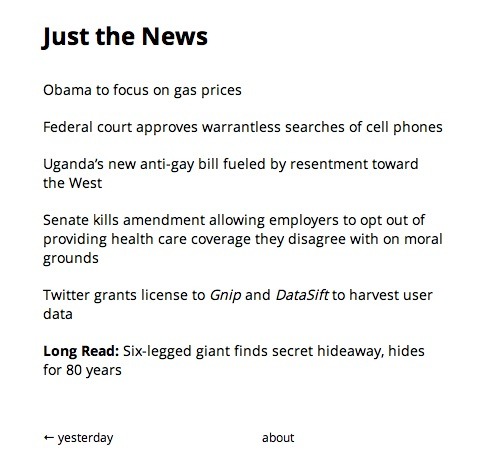
See all that stuff around the text? It’s white space.

New to the neighborhood: JustTheNe.ws

See all that stuff around the text? It’s white space. Tumblr user Max Temkin’s new news project is quick info minus clutter, updated once a day. “I’ve always wished I could get my news on a plain white page with a few well-curated stories; no ads, no social media, no comments,” he writes. “I got tired of waiting for someone to build that page, so I made it myself.” Minus the newspaper, this reminds us of the approach of the old Frontpages tumblr (whose loss we’re still upset about and we miss greatly). Just the links. Nothing more, nothing less. Give it a follow.

Posted by ShortFormBlog • Permalink

Feb222012W

Tech: Storify comes to the iPad: Full story curation, at your fingertips

  • “Whether you’re at a conference or at home … you now have storytelling at your fingertips.” Storify co-founder & CEO Xavier Damman's totally psyched about bringing his popular online story-telling tool to the iPad. While Storify, which pulls content from a variety of social networks, does not contain all the functionality of it's Internet-based counterpart, the team at Storify is confident that they've successfully migrated the core Storify experience to iOS. The team also added an additional function not found on the Storify website: The ability to tweet, inside the app, while creating a story. Have you tried it yet? source

Posted by Scott Craft • Permalink