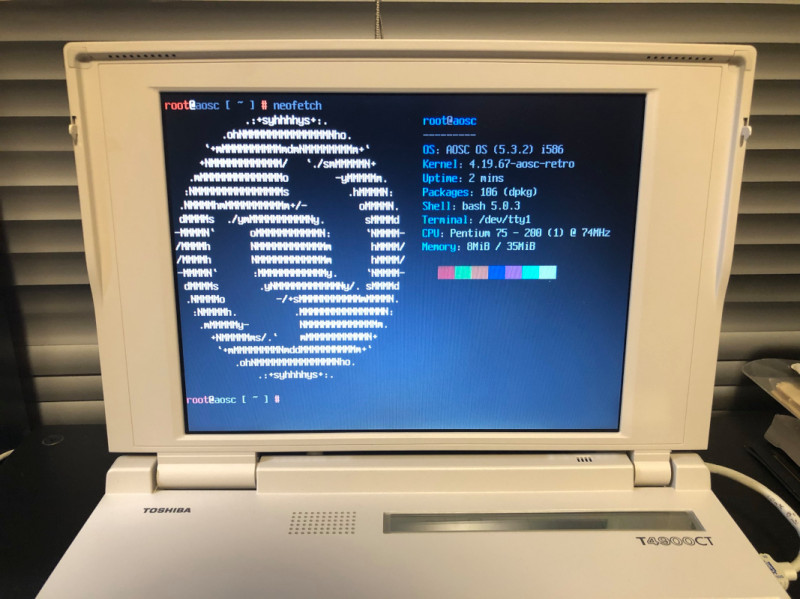
This laptop is a quarter-century old, but there’s actually a modern version of Linux that it can run.
 ShortFormBlogRead a little. Learn a lot. • Now Mullenweg-free! • Since 2009
347 posts
This laptop is a quarter-century old, but there’s actually a modern version of Linux that it can run.
Posted by Ernie Smith • Permalink
Larry Page once said that ‘Google would be building airports and cities’. It has long been believed that the influence of digital actors will remain confined to software, dematerialized content and information. It starts to be clear that they are using their mastery in these areas to take positions in non-digital markets, be it transport, infrastructure management or banking. Google may not be building cities yet but, directly or through its investments, it is already playing a role as a mobility organizer, while IBM participates in the management of water supply infrastructure in several cities.
With the ever-increasing connection of infrastructures and objects, the organization of physical flows requires the control of information flows. A global Internet shutdown is likely to have extremely important consequences for a world that will still be physical, but deeply driven and structured by information and data.
That being said, moving from the thought experiment to the actual functioning of the Internet today, it has to be mentioned that it is extremely unlikely that a global Internet shutdown actually happens. While it is relatively easy to shut down specific parts of the internet for some period of time—as it is well documented here—a global one is, at least so far, almost impossible, due to the distributed and interconnected nature of the Internet
— What Would Happen If the Whole Internet Just Shut Down All of a Sudden? (via kenyatta)
Posted by Ernie Smith • Permalink
Apple will take the hit for it even though the battery came from an unknown source.
— Nadim Maluf, the CEO of the battery-monitoring software firm Qnovo, explaining why Apple doesn’t want end users replacing their own batteries in Apple devices. Basically, where some see the removal of consumer choice and freedom, Apple sees a giant liability—something exemplified by the fact that some MacBooks are facing a ban on planes right now. (Side note: Has Apple ever considered making the batteries user-removable? Just saying.)
Posted by Ernie Smith • Permalink

Lawyers representing Andrew “Weev” Auernheimer will launch a new effort to have the young man’s 41-month prison sentence overturned, arguing that his November 2012 conviction – for exploiting a public-facing web address to generate a list of thousands of iPad owners’ personal email addresses – will have serious consequences for internet freedom. Auernheimer’s attorneys say his actions should not have been considered violations of the Computer Fraud and Abuse Act because he visited a web address that could have been visited by anyone with an internet connection. For its part, the U.S. government continues to insist a simple desire not to have the information accessed is enough for AT&T to claim that his actions were “unauthorized”, putting Auernheimer in direct violation of the CFAA. (Photo courtesy of Gerry Smith) source
Posted by Scott Craft • Permalink
The National Security Agency has built a surveillance system capable of recording “100 percent” of a foreign country’s telephone calls, enabling the agency to rewind and review conversations as long as a month after they take place, according to people with direct knowledge of the effort and documents supplied by former contractor Edward Snowden.
A senior manager for the program compares it to a time machine — one that can replay the voices from any call without requiring that a person be identified in advance for surveillance.
Posted by Scott Craft • Permalink
Posted by Scott Craft • Permalink
Preserving the Internet as an open platform for innovation and expression while providing certainty and predictability in the marketplace is an important responsibility of this agency.
— FCC chairman Tom Wheeler • In a new statement, confirming that the Federal Communications Commission will take steps to implement new net neutrality rules after a federal court struck down the organization’s Open Internet Order earlier this year. Rather than attempting to reclassify internet providers, or challenging the court’s verdict, Wheeler says the FCC will rewrite the rules in a manner that would survive another judicial review. source
Posted by Scott Craft • Permalink
Posted by Scott Craft • Permalink
Robocoin said on Tuesday that later this month it will install the first automated teller machines in the United States that let users buy and sell bitcoin, the latest step into the mainstream for the digital currency.
The kiosks, to be installed in Seattle, and Austin, Texas, are similar to ATMs but have scanners to read government-issued identification such as a driver’s license or a passport to confirm users’ identities.
The ATMs will allow people to swap bitcoin for cash, or deposit cash to buy more bitcoin by transferring funds to or from a virtual wallet on their smartphones.
Though based in Las Vegas, Robocoin’s only current bitcoin ATM is located in Vancouver, and a second machine is expected to begin operation in Calgary before the end of February. Robocoin also plans to expand its operations to Europe and Asia sometime after the Seattle and Austin machines are brought online.
Posted by Scott Craft • Permalink
Posted by Scott Craft • Permalink