Read a little. Learn a lot. • Now Mullenweg-free! • Since 2009
☰

Tag: paywalls

16 posts

Mar 18 2013t

Unlike the New York Times or the Wall Street Journal, The Post has traditionally been a local business…

Unlike the New York Times or the Wall Street Journal, The Post has traditionally been a local business, pulling in large amounts of local advertising from merchants eager to reach the print audience. By contrast, 90 percent of The Post’s online audience is outside the Washington area.

— Why The Washington Post is going to start charging frequent readers of its site. Meanwhile, their building’s still for sale.

Posted by Ernie Smith • Permalink

Dec 27 2012t

More than a year and a half later, it’s clear the New York Times’ paywall is not only valuable, it’s helped…

More than a year and a half later, it’s clear the New York Times’ paywall is not only valuable, it’s helped turn the paper’s subscription dollars, which once might have been considered the equivalent of a generous tithing, into a significant revenue-generating business. As of this year, the company is expected to make more money from subscriptions than from advertising — the first time that’s happened.

— Bloomberg’s Edmund Lee • Discussing the success of the New York Times paywall, which has done something very surprising — it’s allowed the New York Times to make more than half of its overall revenue from subscriptions, rather than the traditional 80 percent advertising/20 percent subscriptions balance that has traditionally defined newspapers. That’s good for a number of reasons, with the biggest being that the New York Times is no longer as overly reliant on ad dollars to sell its news. That’s an awesome spot for the Times to be, but the real question: Does that mean anything for papers that aren’t the Times, which may be a tougher sell than a paper of record?

Posted by Ernie Smith • Permalink

Aug 26 2012t

The Missourian’s change to a pay model is consistent with industry trends; its method, with everything free…

The Missourian’s change to a pay model is consistent with industry trends; its method, with everything free for the first 24 hours of publication, is experimental and reflects a core mission of this newspaper to test innovative practices for the news industry.

— Tom Warhover, executive editor of the Columbia, Mo. Missourian • Regarding the paper’s interesting take on paywalling its content — everything will be free for the first 24 hours, but after the one-day mark, you hit a paywall. (The model corresponds with a suite of new digital apps for the publication.) This is a relatively untried model — most outlets in recent years have preferred to, instead, follow the New York Times’ successful metered paywall model. But the Missourian, which is run by the University of Missouri and staffed by J-school students, is the perfect testbed for an experimental model. The paper was one of the first newspapers to go online, and has a long tradition of trying new things. So it’ll be interesting to see what they do.

Posted by ShortFormBlog • Permalink

Feb 23 2012t

Before Marie Colvin died in Syria, she had one major complaint with her newspaper — her stories, which she…

But Ms. Colvin’s frustrations were also more particular than that: she worried that her accounts of indiscriminate bombing by forces loyal to the Syrian government were not able to reach the widest possible audience.

Days before her death, she asked a fellow journalist to sidestep the online subscription requirement for her newspaper, The Sunday Times of London, and share her latest article from Syria with nonsubscribers. “Getting the story out from here is what we got into journalism for,” she wrote in a message that was republished on Wednesday by Bill Neely, the international editor for ITV News in Britain.

“You have my permission to post it, as in I will take the firing squad in the morning,” Ms. Colvin said, indicating that her bosses might object to the reposting of her articles elsewhere. “I’m just not able to technically do it, as I am still in Baba Amr.”

This puts a seriously human face on a problem widely plaguing the newspaper industry — how do you get your stories read and paid for? The Times’ paywall, implemented by News Corp. in 2010, is the worst of the worst, as you can’t even read excerpts from the stories without a subscription. Newspapers need to make money, yes, but when does the public interest, which Marie Colvin was deeply interested in, take precedent?

Posted by ShortFormBlog • Permalink

Sep 12 2011W

Biz: The Boston Globe starts up its own Web site — wait, didn't they have one?

We’ve never had The Boston Globe have its own front door in the digital space. It’s always been integrated with Boston.com. This was an opportunity to build something brand-new and to have it front and center and really do justice to the brand promise The Boston Globe offers to its readers.

Boston Globe publisher Christopher M. Mayer • On the paper's launch of its own Web site this morning — a paywall-laden one that smartly separates the company's newspaper content from Boston.com content that might work better on the Web. Boston.com is paywall-free and still serves breaking news, blogs and the whole bit. Bostonglobe.com focuses on the newspaper itself. It's an interesting separation and we're curious to see how it works out for them. The Boston Globe's parent, the New York Times Company, famously started up a successful paywall experiment for the mothership paper. (Quote from a paywall-laden article, but there's free registration for the next couple weeks; the source article links to the free Boston.com piece.) source

Posted by Ernie Smith • Permalink

Mar 26 2011W

Tech: New York Times' paywall: Favoring the mobile Web over apps?

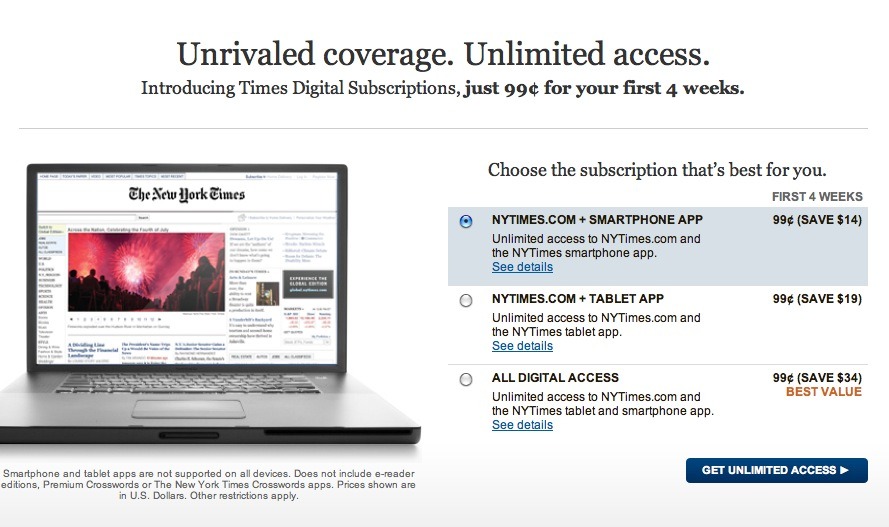
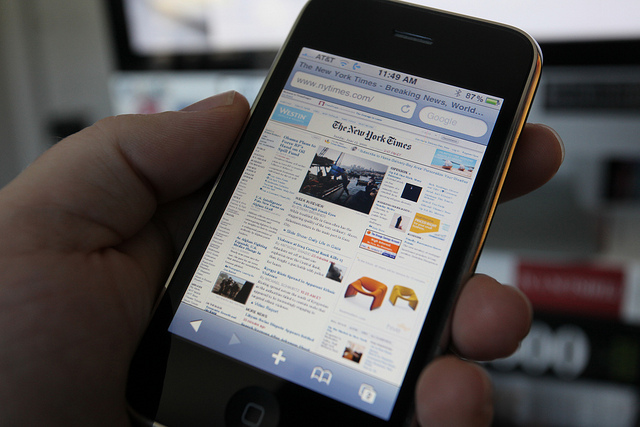
  • The fine print in the NYT's paywall: Have you been wondering to yourself, "Who the heck would pay $260 extra to subscribe to the iPad version of the New York Times?" So have a lot of people. From a distance, the price plan makes little sense and makes the paper nearly as expensive as the dead-tree version (which costs $770 a year for the seven-days-a-week edition outside of NYC). But Poynter's Damon Kiesow has a really interesting take on the matter which a lot of people haven't considered: What if the Times wants to discourage mobile app use by pricing them at a premium, specifically with the iPad version? (above pic taken by Robert Scoble — yes, that's the man's hand)
  • $385 yearly cost of a weekday subscription to the Times
  • $195 yearly cost of a Web-only Times subscription
  • $260 yearly cost to add mobile to the Web
  • $455 yearly cost to add tablet use to the bunch source
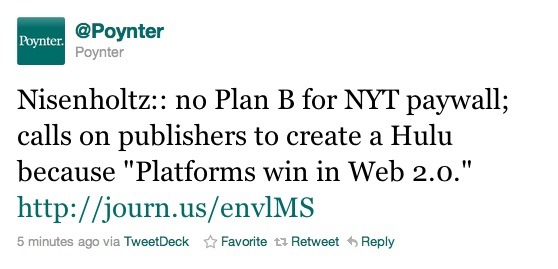
  • » What this all means to you: Now, if you've ever used an iPad, it's pretty clear that the New York Times Web site is as good, if not better than, the NYT iPad app, at least for now. And if they want to further emphasize the tablet-y nature of the iPad, they already have that in the form of Times Skimmer. Furthermore, Apple doesn't take a 30 percent cut out of Web-based subscriptions. Damon Kiesow's perfectly apt reasoning, then, is that the NYT is trying to de-emphasize the App Store by pricing people out of that direction. And you know what? He's right. The NYT Web site will work fine on the iPad. There is an advantage to using NYT's app on your cell phone, so that's kept at a more reasonable cost, but the NYT's plan to focus on the Web over the app? Sneaky.

Posted by Ernie Smith • Permalink

Mar 22 2011W

Politics: New York Times writes puff piece about their paywall model

Some of them even send us checks unsolicited. I have this woman in Canada who’s sent me two $50 checks because she doesn’t understand why she can get our journalism for free. Each time I have to tell her I can’t accept the check.

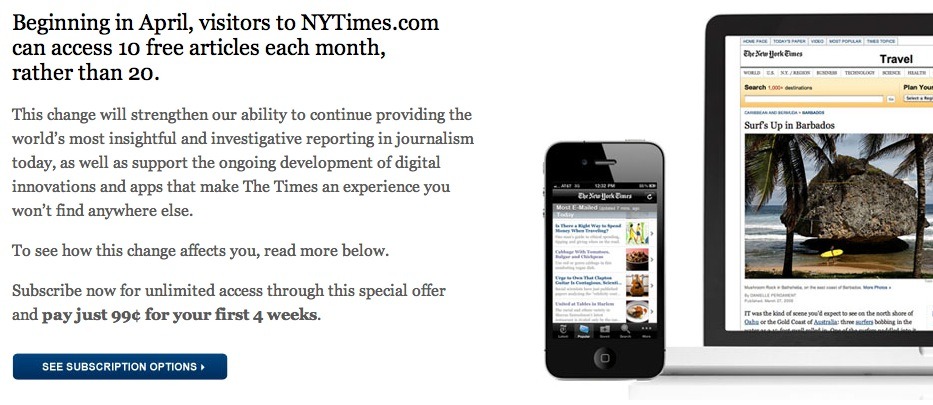
New York Times Corp. Chief Advertising Officer Denise Warren • Discussing the NYT's paywall plan, which hits around the end of the month. Hey, Denise, if you guys won't take the money, we'll put it straight in our pockets! In all seriousness, though, read the piece — it does a great job explaining the mindset of the NYT as they decided to try the paywall model once again. Key thing? Ad money in print is falling, and online isn't keeping up. source

Posted by Ernie Smith • Permalink