Read a little. Learn a lot. • Now Mullenweg-free! • Since 2009
☰

Tag: poynter

13 posts

Apr142013t

As Poynter's Kelly McBride points out, while media coverage of the Kermit Gosnell abortion trial has very…

[Kirsten] Powers, [Conor] Friedersdorf and other critics point out that, given how lurid the details of this case are, it’s surprising that national media outlets haven’t covered it more. It is surprising that more outlets haven’t covered it, but it’s not entirely fair to say that national media haven’t reported on it.

A quick search of the Associated Press archives turns up dozens of articles going back to when the indictment was handed down, AP Spokesperson Paul Colford told Poynter. Likewise, The New York Times ran several stories in 2011 and 2012, both staff-written and AP generated. Although, since the trial began, the Times has only run one story. Philadelphia media, meanwhile, has been covering the case extensivelyfor years.

McBride, in emphasizing the overall issue, puts it like this: “The Gosnell story raises questions about how national media decide when to report on a local story.” Gosnell is charged with multiple counts of murder involving late-term abortions, as well as one case involving the death of a patient.
Posted by Ernie Smith • Permalink

Mar192013t

According to Poynter's Kelly McBride, who has worked for years with survivor advocacy groups on the issue of…

So don’t sign the petition demanding CNN apologize. Instead, draw attention to the good coverage.

ESPN’s Michael Smith and Jemele Hill devoted their entire His & Hers podcast this week to the topic. Hill discussed her own childhood assault as a 12-year-old and the fact that her mother was sexually assaulted as well. They talked about the responsibility parents have to educate their sons and daughters, about the pervasiveness of male entitlement in sports cultures and how difficult it is to achieve justice. Smith explains his sympathy for the convicted boys. Hill describes how she would counsel a teen girl to protect herself in a world that won’t respect her right to say no.

The National Sexual Violence Resource Center tried to draw attention to a study suggesting that more than half of teenagers would find it tough to intervene; 40 percent said they wouldn’t know what to do.

And blogger and former Steubenville resident Alexandria Goddard describes her role in uncovering the documentation of the assault on social media.

It’s not wrong to feel sympathy for two boys crying over their ruined lives. Because of the perceived stigma, we don’t name the victim or see her image. I’m not suggesting that we change that, until victims voluntarily ask us to. But we in the media have to do more to put a face on the victims of childhood rape. We need to find ways to tell their stories, the way David Holthouse did in his moving first-person stories for Westward and This American Life.

“But we in the media have to do more to put a face on the victims of childhood rape.”

Posted by Ernie Smith • Permalink

Feb242012t

When I started planning the site last summer, my plan was to make it more of a general-interest site. Then in…

When I started planning the site last summer, my plan was to make it more of a general-interest site. Then in November, when I left Poynter, I pretty much abandoned that plan to compete against my former employer. Finding a new tagline is on my to-do list.

— Blogger Jim Romenesko • Discussing why his “blog about media and other things I’m interested in” only seems to feature media posts. For a single individual, Romenesko is doing quite well on the blogging front, nearing the level of his former employer, Poynter, all by himself. He’s doing so well that his ad provider, BlogAds, is already talking about raising his rates. Not bad for a guy whose reputation took a public hit (though not without his defenders) a couple of months back.

Posted by ShortFormBlog • Permalink

Dec92011t

How Julie Moos sees Twitter

felixsalmon:

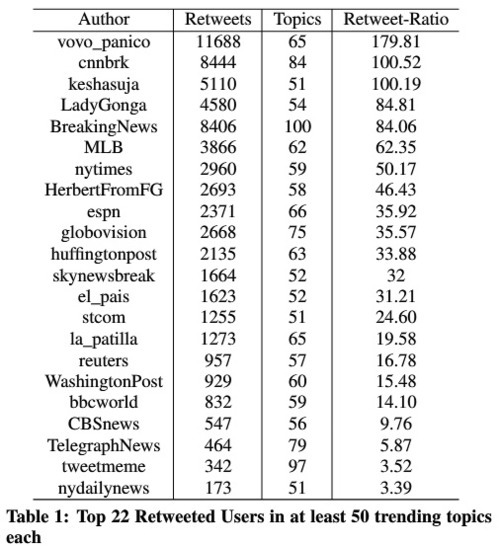
Here’s HP’s list of the most broadly retweeted Twitter accounts:

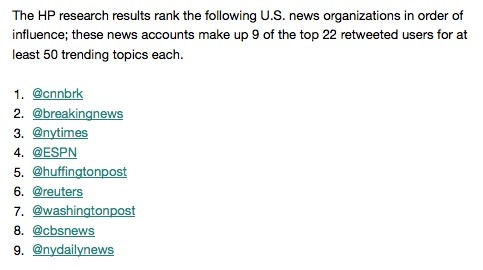
And here’s the way that Julie Moos presents the same list on her Poynter.org blog:

So, the question is, does removing international news organizations and non-news accounts cloud the data? Because we could presumably follow Sky News or the BBC for important information, no matter where we are in the world. And you could conceivably argue that MLB.com is a U.S. news outlet, too. This is a poor way of presenting this info.

Posted by ShortFormBlog • Permalink

Nov232011t

A nice take on the whole Jim Romenesko/Poynter thing from Nieman Journalism Lab, which pulls off the trick of…

Remember when the iPod came out, and a guy at Slashdot famously derided it because it didn’t have the specs he wanted? “No wireless. Less space than a nomad. Lame.

”Or remember when the iPhone came out and the big complaints were it didn’t have a removable battery and you couldn’t install an extra memory card?

What happened was that people actually used iPods and iPhones and found that they’re delightful little devices that are easy to understand, fun to use, and filled with pleasant little surprises. And the checklists fell away, and the human race collectively decided to buy a gajillion of them.

That’s why the journalism world blew up in defense of Romenesko. Because they knew what the Romensko user experience, at its best, was like, and once you know that, the checklist falls away.

The key point we’d like to make about all this: Don’t be stingy with the links, guys. It frustrates users and limits the experience. As the article points out, Romenesko/Poynter posts Nieman stuff a lot, but their traffic levels fell heavily after the aggregation style changed to longer pieces. There’s a reason why we prominently source everything — because if we didn’t, we wouldn’t be doing our job. (For what it’s worth: Poynter linked to us over the weekend, and it was a nice little boost. But all we got was a link.)

Posted by ShortFormBlog • Permalink

Nov202011t

How I ended up leaving Poynter

longformorg:

The Starbucks-fueled saga of how Jim Romenesko, beloved journalism blogger, took an early retirement.

Jim Romenesko | jimromenesko.com | Nov 2011

For a lot of folks, this is inside baseball. Poynter isn’t that big of a deal outside of journalism circles. But it’s really interesting inside baseball about a respected figure. The key line from this whole thing, which explains how journalism’s most beloved linksmith ended up leaving his platform of note? This one: “I was one of the few journalism town criers on the Internet a decade ago; now every news junkie with a Facebook page and Twitter feed is shouting out stories about the news business.”

Posted by ShortFormBlog • Permalink

Nov122011t

My examples bolded the words in each Poynter post that matched the words of the source. While this had the…

My examples bolded the words in each Poynter post that matched the words of the source. While this had the effect of highlighting some confusing or incomplete attributions, my main point was quite different: that these aggregated posts didn’t offer any original thought or valuable synthesis of source materials; they’re merely condensed versions of the original. You can see that this was my main intent in the below example, where I bolded material Jim Romenesko rendered inside of quotes; while those portions raise aggregation issues, they clearly don’t raise attribution issues

— CONFIRMED: it’s all about Moos. CJR is blameless. The Romenesko Saga : CJR (via felixsalmon)

Oh jeez, what are you doing Romenesko?

Posted by ShortFormBlog • Permalink

Nov102011t

On The Romenesko Non-Scandal

fek:

This is handily the stupidest accusation/insinuation of plagiarism I’ve ever seen, and like everyone else, I think it’s the highest of journalism treason short of simply making shit up and take it seriously. But attacking Jim Romenesko is like attacking Green Tea for its caffeine content. Almost a unilateral consensus of media writers and press critics are standing up to this as absolutely bush league, rightly so. Poynter took CJR’s trolling seriously, and it’s going to cost them their sole draw. An edited Jim Romenesko might make for a worse blog than the one he’s running, and why do that when he can just go to Reuters and make a grip more? Also, if Jim’s guilty of something here, what do these guys think of, like, Business Insider or Playbook? C’mon, for fuck’s sake.

Sounds like someone doesn’t understand the idea of aggregation. If we were Poynter, we’d ignore the CJR’s article and reverse course.

Posted by ShortFormBlog • Permalink

Sep222011t

Poynter's Julie Moos nails it with this Storify mashup of the Troy Davis thing — especially the intro.

As an execution nears, journalism’s focus is appropriately on the specifics of that situation: the crimes and evidence, the families. But a brief mention or count of protesters outside the prison does an injustice to the facts and deeply-held beliefs that belong in a civic discussion of the death penalty. When do journalists give that discussion the time and space it deserves? The Storify below captures the related journalistic issues that arose Wednesday night as Troy Davis faced death.

Why don’t we cover the details of death penalty cases like this? Like, in full? Why does our collective big-media ADD only focus on the moment beforehand? Is it because there are too many cases? Too many stories that deserve our attention more? And where does the debate about the supporters and detractors fit into the whole thing? There are a lot of thoughts to keep in mind about all this, but as a journalistic society, we have selective viewing habits. Instead of focusing on the peak points, why not focus on the 22 years between Davis’ alleged crime and his execution? It’s something this site needs to work on, but it’d be easier if other news outlets took lessons from this.

Posted by ShortFormBlog • Permalink