Read a little. Learn a lot. • Now Mullenweg-free! • Since 2009
☰

Tag: aggregation

7 posts

Apr222012t

They said that they felt as if they were out there alone in digital land, under high pressure to get Web…

They said that they felt as if they were out there alone in digital land, under high pressure to get Web hits, with no training, little guidance or mentoring and sparse editing. Guidelines for aggregating stories are almost nonexistent, they said. And they believe that, even if they do a good job, there is no path forward. Will they one day graduate to a beat, covering a crime scene, a city council or a school board? They didn’t know. So some left; others are thinking of quitting.

— The Post fails a young blogger (via frontofbook)

With some disclosure (I work for the Washington Post Company, but not at the Post proper) I’ll say that this whole situation is a real heartbreaker. My hope is that the Post can figure out a way to balance the need for fast-paced aggregation with its high journalistic standards. Worth reading is Ombudsman Patrick Pexton’s previous article on the subject. (He wrote this piece, too.) I don’t agree with every point he makes here, but I think that he’s pointed out an important issue — how high pressure, as is common with blogging trending news stories, puts bloggers at a disadvantage. — Ernie @ SFB
Posted by ShortFormBlog • Permalink

Nov232011t

A nice take on the whole Jim Romenesko/Poynter thing from Nieman Journalism Lab, which pulls off the trick of…

Remember when the iPod came out, and a guy at Slashdot famously derided it because it didn’t have the specs he wanted? “No wireless. Less space than a nomad. Lame.

”Or remember when the iPhone came out and the big complaints were it didn’t have a removable battery and you couldn’t install an extra memory card?

What happened was that people actually used iPods and iPhones and found that they’re delightful little devices that are easy to understand, fun to use, and filled with pleasant little surprises. And the checklists fell away, and the human race collectively decided to buy a gajillion of them.

That’s why the journalism world blew up in defense of Romenesko. Because they knew what the Romensko user experience, at its best, was like, and once you know that, the checklist falls away.

The key point we’d like to make about all this: Don’t be stingy with the links, guys. It frustrates users and limits the experience. As the article points out, Romenesko/Poynter posts Nieman stuff a lot, but their traffic levels fell heavily after the aggregation style changed to longer pieces. There’s a reason why we prominently source everything — because if we didn’t, we wouldn’t be doing our job. (For what it’s worth: Poynter linked to us over the weekend, and it was a nice little boost. But all we got was a link.)

Posted by ShortFormBlog • Permalink

Nov212011t

On taking screenshots of a story

nostrich replied: Uh, guys, screenshotting the entire contents of an article? That’s no better than HuffPo-style over-aggregation. Uncool.

  • » SFB says: While it’s fair to note that in some instances we’ve probably screenshotted a little more than we should have, a couple points to that: 1) We link the article prominently both in the text and the image, 2) News articles tend to update, and the story itself may look different a couple of hours from now. Often it’s a quick art element in the case of a breaking news story where art wouldn’t otherwise be available. In the case of the Ben Parr article this was a reply to, the news had just broken, so it’s entirely possible that’ll be the case, especially if, for example, they get a Mashable staff member on record. (The story had already changed once.) In the future, we’ll try to be careful about how much we screenshot, though. — Ernie @ SFB

Posted by ShortFormBlog • Permalink

Nov102011t

On The Romenesko Non-Scandal

fek:

This is handily the stupidest accusation/insinuation of plagiarism I’ve ever seen, and like everyone else, I think it’s the highest of journalism treason short of simply making shit up and take it seriously. But attacking Jim Romenesko is like attacking Green Tea for its caffeine content. Almost a unilateral consensus of media writers and press critics are standing up to this as absolutely bush league, rightly so. Poynter took CJR’s trolling seriously, and it’s going to cost them their sole draw. An edited Jim Romenesko might make for a worse blog than the one he’s running, and why do that when he can just go to Reuters and make a grip more? Also, if Jim’s guilty of something here, what do these guys think of, like, Business Insider or Playbook? C’mon, for fuck’s sake.

Sounds like someone doesn’t understand the idea of aggregation. If we were Poynter, we’d ignore the CJR’s article and reverse course.

Posted by ShortFormBlog • Permalink

Aug242011t

Big news in the world of media pixel-pushing: Jim Romenesko, the longtime Poynter scribe who's been…

In Jan. 2012, Romenesko will launch his own site – JimRomenesko.com – and become a part-time staffer for Poynter. He’ll post casually to the media-news blog, the soon-to-be renamed “Romenesko+,” and will continue tweeting from the @romenesko and @poynter Twitter accounts. Poynter’s Julie Moos, Steve Myers and Jeff Sonderman will also contribute to the revamped Romenesko blog.

In an interview with The Huffington Post, the 57-year-old journalist said he’s been thinking about doing something new for awhile and must have gotten the “12-year itch.” (He left Milwaukee magazine after 12 years, too). “I went back and forth to renewing (my contract), not renewing,” Romenesko said. “In the end, I decided I wanted to go back and do my own blog, the way I was before Poynter picked me up.”

This guy was a huge inspiration to me when starting the site. Will be sad to see a little bit less of his work at Poynter. He’s one of the real trailblazers in this field.

Posted by ShortFormBlog • Permalink

Feb92011W

Biz: Did the TV guys win? How fast-flying TBD got its wings clipped

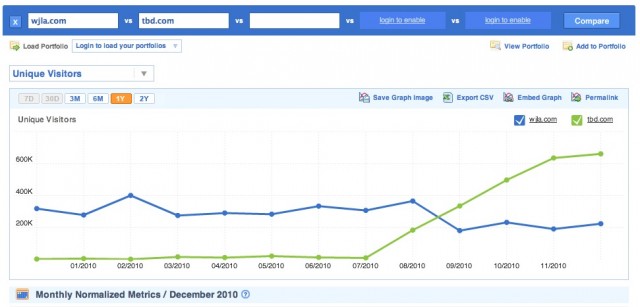
  • Above is a quick Compete.com chart comparing DC media outlets Wjla.com to TBD.com through December. See something notable here? Yeah, we do too. WJLA.com has slightly lower traffic than it did six months ago. But TBD has come out of nowhere to effectively triple the amount of traffic WJLA was getting. Which is pretty amazing, if you think about it – an effective rebranding greatly expanded Allbritton's reach. (Both are effectively dwarfed by The Washington Post, but the Post has a national reach whereas the Allbritton-owned sites skew local.) And TBD's editor Erik Wemple says January was the site's best month ever. Despite this, though, WJLA effectively won the battle for media presence in Allbritton's corporate structure. How did this happen?
  • HoW TBD BECAME TBD Allbritton, which also owns Politico, said it planned to launch a local news site last year. They brought on Jim Brady, a former Washington Post and AOL guy, who crafted a vision of a local news brand that worked across the board – in broadcast, on cable TV and online. It launched six months ago to much industry attention for its HuffPo-like approach to local news.
  • The visionary, out Unfortunately, corporate culture hurt the site right off the bat. Only a year after Brady started with Allbritton, he was out, a victim of a debate over aggregation (which TBD is really good at) vs. original reporting. "As we talked about the next phase of our growth, it seemed clear to Jim and I both that we had some stylistic differences," wrote publisher Robert Allbritton.
  • Did The TV Guys win? Now, just six months after TBD launched, it appears that the folks at WJLA control TBD's destiny. The TBD TV component (on cable) is effectively going away. WJLA.com, the former site, is coming back alongside TBD. And WJLA's general manager, Bill Lord, will be taking over as head of each of the local news entities. It appears the old-schoolers won. source
  • » Bloodletting on Twitter: Jim Brady, an active tweeter, has been ripping his old company over the last day or so over the decision to restructure. In his harshest tweet, he offered this sentiment: "At good companies, the people who resist necessary change are pushed aside. At bad companies, they are put in charge. RIP, the old TBD." There is a degree of universal-ness to what he has to say, and many have been made their feelings known about the matter on Twitter today. While it's certainly not the worst decision a company has made, TBD's restructuring reflects a debate happening in newsrooms around the world: Is change needed? Or is the status quo more effective? Allbritton appears to have chosen the latter route, despite, you know, the chart above.

Posted by Ernie Smith • Permalink