Read a little. Learn a lot. • Now Mullenweg-free! • Since 2009
☰

Tag: blogging

49 posts

Jun 7 2012t

WordPress Integrates Tumblr to Compliment, Not Compete

curiousontheroad:

WordPress is finally integrating its blogging platform more closely with social networking sites. A new publicize feature allows users to link various social media accounts to their WordPress blogs. Previously, users had plugins they could install that allowed them to cross-post their articles.

daniscalifornia wonders, however:

do you have a distinct use case for Tumblr/Wordpress, and would it make sense to post Wordpress blogs onto Tumblr?

I use my Tumblr to curate stuff written by others - mostly journo/tech news links and quotes, and my personal blog to write longer pieces (700+ words) sometimes about journalism but often personal or creative writing. So it’s important for me to have both, right now.

I think WordPress coudln’t sit idly by for much longer while Tumblr traffic is skyrocketing. Let’s face it: A lot of the conversation that used to happen through blogs is now happening on social media. Blogs are becoming more of a home base for longer articles, as Dani says. But those articles are spread through social media, and making that easier from WordPress is overdue.

Kind of curious as to what this kind of addition means. We use a kind of hacked-together WordPress plugin to do kind of the same thing, but I imagine what we use is far more customizable than WordPress’ own option. Appears to only be WP.com for now.

Posted by ShortFormBlog • Permalink

Tags for this post

Jun 3 2012t

On "curation" and getting caught up in terms

idroolinmysleep:

“So like there’s nothing for you to curate without creation? This precious bit of dressing-up what people choose to share on the Internet is, sure, silly, but it’s also a way for bloggers to distance themselves from the dirty blogging masses. You are no different from some teen in Indiana with a LiveJournal about cutting. Sorry folks! You’re in this nasty fray with the rest of us. And your metaphor is all wrong. More likely you’re a low-grade collector, not a curator.” —

Choire Sicha: You Are Not a Curator, You Are Actually Just a Filthy Blogger

Gonna curate some links in the meantime.

Saw this yesterday, found it to be a bit of a talker, wanted to write up a response. First up: Choire has been at this long enough (he worked at Gawker nearly a decade ago) that he’s arguably an elder statesman of blogging, along with folks like Andrew Sullivan, Josh Marshall and a couple of others. That automatically makes his opinion valid enough that we should listen, but I’m sure in a lot of ways it gives him a different take on this whole thing than someone who got into this in, say, 2008 or 2009.

So let’s take on this term. “Curation.” The first time I ever heard someone use the term in relation to Web content was in 2009, when Robert Scoble wrote this great piece about how “curation” was going to be a billion-dollar industry, once someone figured out a killer product that made it really stupidly simple to organize our thoughts into one piece. Not long after that, we got Storify, and, separately, Tumblr sort of became the place for this style of link sharing. I don’t see a billion dollars yet, but the basic idea seems to be catching on. (And no, it’s nothing like curating art. Big deal.)

But here’s the thing: I don’t think anyone is actually trying to “class up” their work by using this term. (Well, maybe except for the dude quoted in Choire’s piece.) These “curators” are just using different techniques than people were using a decade ago, and someone threw out that term one day, and it stuck.

And it’s happened before, too. Do you know how long pre-digital journalists bristled at the term “blogger” around 2004? I’m sure there’s some middle-aged newspaper columnist somewhere who once wrote a column titled “You Are Not a Blogger, You Are Actually Just a Terrible Journalist.” Do we need to rehash the purist’s argument every time someone does something a little differently? I’m sure the telegraph guys were pissed when they were shown the telephone for the first time.

So let’s get down to it: You’re not a curator, but then you’re not a blogger, either. You’re just a person with an internet connection who uses it to communicate. The quality of the information you share, report, or comment on is what matters. Not the term. — Ernie @ SFB

Posted by ShortFormBlog • Permalink

May 30 2012t

Recently, Business Insider — particularly editor Henry Blodget and superhuman deputy editor Joe Weisenthal…

Even with a journalism-lite approach to the news, where reporters post as many as 15 news stories a day based largely on work by rival reporters - there’s not much money to be made. It’s a poor way to make a living.

Mr Blodget is not lighting cigars with hundred dollar bills and stubbing them out on the backs of hard working journalists doing original reporting elsewhere.

In 2010, Business Insider had its first profitable year, it made $2,127 on revenues of $5 million. Even by rewriting other people’s news stories there is barely any money to be made - so how can quality journalism be supported?

First off, we recommend you read The New York Times’ piece on Weisenthal — that guy has more obsessive work habits than all of us, combined. (Then, when you’re done, read Blodget schooling a college professor.) Weisenthal’s habits show an issue with modern journalism in general. It’s all about getting as many pageviews as possible, no matter how stressful that proves to be in practice and how much that limits your quality control. “Henry Blodget and the Business Insider editorial team aren’t the ones responsible for the poor state of journalism today,” Foremski says, “they are merely the expression of what’s currently possible given the means available - which isn’t much, a whole lot of nothing much (about 250 news stories a day at Business Insider).” Foremski suggests the current model of advertising — obsessed with pageviews over quality — is the problem.

Posted by ShortFormBlog • Permalink

May 10 2012t

As an update to our post from last night about the possible sale of TechCrunch's parent company AOLTech, AOL…

“We don’t have any interest in selling TechCrunch or Engadget,” he said firmly. “Our number one goal basically has been to scale them up. At this point, it’s likely we’ll just end up investing ourselves.”

TechCrunch itself covered the rumors, saying that the situation was rooted in a stunted spinoff and suggesting PandoDaily, run by former TC staffer Sarah Lacy, got caught up in its own issues when reporting the story: “We figure this story got skewed because PandoDaily is going through its own troubles, and looking for a target to project its drama onto; Sometimes not wanting to seem weak makes you seem weak.”

Posted by ShortFormBlog • Permalink

Apr 22 2012t

They said that they felt as if they were out there alone in digital land, under high pressure to get Web…

They said that they felt as if they were out there alone in digital land, under high pressure to get Web hits, with no training, little guidance or mentoring and sparse editing. Guidelines for aggregating stories are almost nonexistent, they said. And they believe that, even if they do a good job, there is no path forward. Will they one day graduate to a beat, covering a crime scene, a city council or a school board? They didn’t know. So some left; others are thinking of quitting.

— The Post fails a young blogger (via frontofbook)

With some disclosure (I work for the Washington Post Company, but not at the Post proper) I’ll say that this whole situation is a real heartbreaker. My hope is that the Post can figure out a way to balance the need for fast-paced aggregation with its high journalistic standards. Worth reading is Ombudsman Patrick Pexton’s previous article on the subject. (He wrote this piece, too.) I don’t agree with every point he makes here, but I think that he’s pointed out an important issue — how high pressure, as is common with blogging trending news stories, puts bloggers at a disadvantage. — Ernie @ SFB

Posted by ShortFormBlog • Permalink

Apr 2 2012t

Gage Skidmore: How one teenager gives the GOP its Flickr close-up

image

You don’t know him, but you’ve seen his work: The rise of Creative Commons has leveled the playing field for bloggers, giving many the opportunity to illustrate stories with free-to-use images that are at times comparable to wire photos. But the quality varies, and it’s rare to find someone sharing high-quality pictures consistently — but Gage Skidmore pulls it off. The 18-year-old photographer, who shoots celebrities and conservative politicians largely as a hobby, has uploaded nearly 9,000 photos to Flickr since early 2008, and thanks to favorable licensing, finds his photos of famous and important people in use all over the Web — including such sites as MSNBC, Fox News, The Atlantic and Mashable. What drives his work? Click on to see his take on the matter.

How he got started in photography

  • Why he does it “I was inspired to take photos of various political figures and celebrities because of my own personal interest in seeing good, quality photos at the various events that I have had the pleasure of attending,” he said. His efforts have taken him to such political events as CPAC and the Values Voter Summit, as well as pop-culture events like San Diego’s Comic-Con.
  • His politics Skidmore, who describes his politics as “pretty much in line with the constitutionally conservative principles that such people as Ron Paul and Rand Paul represent,” says that he got his start shooting politics in 2009, with his first subject being the Kentucky senator. Skidmore says he largely supports the Republican platform on domestic and social issues.
  • His current work Since graduating high school, he took a year off before college to cover political events around the country, including such electoral hotbeds as Washington DC, Iowa and New Hampshire. (It is an election year, after all.) Skidmore was even recognized at the most recent CPAC by someone at the American Enterprise Institute who commonly uses his photos.

Why he gives away his work

I always enjoy seeing my photos being used by people, which is the main reason why I freely license them. The more people use my photos, the better. Crediting me is just icing on the cake.

Gage Skidmore • Discussing why his freely offers his work to others under a Creative Commons license. The license he uses, Attribution-ShareAlike 2.0 Generic, allows for free use and adaptation of his work for all uses, including commercial. As a result, many of his images show up on Wikimedia Commons for use on Wikipedia. This does not preclude his getting paid for the work, however — in fact, he’s received compensation in the past from a number of publications, and Sen. Rand Paul himself paid to use one of Skidmore’s images in the senator’s 2011 book, “The Tea Party Goes to Washington.” Skidmore’s trips around the country and camera equipment upgrades have partly been paid for through the use of donations, some of which he’s asked for on sites such as Daily Paul.

His favorite subject

image

“Ron Paul, by far”: While Skidmore, beyond taking photos, largely doesn’t interact with his photo subjects (which recently included — when he took photos at WonderCon in Anaheim, Calif. — the cast and crew of “Community”), if he had to choose a favorite person to shoot, it’d be Ron Paul. “He is just such a kind hearted person who’s only intention is to spread the message of freedom throughout the country, which is a tough task at any age, but to be 76 and be as energetic and enthusiastic as he is is remarkable,” he says. “Even I can hardly keep up with him.” It helps, he says, that Paul always carries a smile on his face. “That makes my job much, much easier.”

How you can do what he does

Photo pass: Not needed. While Skidmore travels to a number of venues to get his photos, his process of actually getting the shots he needs once he’s at the events doesn’t sound particularly difficult — he says that most of the events he goes to are free to enter. “My advice to people looking to get into political photography is to simply dress professionally, and get the best photography equipment you can afford,” he suggests. “Then practice, practice, practice.” Skidmore may be known for his photography, but that doesn’t mean it’s a career choice — surprisingly, he dislikes taking photos. “My only enjoyment in photography is seeing my photos afterwards being received positively,” he says, saying that he enjoys the wide audience they receive as well as the people he meets as the result of his work. Our take: If he ever chooses to go pro, he could totally do it — and possibly charge a few bucks along the way. (photos by Gage Skidmore) source

Posted by ShortFormBlog • Permalink

Mar 2 2012t

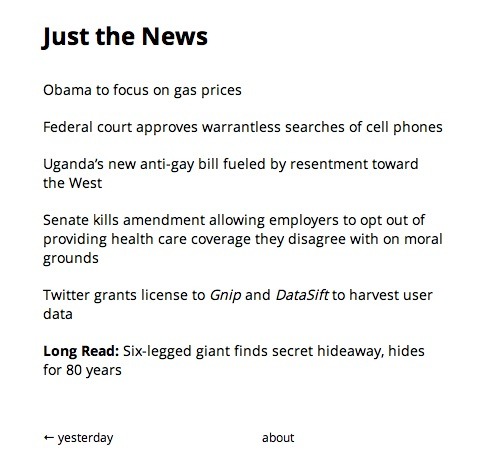
See all that stuff around the text? It’s white space.

New to the neighborhood: JustTheNe.ws

See all that stuff around the text? It’s white space. Tumblr user Max Temkin’s new news project is quick info minus clutter, updated once a day. “I’ve always wished I could get my news on a plain white page with a few well-curated stories; no ads, no social media, no comments,” he writes. “I got tired of waiting for someone to build that page, so I made it myself.” Minus the newspaper, this reminds us of the approach of the old Frontpages tumblr (whose loss we’re still upset about and we miss greatly). Just the links. Nothing more, nothing less. Give it a follow.

Posted by ShortFormBlog • Permalink

Jan 17 2012t

We’d love to try Pinterest

ireportcnn:

5 Ways Journalists Can Use Pinterest - 10,000 Words

some of these ideas feel forced (teasers), but others are spot on (showcasing features and staff, and user participation, of course).

We’d love to try Pinterest for some of these ideas. We’re bothered, though, that they haven’t validated its journalistic use by putting in categories for news and politics, meaning that if we were to use it for this reason, it’d be hard for people to find it because it doesn’t fit neatly in any of the other main categories. But Pinterest is clearly where things are going: We’ve run into numerous people who have never used Tumblr or Twitter who are singing the praises of Pinterest. Clearly they’ve hit an untapped market here.

Posted by ShortFormBlog • Permalink

Jan 12 2012t

This article references Jerry Pournelle,

thisistheverge:

Who Word-Processed First? Professor’s History Has Writers Staking Their Claims - NYTimes.com

“I think there’s a great deal of nonsense about computers and writers,” Hersey, who died in 1993, told The Paris Review. “The machine corrupts the writer, unless you write with a pencil you haven’t chosen the words, and so on. But it has made revision much more inviting to me.”

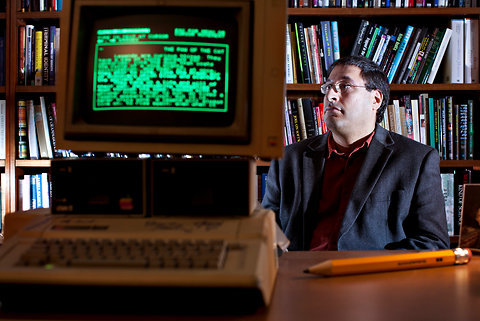
This article references Jerry Pournelle, who was a pretty awesome columnist for Byte Magazine back in the day. He apparently has a claim to being one of the first writers to use a word processor to write a book; he has a similar claim to possibly being the first blogger. Read up on him; he’s awesome.

Posted by ShortFormBlog • Permalink

Dec 5 2011t

Advice for Aspiring Bloggers

onaissues:

Advice for aspiring bloggers from Nicolas Lazaro of The Bengal Stripe

Whatever blogs you read now, don’t try to emulate them. Know yourself, know what you like, and build an online identity based off of that. Keep away from fads and anything that doesn’t fit with who you are, and create some real content; don’t just post pictures that you think are cool. …Lastly, there will be a dry patch at first unless you’ve had a running start, just stick with it and if it’s something you truly enjoy, eventually other people who enjoy it will find it too. None of your favorite blogs started out with thousands of readers, they got to where they are by being real and by being smart.”

Via Om Malik.

This is really good advice. Do what you do, be yourself, create cool things, and don’t worry about the other guy.

Posted by ShortFormBlog • Permalink