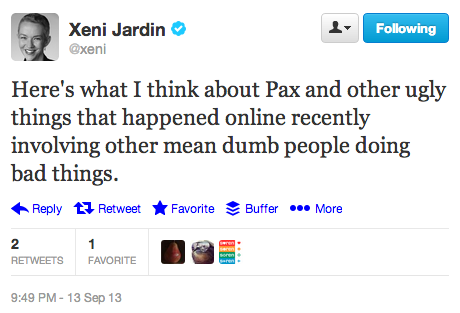



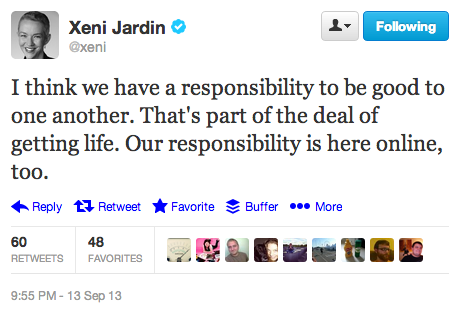

Boing Boing’s Xeni Jardin, speaking truth on trolls like Pax Dickinson.
 ShortFormBlogRead a little. Learn a lot. • Now Mullenweg-free! • Since 2009
6 posts
Posted by Ernie Smith • Permalink
Before Dickinson’s reported resignation, it seemed his behavior online was the ultimate test of the ‘my views on Twitter do not reflect those of my employer’ defense.
— “Controversial CTO Pax Dickinson Is Out at Business Insider,” The Atlantic Wire.
Behind this link are examples of this guy’s racist, homophobic, Tucker Max-style tweeting skills. You could literally create a Public Shaming-style site out of his posts. (But that doesn’t mean Public Shaming isn’t already on the case.)
Posted by Ernie Smith • Permalink
There are many sections in this lengthy article that are worth reading, but this one says more about Mayer’s leadership style than anything else here:
For the 30 people sitting around the table, their first meetings with Mayer over the past month had been terrifying.
For years, Yahoo had been a place where the CEO was a distant figure who would meet with various members of his or her executive leadership team to lay out broad strategies for each function: design, technology, product, etc.
Mayer skipped all that.
“She was like ‘yeah, yeah, yeah. We’ll get to that. Let’s first get some stuff out the door that actually works,’” says a witness to those early days.
It was a level of energized scrutiny none of them were used to.
Mayer came at them with “a voracious flood of possibilities” about what the new products could look like. Her ideas were both big and small — minute even. Mayer displayed such a “profound capacity for detail,” that the leadership in the room finally set up the two transcribers so that later they could “share and dissect” all of Mayer’s ideas and decisions.
One of them remembers thinking: “Who is this woman and what is she actually saying?”
Mayer was pushing through a new redesign of the Yahoo Mail app. It was going through, fast. The team she was leading had to catch up, quick. And the focus on creating amazing products such as what’s shown here is really just the thing that nails it. It took me about an hour to read this piece, and it was worth every word. If you think Business Insider is kind of a lame site, this article may very well change your mind.
Posted by Ernie Smith • Permalink
Even with a journalism-lite approach to the news, where reporters post as many as 15 news stories a day based largely on work by rival reporters - there’s not much money to be made. It’s a poor way to make a living.
Mr Blodget is not lighting cigars with hundred dollar bills and stubbing them out on the backs of hard working journalists doing original reporting elsewhere.
In 2010, Business Insider had its first profitable year, it made $2,127 on revenues of $5 million. Even by rewriting other people’s news stories there is barely any money to be made - so how can quality journalism be supported?
First off, we recommend you read The New York Times’ piece on Weisenthal — that guy has more obsessive work habits than all of us, combined. (Then, when you’re done, read Blodget schooling a college professor.) Weisenthal’s habits show an issue with modern journalism in general. It’s all about getting as many pageviews as possible, no matter how stressful that proves to be in practice and how much that limits your quality control. “Henry Blodget and the Business Insider editorial team aren’t the ones responsible for the poor state of journalism today,” Foremski says, “they are merely the expression of what’s currently possible given the means available - which isn’t much, a whole lot of nothing much (about 250 news stories a day at Business Insider).” Foremski suggests the current model of advertising — obsessed with pageviews over quality — is the problem.
Posted by ShortFormBlog • Permalink

Today in smug bastards we want to punch in the face. Could imagine his potential line of reasoning now. “What if we took two of the most addictive things in the world and put them together?” Great idea, goat-killer!
Posted by ShortFormBlog • Permalink
We only did only $5 million of revenue last year ($4.8 million, to be precise, of which most came from advertising). And, yes, $5 million of revenue is pretty puny in general. It’s less than a single big network news anchor gets paid in a single year, for example.
But $5 million of revenue is a lot more revenue than we did three years ago ($39,495). And we’re a few years younger than those other digital guys mentioned above. And we’re on a similar trajectory.
How sad is it that Business Insider, which has some of the most questionable ad-bait methods in the industry (see the slideshows) only makes $5 million in revenue? Sure, it’s $5 million more than anyone on Tumblr is making, but their entire business model is based around making as much money as possible.
Posted by ShortFormBlog • Permalink