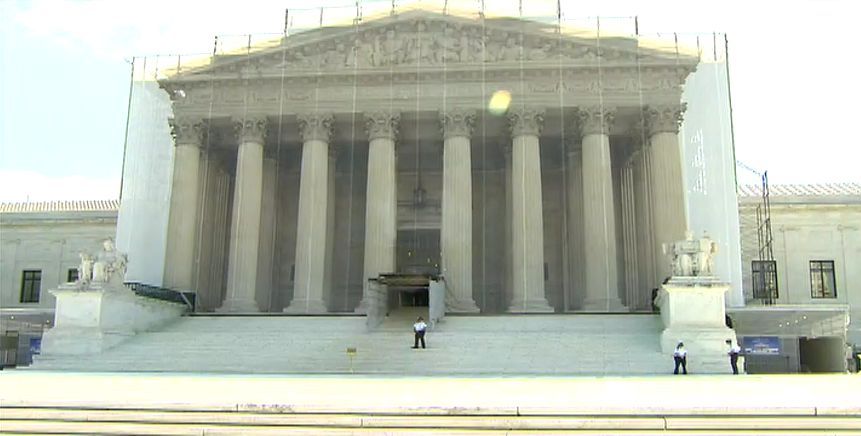
BREAKING NEWS: Supreme Court strikes down #DOMA, the federal Defense of Marriage Act
More forthcoming, but … a fairly big start to the day.
 ShortFormBlogRead a little. Learn a lot. • Now Mullenweg-free! • Since 2009
215 posts
BREAKING NEWS: Supreme Court strikes down #DOMA, the federal Defense of Marriage Act
More forthcoming, but … a fairly big start to the day.
Posted by Ernie Smith • Permalink
DOMA singles out a class of persons deemed by a State entitled to recognition and protection to enhance their own liberty.
— The majority opinion in the Supreme Court’s ruling on the Defense of Marriage Act. SCOTUS has decided DOMA is unconstitutional.Read more at NPR’s The Two-Way. (via npr)
This seems like a pretty historic one right here.
Posted by Ernie Smith • Permalink
This case is about power in several respects. It is about the power of our people to govern themselves, and the power of this Court to pronounce the law. Today’s opinion aggrandizes the latter, with the predictable consequence of diminishing the former. We have no power to decide this case. And even if we did, we have no power under the Constitution to invalidate this democratically adopted legislation.
Posted by Ernie Smith • Permalink
The Ninth Circuit was without jurisdiciton to consider the appeal. The judgment of the Ninth Circuit is vacated, and the case is remanded with instructions to dismiss the appeal for lack of jurisdiction.
California gays can get their marriage on again.
(via waitingonoblivion)
It’s not everything that same-sex marriage proponents wanted—it avoids a ruling on the larger issue, for one thing—but it’s a victory nonetheless.
Posted by Ernie Smith • Permalink
Federal courts have authority under the Constitution to answer such questions only if necessary to do so in the course of deciding an actual “case” or “controversy.” As used in the Constitution, those words do not include every sort of dispute, but only those “historically viewed as capable of resolution through the judicial process.” This is an essential limit on our power: It ensures that we act as judges, and do not engage in policymaking properly left to elected representatives.
For there to be such a case or controversy, it is not enough that the party invoking the power of the court have a keen interest in the issue. That party must also have “standing,” which requires, among other things, that it have suffered a concrete and particularized injury. Because we find that petitioners do not have standing, we have no authority to decide this case on the merits, and neither did the Ninth Circuit.
Bolded for emphasis.
Posted by Ernie Smith • Permalink
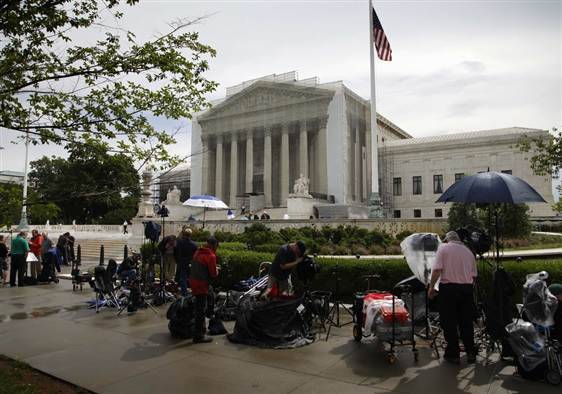
BREAKING: Supreme Court strikes down a key part of 1965 Voting Rights Act
(Photo: Jonathan Ernst / Reuters, file)
Live SCOTUSblog offers latest details.
Chief Justice John Roberts, in his opinion on the case: “Nearly 50 years later, [the rules laid out by the Voting Rights Act] are still in effect; indeed, they have been made more stringent, and are now scheduled to last until 2031. There is no denying, however, that the conditions that originally justified these measures no longer characterize voting in the covered jurisdictions.”
Thoughts?
Posted by Ernie Smith • Permalink
It falls upon congress to decide on a new formula–essentially, to figure out which states should still require federal approval to change their voting laws. Given how congress is these days, we’re exceedingly doubtful that any agreement will be reached anytime soon. source
Posted by Seth Millstein • Permalink
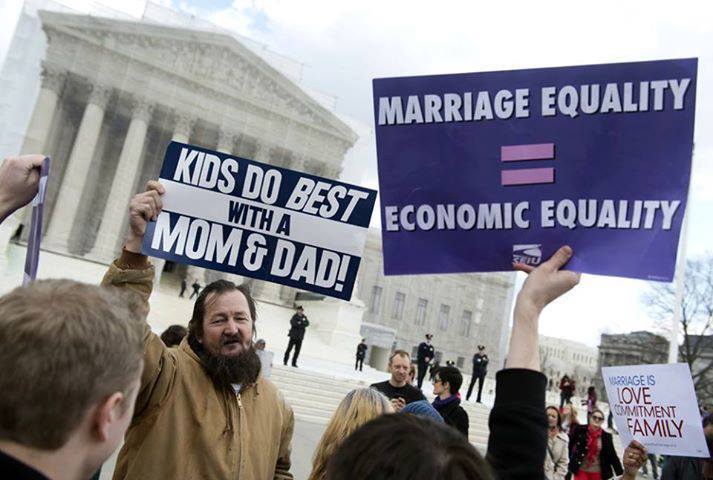
Same-sex marriage opponents plan for DOMA ruling, weigh constitutional challenge (Photo: Saul Loeb / AFP – Getty Images file)
Opponents of same-sex marriage prepare for their next chapter as they await highly-anticipated Supreme Court rulings on the Defense of Marriage Act and California’s Proposition 8. If the decisions aren’t in their favor, they say they may pursue an amendment to the U.S. Constitution defining marriage as between a man and a woman.
Anyone seeing them actually being able to pull off such an amendment? Here’s what it would take, according to Wikipedia:
Before an amendment can take effect, it must be proposed to the states by a two-thirds vote of both houses of Congress or by a convention (known as an Article V convention) called by two-thirds of the states, and ratified by three-fourths of the states or by three-fourths of conventions thereof, the method of ratification being determined by Congress at the time of proposal. To date, no convention for proposing amendments has been called by the states, and only once—in 1933 for the ratification of the twenty-first amendment—has the convention method of ratification been employed.
The first route is unlikely considering the current makeup of the Senate in particular. The second route is unlikely because it would require a lot of movement at a grassroots level to make it happen.
Posted by Ernie Smith • Permalink
The Supreme Court on Monday ordered lower courts to take a fresh look, under a more demanding standard, at the race-conscious admissions policy used to admit students to the University of Texas. The 7-to-1 decision was simultaneously modest and significant, and its recalibration of how courts review the constitutionality of affirmative action programs is likely to give rise to a wave of challenges to admissions programs at colleges and universities nationwide.
For now, the Texas program and other affirmative action programs can continue without changes.
See the full ruling here.
Posted by Scott Craft • Permalink
The Supreme Court ruled Monday against an Arizona ballot measure requiring new voters to present proof of citizenship before being added to the voting rolls — but the justices dodged the question of whether states could ever impose such a requirement without federal approval.
The justices ruled, 7-2, that Arizona’s effort to establish proof-of-citizenship requirements for new voters ran afoul of the so-called “motor voter” law Congress passed in 1993. That law, the National Voter Registration Act, allows for mail-in voter registration on a federal form that allows applicants simply to swear that they are U.S. citizens eligible to vote.
Arizona voters created the proof-of-citizenship requirement as part of Proposition 200, a ballot measure passed in 2004, 56 percent to 44 percent.
It’s important to note that this isn’t necessarily the end of discussion on the matter, as today’s Supreme Court ruling essentially offers Arizona another route through which the state could attempt to implement the new regulation. Still, future passage seems unlikely given that the state of Arizona would need approval from the federal government to implement the proof-of-citizenship requirement.
Posted by Scott Craft • Permalink