Read a little. Learn a lot. • Now Mullenweg-free! • Since 2009
☰

Tag: nuclear energy

40 posts

Nov 24 2013t

By the numbers: Quick stats on the Iran nuclear deal that was just reached

  • 5% the maximum level at which Iran can enrich its uranium, per the agreement; anything over that level (such as the 20 percent weapons-grade uranium the country has) must be diluted
  • zero the number of nuclear centrifuges Iran can build after the agreement passes; any of the 8,000 that the country currently has but are non-operational cannot be turned on, but those in operation won’t need to be dismantled
  • $6B+ the amount in sanctions relief the U.S. will offer Iran in exchange for the initial nuclear deal—an amount small enough that an executive order can do the trick
  • six the number of months the new deal buys the negotiators as far as creating a more in-depth deal

Posted by Ernie Smith • Permalink

Nov 24 2013t

Accord reached with Iran to halt nuclear program

The United States and five other world powers announced a landmark accord Sunday morning that would temporarily freeze Iran’s nuclear program and lay the foundation for a more sweeping agreement.

It was the first time in nearly a decade, American officials said, that an international agreement had been reached to halt much of Iran’s nuclear program and roll some elements of it back.

The aim of the accord, which is to last six months, is to give international negotiators time to pursue a more comprehensive pact that would ratchet back much of Iran’s nuclear program and ensure that it could be used only for peaceful purposes. […]

Iran, which has long resisted international monitoring efforts and built clandestine nuclear facilities, agreed to stop enriching uranium beyond 5 percent, a level that would be sufficient for energy production but that would require further enrichment for bomb-making. To make good on that pledge, Iran will dismantle links between networks of centrifuges.

Its stockpile of uranium enriched to 20 percent, a short hop from weapons-grade fuel, would be diluted or converted into oxide so that it could not be readily used for military purposes. Iran agreed that it would not install any new centrifuges, start up any that are not already operating or build new enrichment facilities.

The agreement, however, does not require Iran to stop enriching uranium to a low level of 3.5 percent, or to dismantle any of its existing centrifuges.

Posted by Patrick deHahn • Permalink

Nov 24 2013t

With this first step, we have created the time and the space in order to be able to pursue a comprehensive…

With this first step, we have created the time and the space in order to be able to pursue a comprehensive agreement… to ensure that Iran does not obtain a nuclear weapon.

— United States Secretary of State John Kerry stated in a speech from Geneva right after he and members from five other nations had come to a deal over Iran’s nuclear development Saturday night.

Posted by Patrick deHahn • Permalink

Jul 1 2012t

Japan restarts first nuclear reactor since earthquake, Fukushima disaster

  • 70% of Japanese voters want to ditch nuclear power source
  • » But that’s not happening — at least not yet. A couple weeks back, the Japanese government agreed to let the Kansai Electric Power Co. restart two reactors at the country’s Ohi plant. On Sunday, one of those reactors started up again — and there were protests. One was 100 strong near the Ohi plant; another saw 7,000 people fill the streets of Tokyo. Most want to see the country end its dependence on nuclear power. Will public pressure make a difference here?

Posted by ShortFormBlog • Permalink

Dec 28 2011W

World: Iran threatens major waterway in fight against U.S. sanctions

Closing the Strait of Hormuz is very easy for Iranian naval forces. Iran has comprehensive control over the strategic waterway.

Iranian Adm. Habibollah Sayyari • Claiming that Iran has the ability to close the Strait of Hormuz, a major waterway that's extremely important for the distribution of one-sixth of the world's oil. Sayyari's threats come as Iran worries that the U.S. and its allies will start to sanction Iran's all-important oil supply out of frustration with the country's controversial nuclear program. Congress recently passed a bill to sanction the country's central bank, which Obama plans to sign despite having misgivings about the effects it might have. As tensions continue to rise over Iran's nuclear program, could military action become an option for the U.S.? source

Posted by Ernie Smith • Permalink

Sep 4 2011W

World: Big news: Iran's energy grid officially includes nuclear power

  • what Iran's Bushehr nuclear power plant has just connected to the country's grid for the first time, making it the first time the Middle East has produced its own nuclear power.
  • when The plant "joined the national grid" at 11:29 p.m. last night (that was 2:59 p.m. Eastern), and will have a ceremony to inaugurate the plant on September 12. source

Posted by Ernie Smith • Permalink

Aug 23 2011t

Some nuclear power food for thought

shortformblog:

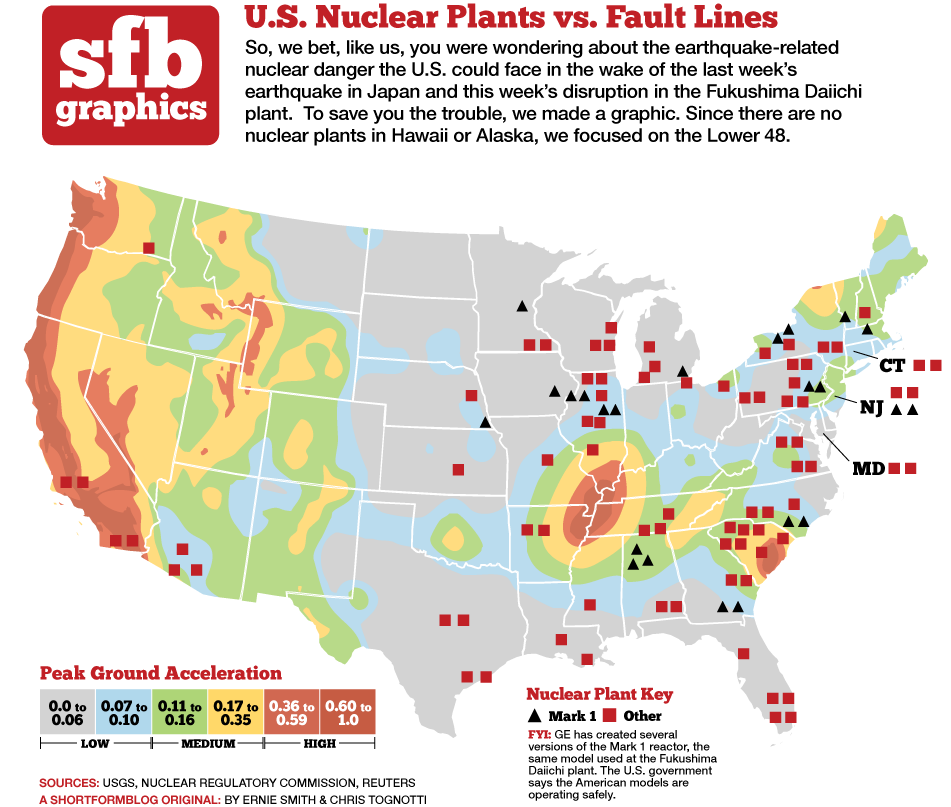
GRAPHIC: Examining U.S. nuclear reactor/fault line geography Some nuclear power food for thought: A lot of tumult has been taking place here in America over the nuclear crisis unfolding in Japan. This has ranged from rational concerns (this model of reactor seems unsafe!) to the not-so-rational ones (I need to buy potassium iodide RIGHT NOW!). With that in mind, we’ve decided to focus on a simple, practically important question; if the Mark 1 Reactor is indeed inferior on safety, where are ours and are they earthquake safe? The map tells the tale: 23 plants are presently using a Mark 1, all of which are in the eastern half of the country. (h/t to the USGS, Reuters and the Nuclear Regulatory Commission, the sources of the maps we used). SRC

Now seems like a good time to bring this back to the fore, considering that the quake happened near a nuclear power plant.

Posted by ShortFormBlog • Permalink

Jun 28 2011W

World: Wildfire gets a little to close to Los Alamos' nuclear waste

These drums are designed to a safety standard that would withstand a wildland fire worse than this one.

Los Alamos National Laboratory spokeswoman Lisa Rosendorf • Attempting to reassure people that, even as a large wildfire gets close to the birthplace of the atomic bomb — which has about 30,000 55-gallon drums of Cold War-era nuclear waste on the premises, located less than four miles away from the fire — that things are safe. Rosendorf says that it's located in a place with few trees nearby, meaning that the fire would be unlikely to spread into that particular area, and if it did, it would not affect the drums. Let's hope she's right. source

Posted by Ernie Smith • Permalink

Apr 19 2011t

More on nuclear energy and whether it's safe

p53angel asks: Hey guys! So first, a little background, I’m a 2nd year microbio major at Ohio State U (basically, I’m into science and what we can use it for). However, and a big however, looking at what’s happened in Chernobyl, Brazil, and recently Japan (heck even the “demon core,”) I’m beginning to wonder if we haven’t bitten off more than we can chew with nuclear power. Before the Sendai earthquake, I was pretty convinced that nuclear power was pretty safe because we understood it, and took tons of precautions with it, but I’m having doubts now; and it was a magic solution to the fossil fuels dilemma. But what about all the toxic waste we don’t really have a way of getting rid of? What about when it goes wrong, something completely out of our control (like an earthquake and tsunami.) It’s like the Jurassic Park question: we can, but should we? In this case, are we ready to play with this fire? I mean, areas in Ukraine are never going to be habitable again. That’s pretty serious stuff. (and, granted, Fukushima is not like that, and Chernobyl was 30 years ago in the Soviet Union). Still. The question stands; Should we use nuclear power on such a massive scale when we really can’t control what we’re doing to our environment/ourselves? Just my thoughts, I’m curious about what you guys have to say. Thanks!

  • » We say: Without digging too far into all this, I guess that you have to weigh the risk/reward here. That’s ultimately our feeling on the whole mess, and something we’ve said in the past about this matter. The thing is, even with the environmental issues that have come up of late, it’s still far safer than many forms of energy. And even ones considered “safe” have their downsides. And to put into clear terms: I don’t think anyone’s arguing about making nuclear our only energy source. Rather, I think that, because the damage caused when nuclear energy screws up is so acute (thereby lending itself to media frenzy), it leads to the type of overreaction that ultimately hurts further research and discourages figuring out how to make it safer. Coal and oil make smog and are growing more limited by the year; solar is an intermittent resource without continuous availability; wind makes noise and has many of the same problems as solar; biomass cuts into our food supply; fracking natural gas can damage the water supply. And well, nuclear energy occasionally causes fluke accidents like Fukushima and has not-insignificant waste issues. The question is, is there a way avoid or limit these flaws, with any of these sources?

Posted by ShortFormBlog • Permalink