 ShortFormBlog
No scientist ever has come out against nuclear energy, nor has anyone with financial investments in nuclear power EVER written about the benefits of nuclear, don’t even read Anna’s blog okay? Just quit it, you’re not a scientist and you don’t get it. Don’t talk to me about subsidies either or make this about alternative sources of energy, the only alternative is coal and it’s worse okay? Furthermore don’t talk about global politics or our hypocrisy towards Iran or North Korea, okay? These are all silly worries by people who don’t get the science.
/sarcasm
Holy shit…. Do I need to get into some deep physics this time? You kids know I will. I’ll do math.
Both nuclear energy and energy produced by coal are dangerous, just in different ways. We don’t even fully know the extent to which nuclear energy is dangerous - that’s how new it is and that’s how little we know about its capabilities. The potential catastrophe of nuclear disaster (and not just nuclear meltdown but spent fuel leaks, which have the capability of being frequent and are frequent in the United States) is much greater than that of coal. And like Luis said, nuclear energy and coal are not the only two options and neither have the capacity to fix our energy problem. Solutions do not lie in either realm and it would be very unwise of us, particularly with the the vast number of scientists who have been speaking out against each for decades - the rest of the world is just now listening, to waste this moment and continue supporting the same unsustainable and dangerous energy practices.
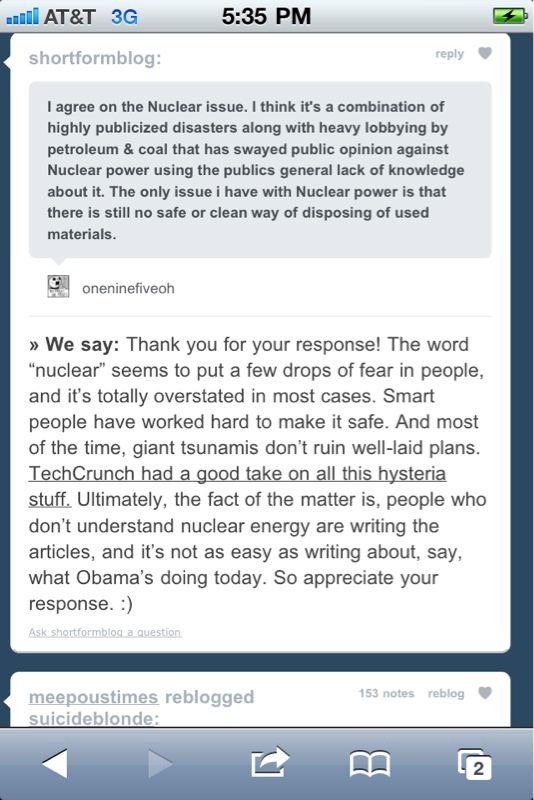
No arguments were made against green energy, nor were arguments made strictly in favor of ‘nuclear’ as a better source of energy than anything else. In fact, our original post went like this: “After having had weeks to think about this issue due to the Fukushima crisis, we say no. For all the problems it has, when it’s working OK, it’s safer than most other widely-used forms of energy. I think people are too quickly scared of it, and its reputation is too quickly diminished because of isolated incidents like Fukushima. We bet, however, that lots of people disagree with us on this. What do you think?"
The argument was clearly pointed at two things: Early reporting that seemed to get a lot of the facts incorrect and instill a lot of fear and misinformation into others (How many times did you hear "nuclear meltdown” when Fukushima was just starting out? Or reports that made it sound like Chernobyl when it clearly wasn’t the same?), and that incidents like Fukushima are the exception, not the rule. That’s not to say the danger isn’t there, nor that we shouldn’t question it, but let’s at least get our information straight here.
And we hear things like stories about increased radiation in the U.S. — despite the fact that the radiation level is less than what one would get by eating a banana. (Which, it its credit, we saw ABC point out on “World News Tonight.” But a lot of other outlets didn’t get that far.) I don’t think it’s unfair to point this out to people.
Also, if you’ve been reading the blog for a few weeks, you’d know that we’ve made efforts to put into perspective some of the info coming out. Because the average person has no idea what a “microsievert” is. Now, none of this is to say that nuclear power on its own is safe, nor does it give validity to some of the questionable practices reported at Fukushima, just to say that lots of work has been put in to ensure its safety in case incidents like Fukushima crop up. MIT has a great blog about what’s going on that’s worth reading.
All forms of energy have a risk/reward ratio. And that’s what we should weigh. Whether or not we like a form of energy, we should at least keep an open mind about everything. And let’s not put all of our marbles into any one pile — instead, let’s do our research as a society and find the best one.