Read a little. Learn a lot. • Now Mullenweg-free! • Since 2009
☰

Tag: nuclear energy

40 posts

Mar 18 2011t

Some nuclear power food for thought

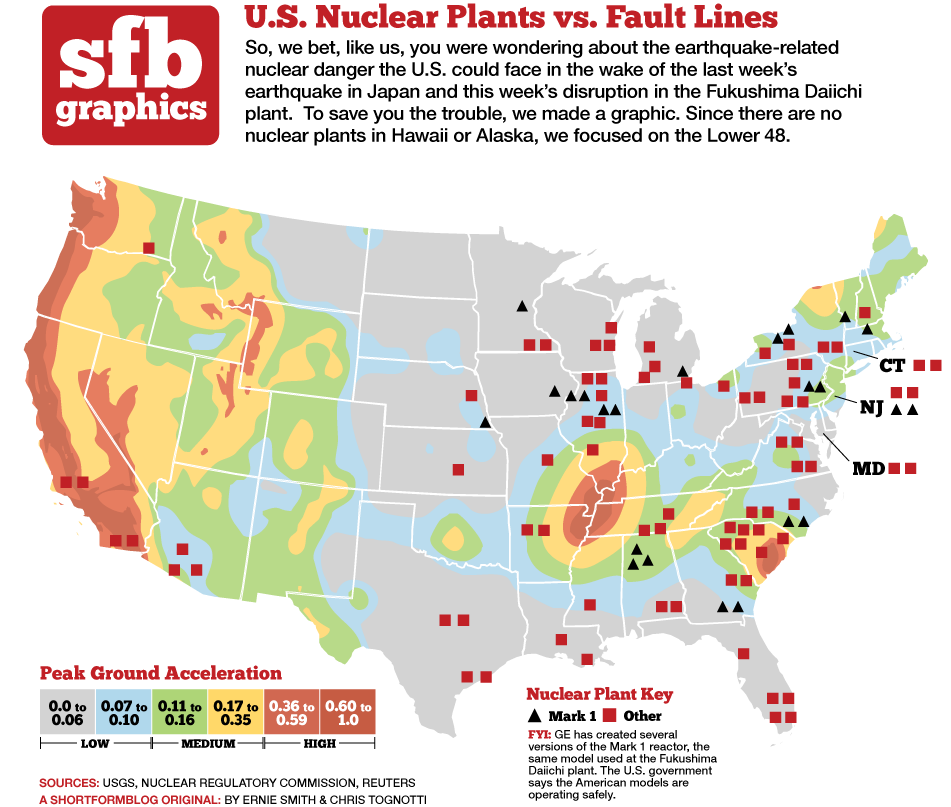
GRAPHIC: Examining U.S. nuclear reactor/fault line geography

  • Some nuclear power food for thought: A lot of tumult has been taking place here in America over the nuclear crisis unfolding in Japan. This has ranged from rational concerns (this model of reactor seems unsafe!) to the not-so-rational ones (I need to buy potassium iodide RIGHT NOW!). With that in mind, we’ve decided to focus on a simple, practically important question; if the Mark 1 Reactor is indeed inferior on safety, where are ours and are they earthquake safe? The map tells the tale: 23 plants are presently using a Mark 1, all of which are in the eastern half of the country. (h/t to the USGS, Reuters and the Nuclear Regulatory Commission, the sources of the maps we used). source

Posted by ShortFormBlog • Permalink

Mar 18 2011t

More on American nuclear plants and fault lines

anonopgreen:

Hello, my name is Green and I’m a geology major.

Cons: From what I’ve read, the safety concerns of the reactors are legitimate. Mark 1 does have some problems.

Pros: At the very least, when reactors are built near/on fault zones, they are usually built to withstand the earthquakes. However - that can only do so much when there is a problem with the design of the REACTOR itself.

My opinion - we need to work on the reactors themselves - building near a fault is not necessarily a huge problem (I wouldn’t recommend it, but it can be managed if done properly).

SO BASICALLY the country needs to take a look at how they manage funds and put some money used for *ahem* other things lol wars into

\1. Upgrading our nuclear power plants

\2. Using geothermal energy (Lol check out the Snake River Valley in Idahoooo)

\3. Using more Solar/Wind power.

Put you know this will be a fucking huge fight because there are people who don’t want certain OTHER energy industries to fall.

End science rant/

Great commentary on our original graphic.

Posted by ShortFormBlog • Permalink

Mar 16 2011W

World: The single most cringe-worthy quote on Japan you'll see today

Japan has some of its industry curtailed, like auto and steel — but that's not going to last too long. People are starting to realize that there [sic] economy is not going to be shut down for long — and they're going to have to start to look for alternative fuel sources.

INFA Energy Brokers CEO Brad Schaeffer • Suggesting that Japan will have to switch its energy sources to an alternative source. But Schaeffer means "alternative" in the way one might call a band like Nickelback "alternative" — see, he thinks that Japan should move to oil. "Remember, they need to get their nation back on their feet," he says. "They aren't worrying about their carbon footprint so much. They're thinking we need to get oil here now – so we can get our generators up and running." While there's some grain of truth here, we wonder how much of what he's saying is wishful thinking, seeing that he's the CEO of an energy-brokering company. Quotes like these? They seriously make us cringe. source

Posted by Ernie Smith • Permalink

Mar 15 2011W

U.S.: Back in the States, Americans raiding geiger counter stockpile

  • cause After last week's earthquake, a series of nuclear troubles hit the Fukushima reactors and other nuclear reactors throughout Japan. Fukushima most seriously, as we're sure you've read.
  • reaction In the United States, even though the odds are slim to none that the crisis will affect them, sales of geiger counters and potassium iodide have skyrocketed. Has there been a run on tinfoil hats? source

Posted by Ernie Smith • Permalink

Mar 15 2011W

World: Fukushima update: Radiation briefly reaches one sievert an hour

  • 1,000 the level the radioactivity reached near the Fukushima reactor, in milli-sieverts per hour – which is a new high, by far
  • 800-600 the level the radioactivity fell to not much longer after that, in milli-sieverts per hour; this is still far more than average source
  • » For context: Please check out our various updates here, here, here, and here.

Posted by Ernie Smith • Permalink

Mar 15 2011W

World: UPDATE: Fukushima's radiation levels drop significantly

  • 11.9 the current peak radiation count, in milli-sieverts per hour
  • 400 the peak radiation count in milli-sieverts per hour – which was hit last night
  • 300k the peak mSv/hour count at Chernobyl – to keep things in check source
  • » It's no longer at its peak, and that's a good thing: The International Atomic Energy Agency says that the decrease happened over a six-hour period. And the IAEA makes a good point that you should keep in mind. "This is a high dose-level value, but it is a local value at a single location and at a certain point in time," they say. In other words, even if you're within the 20-mile radius where radiation is likely to hit, the level will most assuredly be far lower than these peak levels. It's still high, though – one milli-sievert per hour is equal to the yearly legal limit of radiation you're supposed to get. (see our earlier posts about this topic here and here)

Posted by Ernie Smith • Permalink

Mar 15 2011W

World: Tracking radiation levels in Tokyo: A minorly scary photo

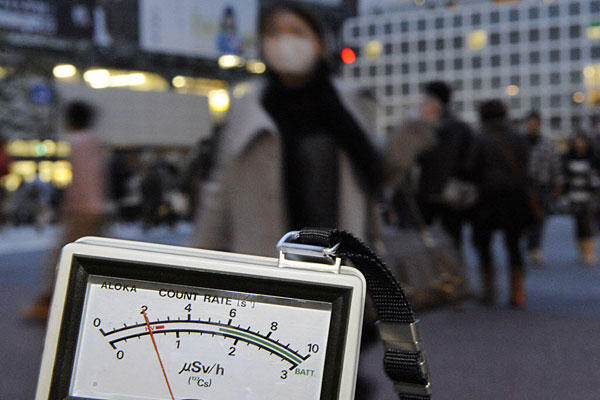
  • Photo of the day: "A radiation detector marks 0.6 micro-sieverts, exceeding normal levels Tuesday, near Shibuya train station in Tokyo. Concern over possible radiation exposure has increased after a fourth reactor released radiation, Tuesday." To compare – this level is higher than average, but only a tiny percentage of what's happening at the plant. 1,000 micro-sieverts per hour equals one milli-sievert per hour. So this is high, but still minor. (Kyodo News/AP) source

Posted by Ernie Smith • Permalink

Mar 14 2011W

World: UPDATE: What does "400 times annual legal limit" mean?

  • 400 the amount of radiation in the air, in milli-sieverts per hour, according to the given estimate
  • 40 the amount of radiation that is, in roentgen per hour – which, don't get us wrong, is very high
  • 30k the amount of radiation in Chernnobyl had – which Fukushima doesn't touch source
  • » This is an extremely large jump: One milli-sievert per hour is the legal annual limit for radiation in a year. Our earlier estimate showed a level of 8,217 micro-sieverts. 1,000 micro-sieverts equals 1 milli-sievert. So we went from 8,000 to 400,000 in a couple of hours. This is still no Chernobyl, but this is a huge jump. If it jumps to 1,000,000 micro-sieverts, it leads to radiation sickness – and then we're in trouble.

Posted by Ernie Smith • Permalink