Read a little. Learn a lot. • Now Mullenweg-free! • Since 2009
☰

Tag: middle east

175 posts

Aug 20 2014t

If genuine, we are appalled by the brutal murder of an innocent American journalist and we express our…

If genuine, we are appalled by the brutal murder of an innocent American journalist and we express our deepest condolences to his family and friends.

— National Security Council spokeswoman Caitlin Hayden • Discussing the video purportedly showing photojournalist James Foley being killed at the hands of ISIS, reported as retaliation for U.S. airstrikes on Iraq. Though it’s not confirmed, Foley has been missing for nearly two years, reportedly kidnapped while on the ground in Syria. Our policy on the video follows perzadook’s: We ain’t linking to it.

Posted by Ernie Smith • Permalink

Apr 27 2014t

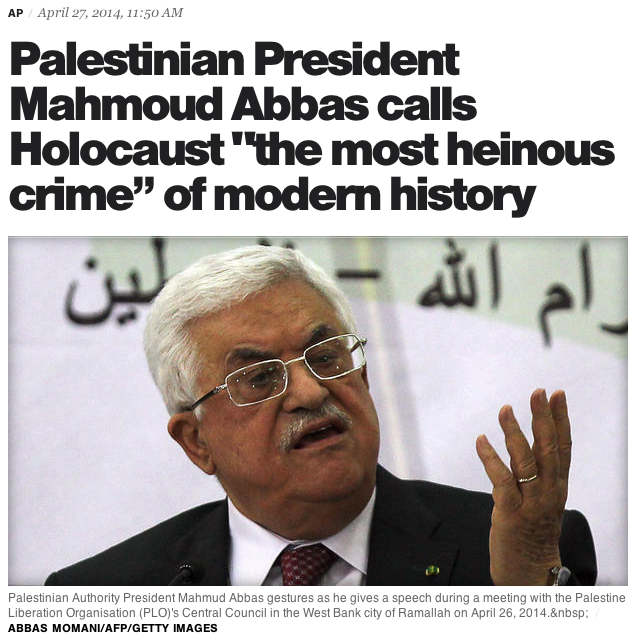
Palestinian President Mahmoud Abbas acknowledges

Palestinian President Mahmoud Abbas acknowledges that the Holocaust was heinous, which is a big deal because Holocaust denialism is a somewhat common thing in the Middle East. (Though that said, some have disputed this perception.)

Back in the ‘80s, Abbas himself wrote a book that some consider a piece of Holocaust denialism.

Posted by Ernie Smith • Permalink

Mar 30 2014t

Spanish journalist Javier Espinosa and photojournalist Ricardo Garcia Vilanova returned home today after six…

thepoliticalnotebook:

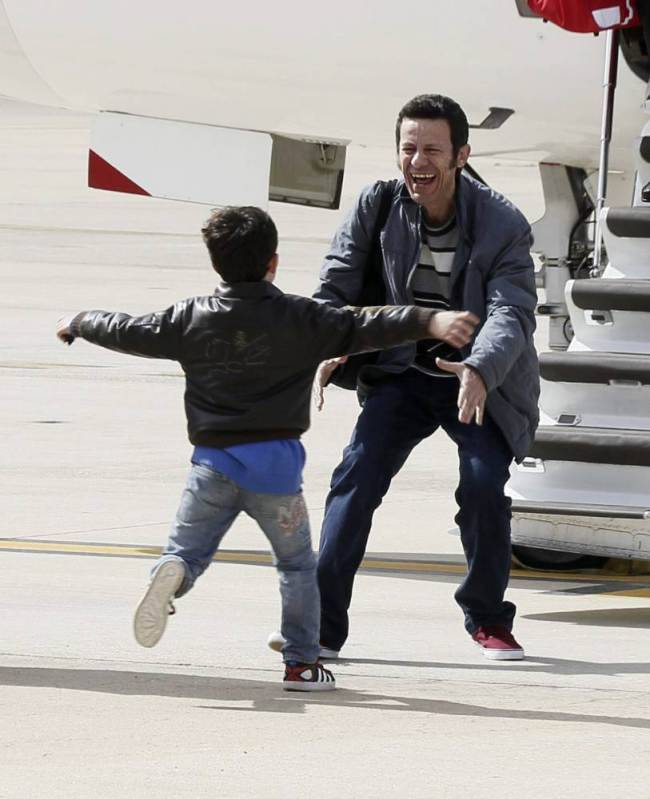
Spanish journalist Javier Espinosa and photojournalist Ricardo Garcia Vilanova returned home today after six months held captive by an Al Qaeda-linked group in Syria. Above, Espinosa greets his son Yerai on the Torrejon military airport in Madrid.

Photo: AFP/Getty

This is so great.

Posted by Patrick deHahn • Permalink

Mar 25 2014t

“It is unlikely at the current time that dialogue will resume between the Syrian regime and the opposition in…

It is unlikely at the current time that dialogue will resume between the Syrian regime and the opposition in Geneva

— United Nations envoy Brahimi stated Monday. On the ground, Syrian forces battled with rebels who captured a village and a crossing on the Turkey border. UN’s Ban ki-Moon also blamed both sides of the conflict for blocking humanitarian aid.

Posted by Patrick deHahn • Permalink

Jan 14 2014t

We cannot get liberated from the terrorism of the Brotherhood in Egypt without ending it in Gaza, which lies…

We cannot get liberated from the terrorism of the Brotherhood in Egypt without ending it in Gaza, which lies on our borders.

— An unidentified Egyptian security official • Justifying upcoming efforts by Egypt’s ruling military leaders to stamp out Hamas, now that the Muslim Brotherhood is no longer viewed as a credible threat to the Egyptian government. Egypt’s military leaders apparently believe that Hamas can be driven out of Gaza via the same sort of mass protests that ultimately led to former Egyptian President Mohamed Morsi being removed from office, though experts on the region aren’t quite as convinced that the strategy will prove effective. source

Posted by Scott Craft • Permalink

Dec 29 2013t

Saudi Arabia just gave Lebanon a really big end-of-year present

  • $3B the size of the investment Saudi Arabia just made in the Lebanese army, an investment meant to strengthen the army’s resources. Those resources are seen as weaker than those of the Islamic militant group Hezbollah, which is located in the country and is supporting the nearby Syrian government in the country’s ongoing civil war. The move could weaken Iran’s influence on the country, but some analysts suggest the source of the funding makes it divisive.

Posted by Ernie Smith • Permalink

Dec 16 2013t

“We’ve seen several red lines put forward by the president, which went along and became pinkish as time grew…

We’ve seen several red lines put forward by the president, which went along and became pinkish as time grew, and eventually ended up completely white. When that kind of assurance comes from a leader of a country like the United States, we expect him to stand by it. There is an issue of confidence.

— Prince Turki al-Faisal, the former intelligence chief of Saudi Arabia, describes his country’s disappointment in the United States and Obama regarding the Syria conflict.

Posted by Patrick deHahn • Permalink

Dec 16 2013t

“No one really wants to go to war in Syria because it’s a huge sectarian, you know, mess, with all kinds of…

No one really wants to go to war in Syria because it’s a huge sectarian, you know, mess, with all kinds of implications. […] But look, this is complicated. This isn’t easy.

— United States Secretary of State John Kerry shares with ABC News ‘The Week’ on how he views Syria today. He also admits al Qaeda is an issue he will have to confront there.

Posted by Patrick deHahn • Permalink

Nov 25 2013t

CRACKDOWN: Egypt President Approves Harsh Anti-Protest Law

Egypt’s interim president on Sunday banned public gatherings of more than 10 people without prior government approval, imposing hefty fines and prison terms for violators in a bid to stifle the near-constant protests roiling the country. The new law is more restrictive than regulations used under the rule of autocrat Hosni Mubarak, overthrown in Egypt’s 2011 uprising that marked the start of unrest in the country.

Another terrifyingly disappointing move from the country of Egypt. The country is often looked to as an example in the MENA region and now there’s this rather alarming set of news. They’re clearly hurting the right to protest in a detrimental way.

Posted by Patrick deHahn • Permalink

Nov 24 2013t

Accord reached with Iran to halt nuclear program

The United States and five other world powers announced a landmark accord Sunday morning that would temporarily freeze Iran’s nuclear program and lay the foundation for a more sweeping agreement.

It was the first time in nearly a decade, American officials said, that an international agreement had been reached to halt much of Iran’s nuclear program and roll some elements of it back.

The aim of the accord, which is to last six months, is to give international negotiators time to pursue a more comprehensive pact that would ratchet back much of Iran’s nuclear program and ensure that it could be used only for peaceful purposes. […]

Iran, which has long resisted international monitoring efforts and built clandestine nuclear facilities, agreed to stop enriching uranium beyond 5 percent, a level that would be sufficient for energy production but that would require further enrichment for bomb-making. To make good on that pledge, Iran will dismantle links between networks of centrifuges.

Its stockpile of uranium enriched to 20 percent, a short hop from weapons-grade fuel, would be diluted or converted into oxide so that it could not be readily used for military purposes. Iran agreed that it would not install any new centrifuges, start up any that are not already operating or build new enrichment facilities.

The agreement, however, does not require Iran to stop enriching uranium to a low level of 3.5 percent, or to dismantle any of its existing centrifuges.

Posted by Patrick deHahn • Permalink