Read a little. Learn a lot. • Now Mullenweg-free! • Since 2009
☰

Tag: big data

5 posts

Aug182013t

…the first unusually hot day of the year correlates with a surge in air conditioner sales in Chicago, but not…

…the first unusually hot day of the year correlates with a surge in air conditioner sales in Chicago, but not in muggy Atlanta—there, people wait through an average of two hot days before heading to the appliance store. When the crafts retailer Michaels approached the Weather Channel about advertising on rainy days—when craft projects are popular—the Weather Channel found Michaels’ sales increased not on actual rainy days, but instead when an extended forecast predicted rain within the next three days.

— The Weather Channel knows what you want to buy… (via fastcompany)

meb says: Hide yo kids, hide yo wife: no one is safe from the tag team of Mother Nature and Big Data.

(via maneatingbadger)

If only The Weather Channel was smart enough with their big data to, you know, change the weather.

Posted by Ernie Smith • Permalink

Aug52013t

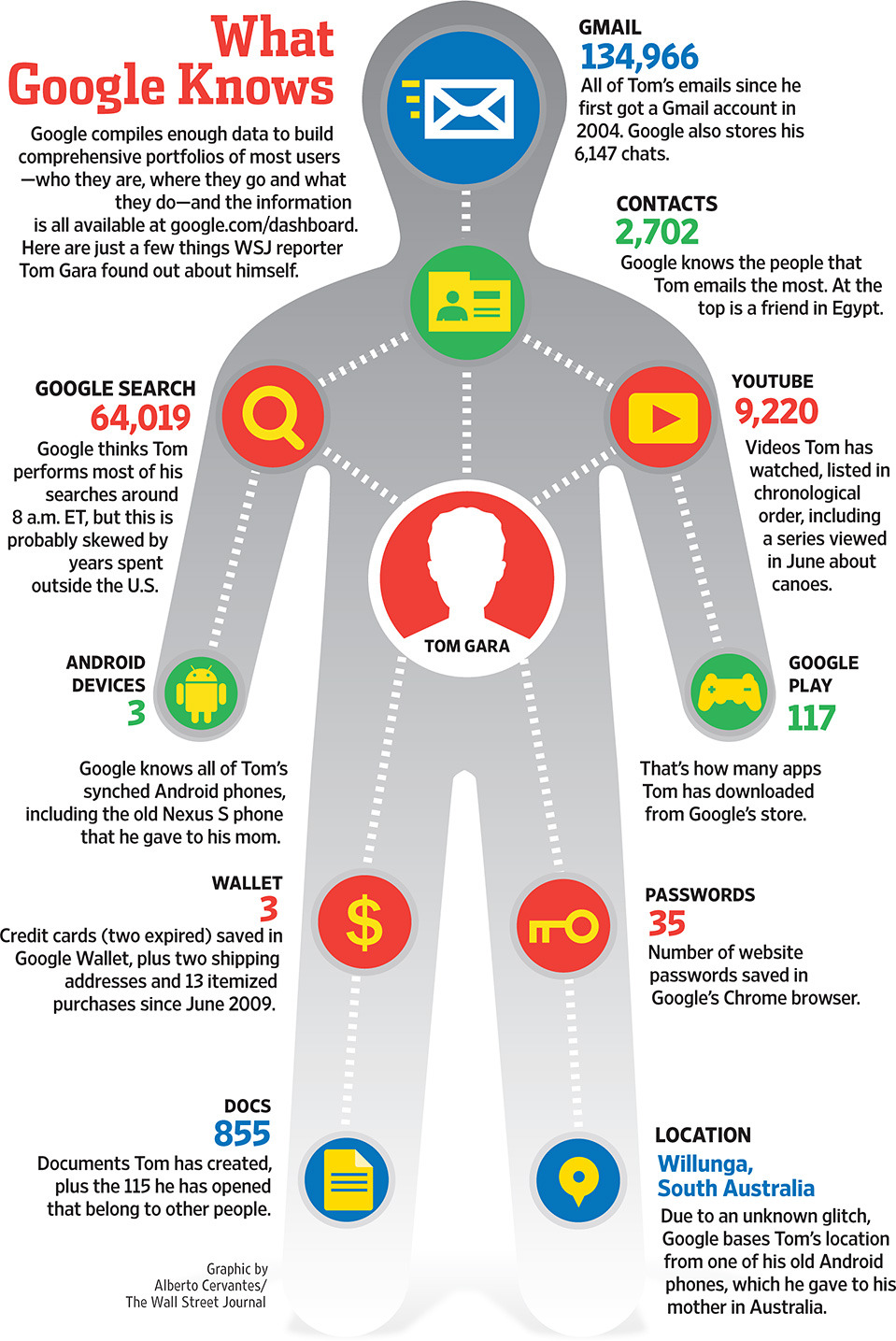
What Google Knows

futurejournalismproject:

What Google Knows

Via the Wall Street Journal:

Every hour, an active Google user can generate hundreds or thousands of data “events" that Google stores in its computers, said people familiar with its data-gathering process.

These include when people use Google’s array of Web and mobile-device services, which have long collected information about what individuals are privately searching for on the Web. It includes the videos they watch on YouTube, which gets more than one billion visitors a month; phone calls they’ve made using Google Voice and through nearly one billion Google-powered Android smartphones; and messages they send via Android phones or through Gmail, which has more than 425 million users.

If a user signs in to his or her Google account to use Gmail and other services, the information collected grows and is connected to the name associated with the account. Google can log information about the addresses of websites that person visits after doing Google searches.

Even if the person visits sites without first searching for them on Google, the company can collect many of the website addresses people using Google’s Chrome Web browser or if they visit one of millions of sites that have pieces of Google code, such as its “+1” button, installed.

Android-based phones and Google Maps can collect information about people’s location over time. Google also has credit-card information for more than 200 million Android-device owners who have purchased mobile apps, digital books or music, said a person with direct knowledge of the matter.

Somewhat related bonus: The Public-Private Surveillance Partnership, via Bloomberg.

Image: What Google Knows, via the Wall Street Journal. Select to embiggen.

What Google knows about you could fill a data center.

Posted by Ernie Smith • Permalink

Tags for this post

May112013t

Bloomberg journalists piss off big-name banks with privacy breach

  • the company Bloomberg LP, the market data company started by current New York City Mayor Michael Bloomberg 32 years ago, built its success from its Bloomberg Terminal electronic trading platform, as well as its journalistic platform, including its wire service and Bloomberg Businessweek magazine. Companies pay as much as $20,000 per year for a single Bloomberg Terminal—and financial companies use many of them, as 310,000 exist worldwide.
  • the problem Apparently Bloomberg journalists have been using this data to monitor big-name subscribers to the Bloomberg Terminal service. Hundreds of the service’s 2,400 journalists worldwide reportedly tracked users of the service through this method, which financial institutions noticed after a journalist pointed out to Goldman Sachs that one of the company’s partners didn’t log into their terminal recently. The incident could prove dangerous to both of Bloomberg’s businesses, as it could damage the credibility of both the wire service and the market data platform.

Posted by Ernie Smith • Permalink

Apr302013t

Using cell phone data, IBM is helping re-route buses in Abidjan, the Ivory Coast's largest city.

The IBM work centered on Abidjan, where 539 large buses are supplemented by 5,000 mini-buses and 11,000 shared taxis. The IBM researchers studied call records from about 500,000 phones with data relevant to the commuting question.

Mobility data is created when someone uses a phone for a call or text message. That action is registered on a cell-phone tower and serves as a report on the user’s general location somewhere within the tower’s radius. The person’s movement is then ascertained as the call is transferred to a new tower or when a new call is made that connects to a different tower.

While the data is rough—and of course not everyone on a bus has a phone or is using it—routes can be gleaned by noting the sequence of connections. And IBM and other groups have found that these mobile phone “traces” are accurate enough to serve as a guide to larger population movements for applications such as epidemiology and transportation (see “Big Data from Cheap Phones.”)

The re-routing data could help trim transit times by as much as 10 percent. Neat. (ht Hacker News)

Posted by ShortFormBlog • Permalink

Nov72012t

It’s a little early to know exactly what we can learn from social media metrics. I think the way we’ll be…

It’s a little early to know exactly what we can learn from social media metrics. I think the way we’ll be looking at this stuff will be very different in four years, in eight years, in twelve years. For right now, we’re kind of in an awkward adolescent age … we’re out of the classical innocent era of our youth where you could just call someone on the phone. But we’re not sure what the substitute for that is yet.

— With all the recent brewhaha about Nate Silver’s controversial projections for tonight’s outcome, and while we’re all waiting for some legit data to come back from the polls, it seems like a good time to revisit our exclusive interview with Mr. Silver back in September. Enjoy! (via election)

Nate Silver is hiding in a dimly-lit room with an iPad and a MacBook Air, hoping his projections are right.

Posted by Ernie Smith • Permalink