Read a little. Learn a lot. • Now Mullenweg-free! • Since 2009
☰

Tag: radiation

29 posts

Mar 23 2011W

U.S.: FDA's Fukushima food ban: Not really that big a deal

  • scary The FDA just limited the import of food from the area of Japan near the Fukushima nuclear disaster, days after officials discovered radiation in some foods, including milk and spinach. A lot of people have been freaking out over this.
  • not scary However, this almost assuredly isn't a big deal — only four percent of our imported foods come from Japan, and the ones we usually eat from the country are things like fish, which weren't significantly affected by Fukushima. source

Posted by Ernie Smith • Permalink

Mar 22 2011W

World: China, South Korea strictly checking Japanese food

  • China and South Korea wary of radiation in food: Some countries (and even individual restaurants) that import food from Japan are concerned about the possibility of radiation contamination. The Japanese government has assured their citizenry that the radiation levels detected in milk, spinach, and some water is not enough to do rapid or lasting damage, though they've imposed a freeze on food from that region. China and South Korea want to look into the matter themselves, though, absent the responsibility of keeping the Japanese citizenry from being stricken with panic, which their government obviously has. That seems reasonable enough. source

Posted by Chris Tognotti • Permalink

Mar 21 2011W

World: Food-borne radiation detection prompts call for ban, general fears

  • worrisomeRadiation has been detected in milk and spinach from areas surrounding the Fukushima Daiichi nuclear plant, causing World Health Organization officials to call for a ban on food coming from that area.
  • zealous An upscale restaurant in Taiwan known as Peony, which specializes in Japanese cuisine, has gone to some length to prove their culinary purity: diners are offered radiation meters to check their food. source

Posted by Chris Tognotti • Permalink

Mar 20 2011W

World: Japan finds more radiation-laden foods, limits their sale

  • bad As we reported yesterday, a number of food items from the region near Fukushima — including milk and spinach — had high levels of radiation in them, leading to considerable concern in Japan.
  • worse Now, more foods have tested positive for radiation — including canola and chrysanthemum greens. Now, Japan has restricted sales of food from anywhere near Fukushima. source

Posted by Ernie Smith • Permalink

Mar 20 2011t

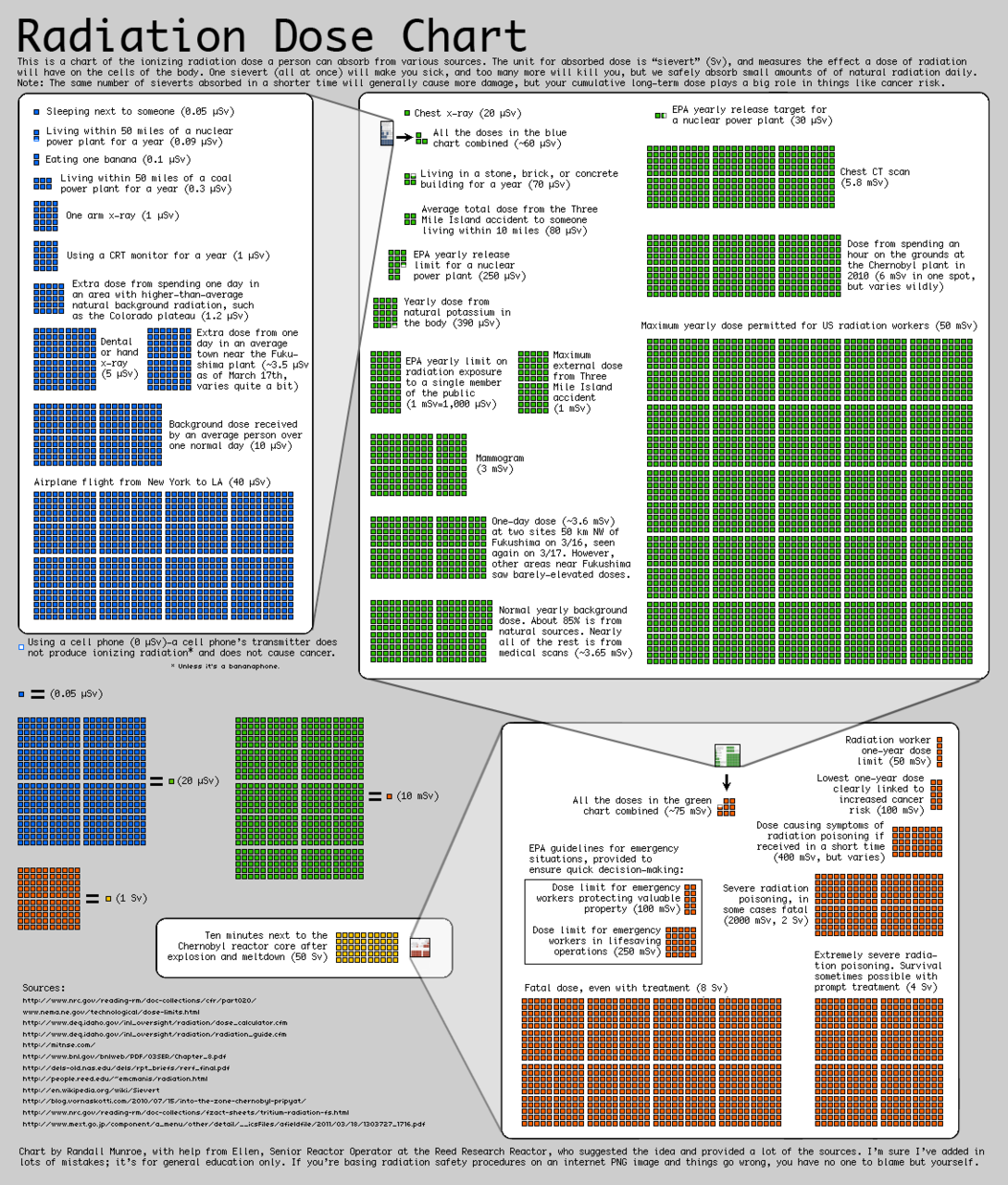
XKCDs Radiation Dose Chart This is a chart of the ionizing radiation dose a person can absorb from various…

sunfoundation:

XKCDs Radiation Dose Chart

This is a chart of the ionizing radiation dose a person can absorb from various sources. The unit for absorbed dose is “sievert” (Sv), and measures the effect a dose of radiation will have on the cells of the body. One sievert (all at once) will make you sick, and too many more will kill you, but we safely absorb small amounts of natural radiation daily. Note: The same number of sieverts absorbed in a shorter time will generally cause more damage, but your cumulative long-term dose plays a big role in things like cancer risk.

This is really fascinating, and totally plays into some of our previous coverage.

Posted by ShortFormBlog • Permalink

Mar 19 2011W

World: Japan: Officials find radiation in milk, spinach and drinking water

  • water Officials discovered safe but high levels of radioactive iodine in the drinking water of five Japanese cities, including Tokyo, during a radiation test. They were trace amounts that were within acceptable legal limits, however.
  • food Officials also discovered high radiation levels in milk and spinach near Fukushima. In the case of the spinach, eating it every day for a year would be equal to 20 percent of the level of radiation you'd get from a CAT scan. source
  • » What happens next: Chief Cabinet Secretary Yukio Edano says that they'll continue to test food products, and if they find contaminated products, they'll ban them from the market. Some experts are understandably skeptical. “They should seriously think about restricting any agricultural products in that area,” said Lam Ching-wan of the University of Hong Kong School of Medicine. “It seems that the whole ecosystem could be affected, so they shouldn’t take any chances.” The radiation factor of milk and spinach is important to note, because after Chernobyl, many cancer cases resulted from children who ingested high levels of radiation in milk.

Posted by Ernie Smith • Permalink