A female passenger groped by TSA gropes back, and is then charged with battery.
Yes.
You read that right.
Raise your hand if you’ve ever seen a “no gropebacks” sign at an airport security checkpoint before.
 ShortFormBlogRead a little. Learn a lot. • Now Mullenweg-free! • Since 2009
126 posts
A female passenger groped by TSA gropes back, and is then charged with battery.
Yes.
You read that right.
Raise your hand if you’ve ever seen a “no gropebacks” sign at an airport security checkpoint before.
Posted by ShortFormBlog • Permalink
Posted by ShortFormBlog • Permalink
Consumers didn’t realize that these reports were used as a factor in determining whether they would get a job. If the report was riddled with errors, the consumer didn’t have recourse.
— Federal Trade Commission lawyer Jamie Hine • Discussing the $800,000 settlement that the social data-scraping company Spokeo just agreed to. The company gained a fairly negative reputation a few years ago for taking publicly-available personal information from social media sites and selling it to job recruiters and other interested parties. (Users could get the information removed, but the process was spotty for years.) The company, which moved away from this model in 2010, failed to follow proper disclosure procedures required for companies like these — including letting consumers know if their information led to people losing jobs based on a Spokeo search. “We do not create our own content, we do not possess or have access to private financial information, and we do not offer consumer reports,” said founder Harrison Tang in a statement regarding the settlement. By the way, we recommend you head over to Spokeo and remove your e-mail address from their database.
Posted by ShortFormBlog • Permalink
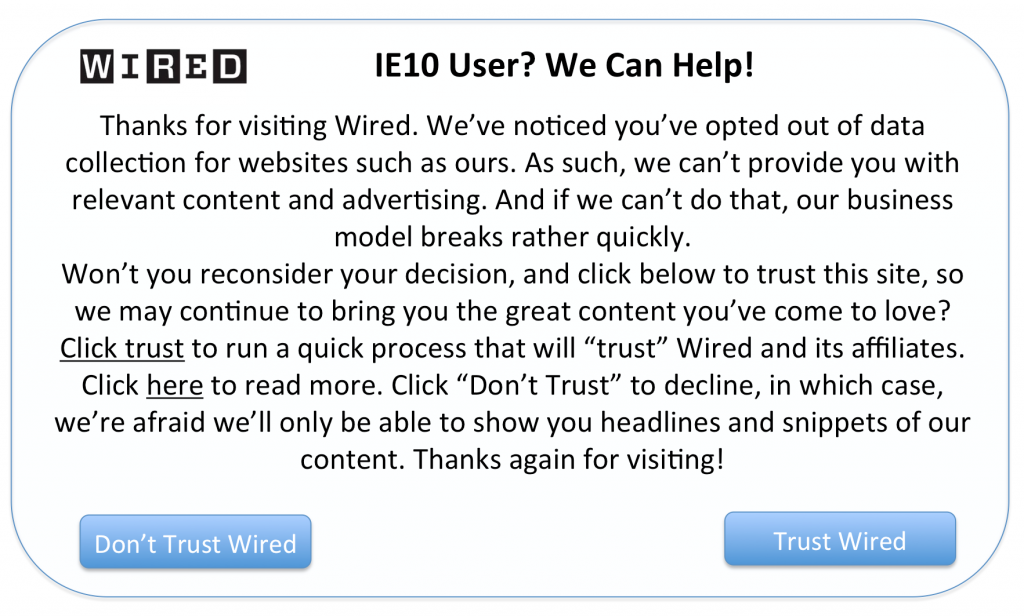
(via Do Not Track Is An Opportunity, Not a Threat | John Battelle’s Search Blog) This is a mockup — for now anyway. But speaking personally, I think it would be fair enough; albeit with the addition of a 3rd option “click to pay (eg: 2$) for a months access to ad-free version” or similar.
First off, to emphasize again: This is a mockup, not real. But it’s rare to see Microsoft ahead of the curve on something like “Do Not Track,” which will be turned on by default on IE10. The solution for sites which could suffer from this type of change is to be upfront about it. Or, you know, to change up their model a little. Either way, let’s not do more stuff like this.
Posted by ShortFormBlog • Permalink
(photo via TheSeafarer)
Posted by ShortFormBlog • Permalink
The American people expect their Government to enhance security without undermining their privacy and civil liberties. Without clear legal protections and independent oversight, information sharing legislation will undermine the public’s trust in the Government as well as in the Internet by undermining fundamental privacy, confidentiality, civil liberties, and consumer protections.
— A statement from The White House • Which included specific reasoning as to why President Obama does not support Congress’ newest efforts to regulate the internet. The President believes the legislation, called CIPSA, is too far-reaching, does not include adequate limitations on the transference of personal information between private companies and the government, and unfairly shields companies from lawsuits pertaining to possible misuse of consumers’ private data. “The Administration looks forward to continuing to engage with the Congress in a bipartisan, bicameral fashion to enact cybersecurity legislation to address these critical issues,” said the White House, continuing, “however, for the reasons stated herein, if H.R. 3523 were presented to the President, his senior advisors would recommend that he veto the bill." source ( source • source)
Posted by ShortFormBlog • Permalink
Posted by ShortFormBlog • Permalink
House Republicans blocked a measure Tuesday night that would have let the Federal Communications Commission prevent employers from forcing workers to reveal their Facebook passwords.
Democrats offered the legislation as part of bill to slap new restrictions on FCC rules after a string of reports about employers insisting on access to social media accounts — a practice that some senators already want investigated by the Justice Department.
[…]
The measure failed, 184 to 236, with no Republicans voting for it.
So wait, why is this getting voted down again? This should have blanket support. Here’s part of the answer, from Republican Rep. Greg Walden: “You don’t protect the consumer. And there are many of us who after this debate concludes and moves on, would be happy to work with you on legislation because I think this is a real issue that we all share, and that is protecting privacy. This doesn’t do that.”
Posted by ShortFormBlog • Permalink
As a user, you shouldn’t be forced to share your private information and communications just to get a job. And as the friend of a user, you shouldn’t have to worry that your private information or communications will be revealed to someone you don’t know and didn’t intend to share with just because that user is looking for a job. That’s why we’ve made it a violation of Facebook’s Statement of Rights and Responsibilities to share or solicit a Facebook password.
— Facebook’s Chief Privacy Officer, Erin Egan • Responding to a recent Associated Press story that discussed potential employers who would ask job applicants for their passwords. Facebook thinks that’s a no-no, and promises it may even consider legal action against companies that use Facebook information in this way. It’s good to see that Facebook is on the same page as us about this matter.
Posted by ShortFormBlog • Permalink
It’s an invasion of privacy for private employers to insist on looking at people’s private Facebook pages as a condition of employment or consideration in an application process. People are entitled to their private lives. You’d be appalled if your employer insisted on opening up your postal mail to see if there was anything of interest inside. It’s equally out of bounds for an employer to go on a fishing expedition through a person’s private social media account.
In case you missed it, we wrote a nice long rant about this a couple of days ago. Suffice it to say, we were not bullish on the idea that employers could access your Facebook account so you could get a job.
Posted by ShortFormBlog • Permalink