kateoplis:
Reuters: Why the NYT will lose to HuffPo
Tom McGeveran asks an important question, in his analysis of the AOL-HuffPo deal:
What is it about the environment of traditional journalism that makes it so that readers are more likely to interact with the Huffington Post reblog of a New York Times article than they are with the article itself?
The answer to this question, I think, is also a key part of the reason why the NYT paywall is a bad idea.
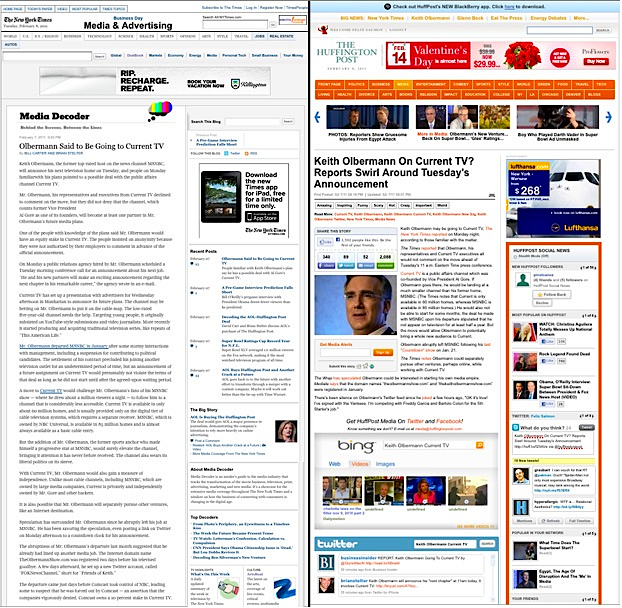
It’s worth using a specific example here, so let’s take Dave Pell’s suggestion and look at the NYT’s Olbermann scoop last night, and HuffPo’s reblog of it. When Pell first tweeted the comparison, the NYT blog had no comments, while the HuffPo blog had “hundreds of comments/likes.” Now, the NYT post is up to 93 comments, but the HuffPo post is still miles ahead: 2,088 comments, 1,392 likes on Facebook, 340 Facebook shares, 89 tweets, and 52 emails. All of which figures are easily visible in a colorful box at the top of the story. The NYT, by contrast, keeps such numbers to itself. …
Still, the difference between the two pages is much starker than it needs to be: the NYT page is like walking into a library, while the HuffPo page is like walking through Times Square. The HuffPo page is full of links to interesting stories elsewhere on the site — about Egypt, or the kid in the Superbowl Darth Vader ad, or the stories my Facebook friends are reading. And there are lot of links to media stories, too; each one has a photo attached. The NYT page, by contrast, feels like it’s at a site-map dead end. It’s part of the Media Decoder blog, and almost every NYT story linked to on the page is also part of that blog. There are almost no photos; there is almost no color. …
Once the paywall goes up, it’s certain that non-subscribers — the vast majority of the NYT readership — will read fewer pages per month than they did before. The NYT’s navigation was never very sticky, as we’ve seen, but from here on in there will actually be a substantial economic incentive not to explore the site, and to save up your precious quota of pageviews for when you need them most.
One of the paradoxes of news media is that most of the time, the more you’re paying to use it, the harder it is to navigate. Sites like HuffPo make navigation effortless, while it can take weeks or months to learn how to properly use a Bloomberg or Westlaw terminal. Once the NYT implements its paywall, it’s locking itself into that broken system: it will be providing an expensive service to a self-selecting rich elite who are willing to put in the time to learn how to use it. Meanwhile, most Americans will happily get their news from friendlier and much more approachable free services like HuffPo.
We personally favor the Times page, by far. Look, there are things The Times could do better here – we think there should have been a photo with that Media Decoder post – but there are so many other sites that do what the Huffington Post does, and better. Most of AOL’s properties do what HuffPo does better.
The Huffington Post is the MySpace of SEO articles. Someone’s eventually going to come with a way to do what they do that’s nicer, slicker, and doesn’t overwhelm the eye. Or Arianna’s folks are going to have to redesign to streamline things. One of the two.
In fact, we’d argue, they’ll redesign because they have AOL’s folks on board now. AOL’s designers are better than HuffPo’s, and they’re going to figure out a way to rein in the overwhelming amount of stuff going on. Politics Daily and AOL News are a breeze to use compared to HuffPo, and that’s no accident. And just look at Engadget if you need proof that they could completely nail this redesign.
Right now, HuffPo looks like what would happen if you took every Web 2.0 startup and put EACH of their widgets on a single page. The only thing it needs is an Apture bar and a Meebo bar and it’d be complete. It’s surprising it doesn’t take five minutes to load.
But here’s another thought: That Media Decoder post could be half as long and say everything it needs to say. The fact that it’s not probably hurt it.
 ShortFormBlog