Since we’ve brought it up in the past two posts, here’s the video for Rage Against the Machine’s “Sleep Now in the Fire.” As you can see, there are many similarities with “Occupy Wall Street” in terms of message, but some differences — the key one of course is that Michael Moore and the band did not have all of the proper permits necessary (and both he and the band were threatened with arrest), whereas the protest today was fairly peaceful and by-the-books. Overall, we think it’s a good historical comparison.
Tag: comparison
16 posts
Reuters: Why the NYT will lose to HuffPo Tom McGeveran asks an important question, in his analysis of the…

Reuters: Why the NYT will lose to HuffPo
Tom McGeveran asks an important question, in his analysis of the AOL-HuffPo deal:
What is it about the environment of traditional journalism that makes it so that readers are more likely to interact with the Huffington Post reblog of a New York Times article than they are with the article itself?
The answer to this question, I think, is also a key part of the reason why the NYT paywall is a bad idea.
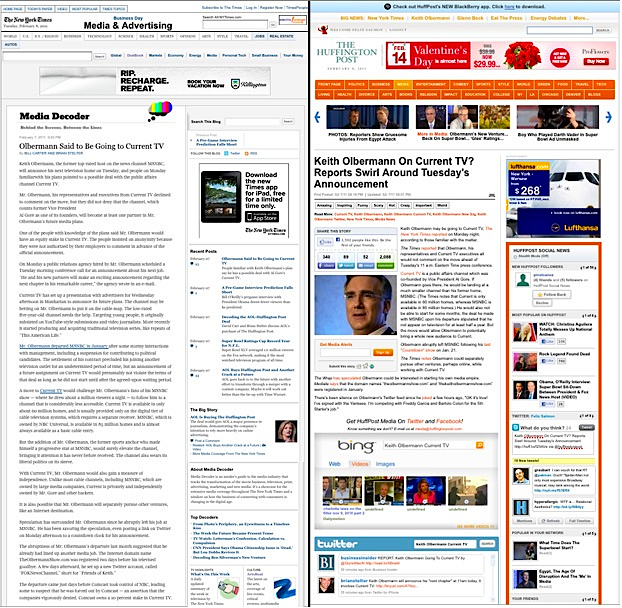
It’s worth using a specific example here, so let’s take Dave Pell’s suggestion and look at the NYT’s Olbermann scoop last night, and HuffPo’s reblog of it. When Pell first tweeted the comparison, the NYT blog had no comments, while the HuffPo blog had “hundreds of comments/likes.” Now, the NYT post is up to 93 comments, but the HuffPo post is still miles ahead: 2,088 comments, 1,392 likes on Facebook, 340 Facebook shares, 89 tweets, and 52 emails. All of which figures are easily visible in a colorful box at the top of the story. The NYT, by contrast, keeps such numbers to itself. …
Still, the difference between the two pages is much starker than it needs to be: the NYT page is like walking into a library, while the HuffPo page is like walking through Times Square. The HuffPo page is full of links to interesting stories elsewhere on the site — about Egypt, or the kid in the Superbowl Darth Vader ad, or the stories my Facebook friends are reading. And there are lot of links to media stories, too; each one has a photo attached. The NYT page, by contrast, feels like it’s at a site-map dead end. It’s part of the Media Decoder blog, and almost every NYT story linked to on the page is also part of that blog. There are almost no photos; there is almost no color. …
Once the paywall goes up, it’s certain that non-subscribers — the vast majority of the NYT readership — will read fewer pages per month than they did before. The NYT’s navigation was never very sticky, as we’ve seen, but from here on in there will actually be a substantial economic incentive not to explore the site, and to save up your precious quota of pageviews for when you need them most.
One of the paradoxes of news media is that most of the time, the more you’re paying to use it, the harder it is to navigate. Sites like HuffPo make navigation effortless, while it can take weeks or months to learn how to properly use a Bloomberg or Westlaw terminal. Once the NYT implements its paywall, it’s locking itself into that broken system: it will be providing an expensive service to a self-selecting rich elite who are willing to put in the time to learn how to use it. Meanwhile, most Americans will happily get their news from friendlier and much more approachable free services like HuffPo.
We personally favor the Times page, by far. Look, there are things The Times could do better here – we think there should have been a photo with that Media Decoder post – but there are so many other sites that do what the Huffington Post does, and better. Most of AOL’s properties do what HuffPo does better.
The Huffington Post is the MySpace of SEO articles. Someone’s eventually going to come with a way to do what they do that’s nicer, slicker, and doesn’t overwhelm the eye. Or Arianna’s folks are going to have to redesign to streamline things. One of the two.
In fact, we’d argue, they’ll redesign because they have AOL’s folks on board now. AOL’s designers are better than HuffPo’s, and they’re going to figure out a way to rein in the overwhelming amount of stuff going on. Politics Daily and AOL News are a breeze to use compared to HuffPo, and that’s no accident. And just look at Engadget if you need proof that they could completely nail this redesign.
Right now, HuffPo looks like what would happen if you took every Web 2.0 startup and put EACH of their widgets on a single page. The only thing it needs is an Apture bar and a Meebo bar and it’d be complete. It’s surprising it doesn’t take five minutes to load.
But here’s another thought: That Media Decoder post could be half as long and say everything it needs to say. The fact that it’s not probably hurt it.
Posted by ShortFormBlog • Permalink
Politics: Parallels: Obama's careening to midterms just like Ronald Reagan
- reaganHaving inherited a recession and sporting a 10.4 percent jobless rate, the GOP managed to only lose 24 seats in the House and hold a 54-seat majority in the Senate during the 1982 midterms.
- obama Under similar circumstances – and a much lower jobless rate – many analysts are predicting that Dems will lose the House and may lose the Senate come November. How about that for parallels? source
Posted by Ernie Smith • Permalink
Tech: Comparison: Posterous is big. Tumblr is a phenomenon.
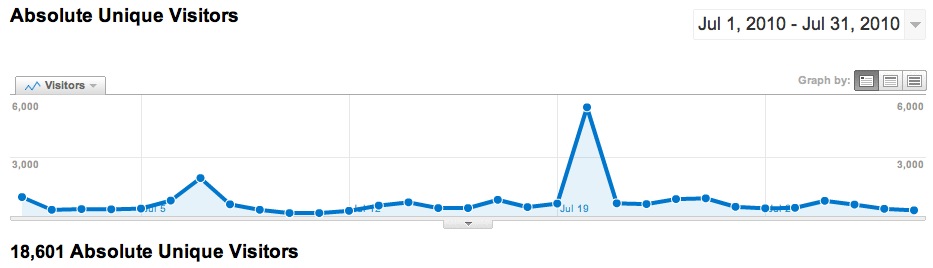
- Posterous is growing, yeah, but Tumblr is basically going to be the next Twitter. Eight million unique visitors per month versus less than two million? It's not really a contest. (Though in Posterous' defense, though, other companies such as Reddit have complained that these stats aren't always accurate – we know, for example, that our stats are totally off and our numbers in July, for example, are nearly triple what Compete says they are.) source
Posted by Ernie Smith • Permalink
Politics: Max Headroom: Godwin's Law broken again and again
-
Glenn Beck: Nazi-obsessed The fact of the matter is, there are dozens of clips that feature the Fox News talker bringing up Nazi Germany. We're going to use this one because he cries in the clip. If this were an isolated incident that'd be one thing, but he regularly does this song and dance.
-
Lewis Black: Stop it, Glen With this bevy of ammo, "The Daily Show's" most gleefully annoyed commentator went on the attack, noting how Beck is the guy who regularly brings up Nazis. Inspired even for a "Daily Show" rant, Black makes a totally convincing argument in his spiel.
-
Newt: Full steam ahead Just days after Black's deafening rant, Newt Gingrich compared the Obama administration to Nazi Germany and Soviet Russia (something he says in his new book). You'd think Black's rant would perhaps quiet the Nazi comparison racket. Nope. Not so much.
Posted by Ernie Smith • Permalink
Tech: How Ning could learn from Moveable Type's licensing folly
- 2004 Six Apart announces that they're going to limit the free version of their Moveable Type.
- 2006 Moveable Type makes it free for personal use again, after open-source Wordpress quickly leapfrogs it.
- thurs. Ning, a free social network creator, decides to start charging all users – including the many free users.
- today Social network hubs Grouply and grou.ps, offer to take on Ning's old users. See the parallels, kids?
Posted by Ernie Smith • Permalink
World: Watergate and Papalgate: What the Pope has in common with Nixon
- So, Pope Benedict's got 99 problems, and a cover-up is one. The Pope is in the middle of one massive modern scandal, one which has already tapped his shoulder personally. He should consider his next move carefully, because he's looking just like Richard Nixon right now. Here's how (we ganked most of this from an Atlantic article, by the way, but we figure they won't mind):
First way: What did he know, anyway?
- Nixon While he wasn't involved with the Watergate scandal directly, his White House denied the scandal even after finding out, claiming they had "no knowledge" of what took place that fateful night.
- Benedict While nobody's claiming he committed any abuse himself, he reportedly found out about the scandal while a cardinal. The Vatican claims "no knowledge"; sound familiar?
Second way: The cover-up
It’s not the crime that gets you… it’s the cover up.
Former President Richard Nixon • Regarding the Watergate scandal, which ultimately was a fairly minor case in the grand scheme of things. If he came clean early and fixed the problem, he would've been fine! Similarly, the Pope could've saved himself a lot of grief if he had dealt with the incidents on his watch – a Wisconsin sex abuse case and a German priest's case (which, admittedly, he may not have known about). The lesson here? Deal with things when first happen; they hurt less.
Third way: Shooting the messenger
- Nixon During the scandal, Nixon held a very negative opinion of the press, claiming “the press is the enemy” to his long-suffering aides.
- Pope Over the weekend, the dude said he won't be “intimidated by petty gossip.” His aides made even more direct attacks on the media.
Fourth way: Thinking you're infallible
- The Pope is believed to be infallible; Nixon only thought he was. One thing that Pope Benedict has over Richard Nixon is papal infallibility, a concept that many misunderstand. He's infallible on specific dogmatic matters – matters which probably don't include sex scandals. Nixon, on the other hand, famously claimed in 1977 that “When the President does it, that means that it is not illegal.” Too bad the Supreme Court disagreed with him. source
Posted by Ernie Smith • Permalink
Politics: A watered-down health care bill might actually be a good thing
To those who argue that piecemeal health care reform is worse than no health care reform, I have five words: the 1957 Civil Rights Act.
Slate columnist Fred Kaplan • Regarding another piece of legislation that was watered down to nothingness. It's forgotten about now, but the legislation was the small push that led to much larger gains for the Civil Rights movement, and later much tougher legislation. It was testy at the time, too – Strom Thurmond filibustered the bill for an entire day, by himself – but the legislation led to big gains in the end. "The 1957 Civil Rights Act was a preposterously small hinge that helped swing open a very wide gate," Kaplan notes. "It's not out of the question that a pared-down health care bill might do the same." source
Posted by Ernie Smith • Permalink
Culture: Could Avatar make a Titanic-type run? Let's compare numbers.
![]()
- Avatar is looking good in its third weekend, dipping just 9% from last week. Not bad for a movie that had a relatively modest launch for a blockbuster. The secret to its success? The same as "Titanic" – staying power. But even if James Cameron's latest can't keep up, his trump card might be an even bigger deal.
- Titanic's track record:
- $1.8 billion total lifetime run – in 1998 money (holy crap)
- $200 million budget for what was expected to be a huge bomb
- $600 million in domestic grosses – in 1998 money! Holy crap!
- $28.6M Titanic's first-weekend box office take – decent, not spectacular
- $35.5M Titanic's second-weekend take – it went up by an astonishing 23.8%
- $36M Titanic's biggest week, which didn't come until week six, by the way source
- How Avatar's catching up:
- $1 billion worldwide already – in just three weeks!
- $280 million the most likely budget for "Avatar"; totals have varied as widely as $250 million and $500 million
- $150 million has been spent on marketing the movie alone, which Fox is taking on the cost of
- $77M Avatar's first-weekend box office take; it was hurt by snow
- $75M Avatar's second-weekend take – down only 1.8%
- $352M Avatar's domestic gross after a $68 million third weekend source
- The 3D wildcard:
- $3-5 the markup the 3D adds to ticket prices source
- Big investment Cameron's film took years to build because of the fact that the technology had to come first, both for filming and in the theater. Cameron paid to build the technology himself along with a bunch of investors.
- Residual effect Fortunately for Cameron, he can sell the cameras to other filmmakers. "Journey to the Center of the Earth 3D" has already used it. Steven Spielberg and Peter Jackson's "The Adventures of Tintin" soon will.
- Cash for conversions Even better for studios, the technology is relatively easy to build into older films. For $30 million, a popular hit like, say, "Titanic," can have a brand new life in 3D. It's like a money machine for Hollywood. source
- Will it beat "Titanic"?
- Before inflation, probably. After, it depends. It's probably not likely that the movie will hold up sixteen straight weeks at No. 1 like Titanic, but it'll have a good shot of holding on tight thanks to the fact that it's going to be in IMAX (where it's made $66 million already) for months. But at the very least, it's looking like it has more staying power than "The Dark Knight," the biggest hit of the naughts. Well, before "Avatar."
Posted by Ernie Smith • Permalink
Culture: "Cloudy With a Chance of Meatballs" has a sunny box-office outlook
- -19% week-two dip, good enough for a second week on top in a week with a lot of wide releases source
Posted by Ernie Smith • Permalink