Read a little. Learn a lot. • Now Mullenweg-free! • Since 2009
☰

Tag: new york times

247 posts

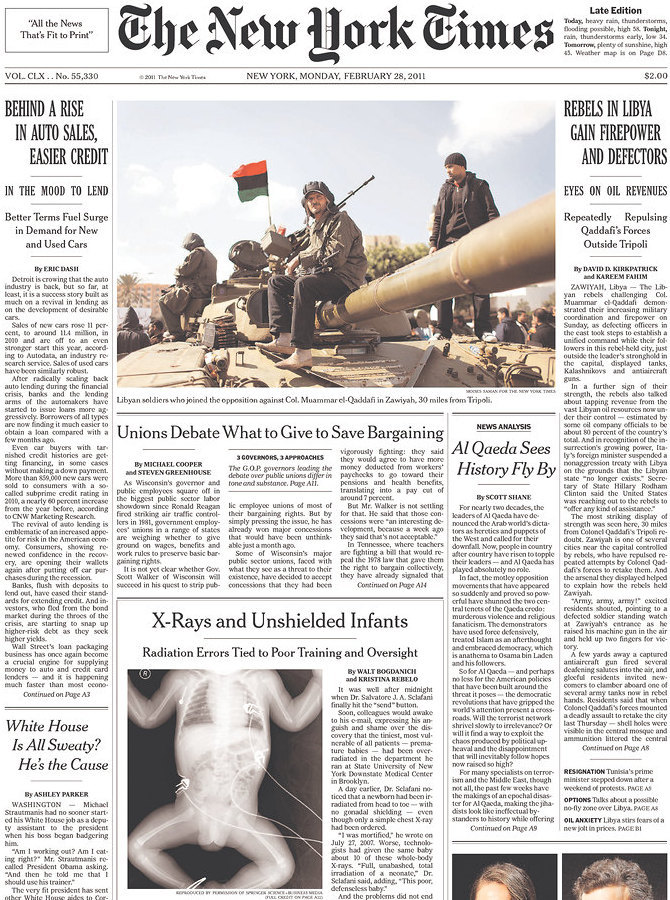
Feb 28 2011t
Feb 8 2011t

Reuters: Why the NYT will lose to HuffPo Tom McGeveran asks an important question, in his analysis of the…

kateoplis:

Reuters: Why the NYT will lose to HuffPo

Tom McGeveran asks an important question, in his analysis of the AOL-HuffPo deal:

What is it about the environment of traditional journalism that makes it so that readers are more likely to interact with the Huffington Post reblog of a New York Times article than they are with the article itself?

The answer to this question, I think, is also a key part of the reason why the NYT paywall is a bad idea.

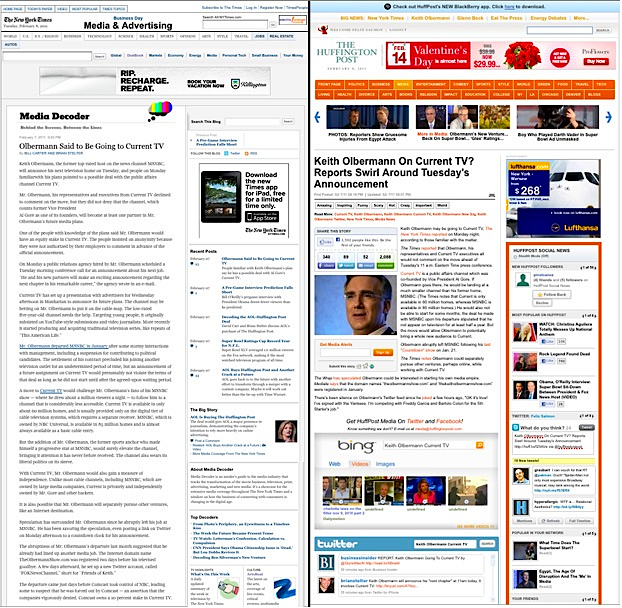
It’s worth using a specific example here, so let’s take Dave Pell’s suggestion and look at the NYT’s Olbermann scoop last night, and HuffPo’s reblog of it. When Pell first tweeted the comparison, the NYT blog had no comments, while the HuffPo blog had “hundreds of comments/likes.” Now, the NYT post is up to 93 comments, but the HuffPo post is still miles ahead: 2,088 comments, 1,392 likes on Facebook, 340 Facebook shares, 89 tweets, and 52 emails. All of which figures are easily visible in a colorful box at the top of the story. The NYT, by contrast, keeps such numbers to itself. …

Still, the difference between the two pages is much starker than it needs to be: the NYT page is like walking into a library, while the HuffPo page is like walking through Times Square. The HuffPo page is full of links to interesting stories elsewhere on the site — about Egypt, or the kid in the Superbowl Darth Vader ad, or the stories my Facebook friends are reading. And there are lot of links to media stories, too; each one has a photo attached. The NYT page, by contrast, feels like it’s at a site-map dead end. It’s part of the Media Decoder blog, and almost every NYT story linked to on the page is also part of that blog. There are almost no photos; there is almost no color. …

Once the paywall goes up, it’s certain that non-subscribers — the vast majority of the NYT readership — will read fewer pages per month than they did before. The NYT’s navigation was never very sticky, as we’ve seen, but from here on in there will actually be a substantial economic incentive not to explore the site, and to save up your precious quota of pageviews for when you need them most.

One of the paradoxes of news media is that most of the time, the more you’re paying to use it, the harder it is to navigate. Sites like HuffPo make navigation effortless, while it can take weeks or months to learn how to properly use a Bloomberg or Westlaw terminal. Once the NYT implements its paywall, it’s locking itself into that broken system: it will be providing an expensive service to a self-selecting rich elite who are willing to put in the time to learn how to use it. Meanwhile, most Americans will happily get their news from friendlier and much more approachable free services like HuffPo.

We personally favor the Times page, by far. Look, there are things The Times could do better here – we think there should have been a photo with that Media Decoder post – but there are so many other sites that do what the Huffington Post does, and better. Most of AOL’s properties do what HuffPo does better.

The Huffington Post is the MySpace of SEO articles. Someone’s eventually going to come with a way to do what they do that’s nicer, slicker, and doesn’t overwhelm the eye. Or Arianna’s folks are going to have to redesign to streamline things. One of the two.

In fact, we’d argue, they’ll redesign because they have AOL’s folks on board now. AOL’s designers are better than HuffPo’s, and they’re going to figure out a way to rein in the overwhelming amount of stuff going on. Politics Daily and AOL News are a breeze to use compared to HuffPo, and that’s no accident. And just look at Engadget if you need proof that they could completely nail this redesign.

Right now, HuffPo looks like what would happen if you took every Web 2.0 startup and put EACH of their widgets on a single page. The only thing it needs is an Apture bar and a Meebo bar and it’d be complete. It’s surprising it doesn’t take five minutes to load.

But here’s another thought: That Media Decoder post could be half as long and say everything it needs to say. The fact that it’s not probably hurt it.

Posted by ShortFormBlog • Permalink

Jan 25 2011t

On newsy stuff we like reading that has nothing to do with Tumblr

jeffmiller asks: What are your favorite (non-Tumblr) websites for news. (Or rather, what news websites do you read on a daily basis?)

  • » We say: Outside of our staple news sites (Reuters, CNN, the NYT and such), my personal favorite site is Mediaite, which I think strikes the perfect balance between news and commentary, and I can guarantee to generally have its finger on the pulse. (The aftertaste is also a little better than Politico, generally.) I also like a lot of The Atlantic’s stable, including The Atlantic Wire, which is a bit of an unsung hero among news commentary sites. I also greatly adore Hacker News, where you can usually find something generally awesome going on, be it a cool startup or interesting technical debate, and have been a faithful reader of Pitchfork, Slashdot and Fark since the late ‘90s. Gawker Media’s stuff is staple food for me, and I’ve been a huge fan of Dave Weigel especially since he moved over to Slate. As for news outlets that never get their fair shake, the Christian Science Monitor always has stuff well-suited to SFB articles. And there’s a lot to like about The Awl. (It’s our Office Hours! Ask us stuff!)

Posted by ShortFormBlog • Permalink

Jan 23 2011W

U.S.: The NYT makes Rockford, Illinois look as depressed as possible

  • "Dear residents of Rockford, Illinois: This is The New York Times. We're doing a photo feature on why your town is so depressed and lacking in jobs. (16 percent unemployment?! We need to do this story, stat!) We need to take photos of your citizens. None of you are allowed to smile. If you smile, we're going to find someone else who looks plainer than you. OK? Thanks. We'll send a photog from Manhattan to the Rust Belt on a private jet sometime next week. Remember. Plain. No smiles. Optimism is dead. Thanks." source

Posted by Ernie Smith • Permalink

Jan 12 2011t

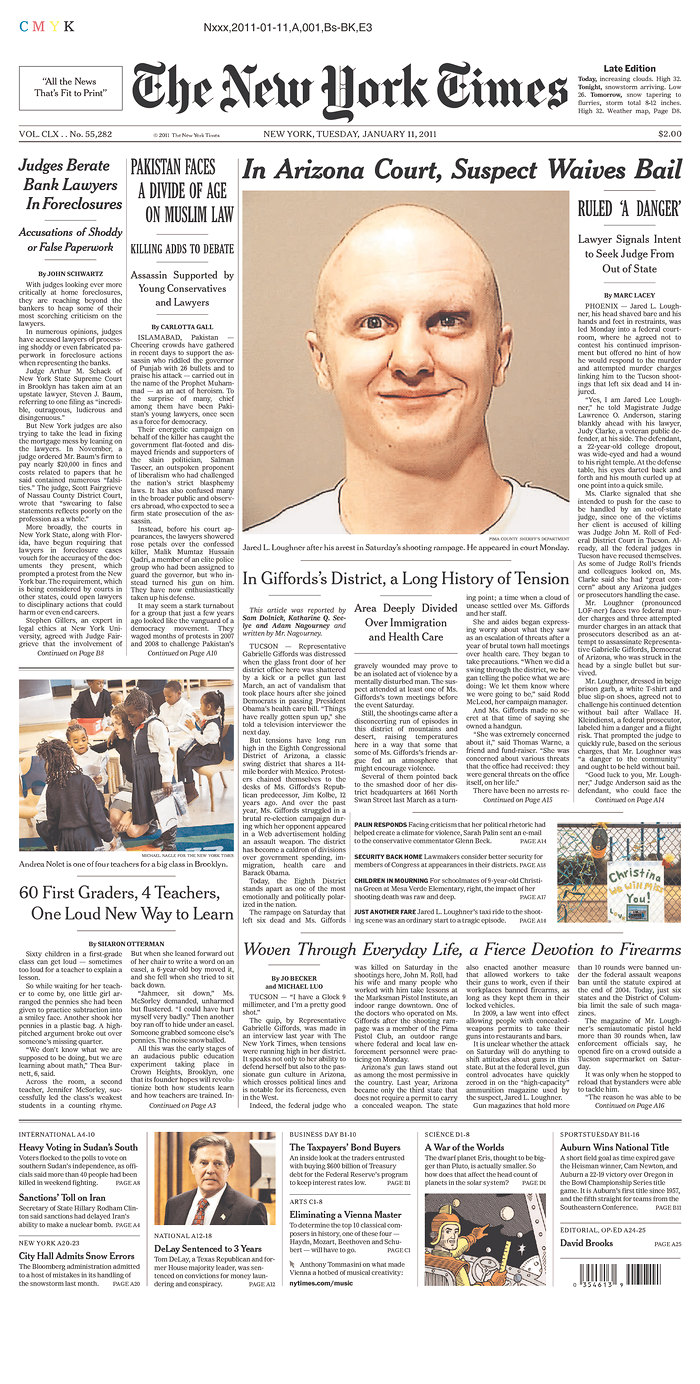
On the differing play of Jared Loughner's insane mugshot

bitshare said: I am not surprised by the NY Post front page because they are always a bit TMZish to me. However, I was taken back when I saw the NY Times front page and how they covered his image large on the front page. I thought it was very distasteful.

  • » We say: Obviously it’s matter of preference, but we actually thought that the NY Times played it the way it should’ve been played. Let’s face it – this photo ranks up there with similar shots of cultural monsters like Charles Manson and the Unabomber, and will be remembered decades from now, unfortunately. As the Times has a paper-of-record role going on, the truth is, that shot is what everyone will be talking about, and none of the other photos on the wires had a tenth of its power. Many other papers gave it similar play. As for the other papers we mentioned, we clearly don’t recommend emulating the NY Post, and the Washington Post felt timid. Either way, it’s fascinating to see, in situations like this one, how different papers handle the same story.

Posted by ShortFormBlog • Permalink

Jan 11 2011W

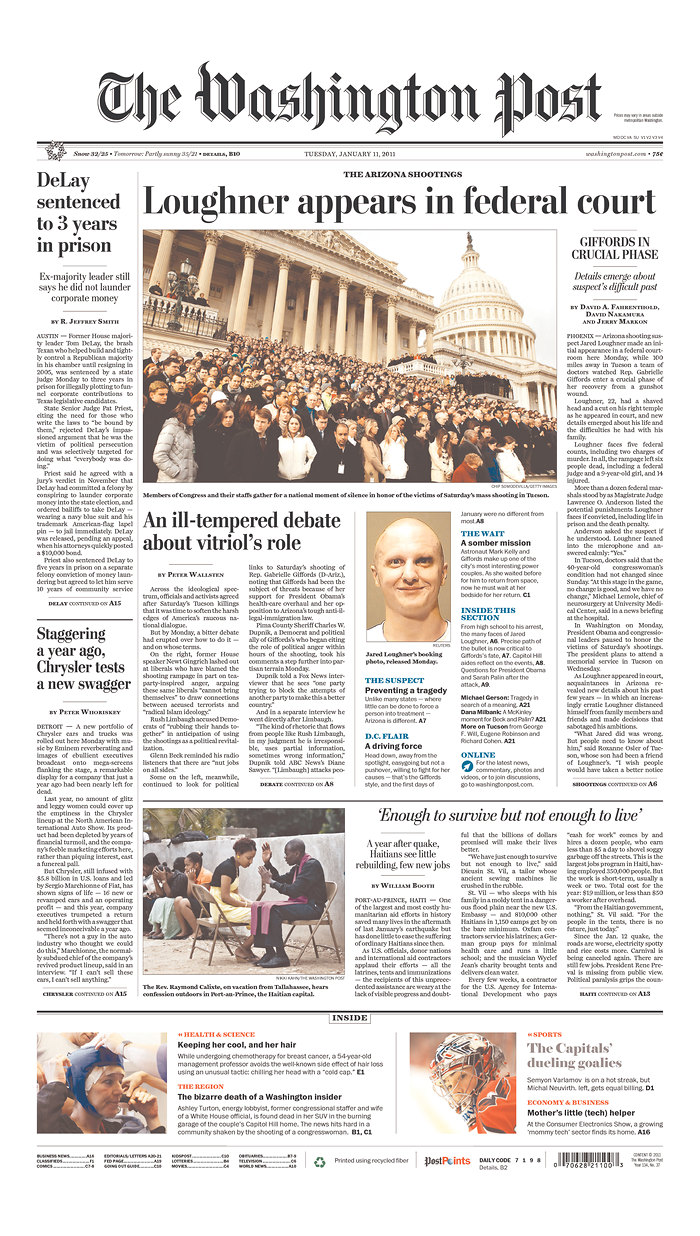
U.S.: How major newspaper editors played Jared Loughner's mug

  • too hot New York Post editor Col Allen, on blowing the photo out: "We felt his leering grin and wild eyes revealed something of his mental state. The image conveyed a sense of madness."
  • too coldWashington Post editor Marcus Brauchli, who chose to stay local over giving the mugshot big play: "Our community is one of the communities hard hit by this. The photo reflected that."
  • just rightNew York Times editor Bill Keller, on playing the pic at an effectively large (for them) three columns: "It felt to me like the obvious right choice. This was the picture of the day." source

Posted by Ernie Smith • Permalink

Dec 14 2010W

U.S.: Air Force blocks newspapers that published Wikileaks materials

  • 25 news sites blocked by the Air Force over Wikileaks fears source
  • » What's the point? Not allowing people to read The New York Times and The Guardian seems a little extreme, and the effect is futile, anyway. Why's that? Well, see, all they have to do to read the cables is GO HOME AND FIRE UP THEIR LAPTOP. Wow, that's some effective security there, guys. By the way, the Army, Navy and Marines aren't doing this, and the Department of Defense is formally distancing itself from the Air Force on this issue.

Posted by Ernie Smith • Permalink

Dec 14 2010W

World: 1931: By 2011, workers and CEOs will all earn the same

  • things have changed in the last eighty years. Of course, no one in 1931 could have predicted the exact nature of those changes, but that didn't stop people from trying. Back when Herbert Hoover was being hailed as the next big thing, The New York Times asked several prominent thinkers to predict what life would look like in eighty years. The results are part dead-on, part way off, and all highly amusing. source

Posted by Seth Millstein • Permalink