Read a little. Learn a lot. • Now Mullenweg-free! • Since 2009
☰

Tag: journalism

694 posts

Nov 9 2009W

U.S.: Good grades for good reporting? Prosecutors attack journalism program

Why are we talking about our grades when we should be talking about whether there's an innocent man in prison?

Evan Benn • A former student of Northwestern journalism professor David Protess. Protess' investigative journalism class is under investigation in the case of a 1978 killing of a security guard in Illinois. Why's that? His class tends to uncover leads in cases such as this one (where they have evidence to prove they have the wrong man), and the prosecutor's suggesting that students do it not for the reporting or the investigation, but for better grades. Deplorable action by the prosecution. (FYI: This is an AP story we linked; we don't like to do this, but felt the subject matter was too good and vital to not run.) source

Posted by Ernie Smith • Permalink

Oct 14 2009W

Tech: Digg vs. the human hand: Why the world needs an editor

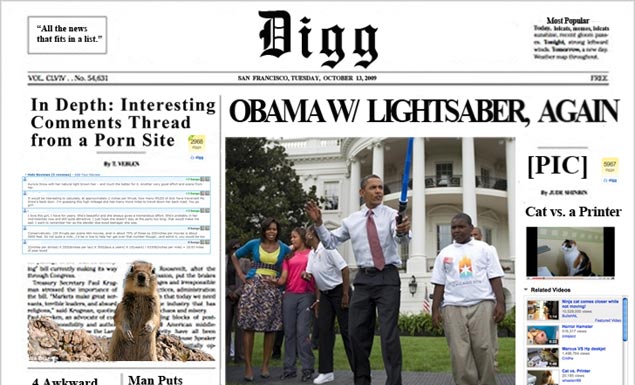
Digg as a newspaper This image, while funny, nails what (to us) is wrong with Digg. It's not that there isn't a place for funny/bizarre content or the chance to be goofy, but when it's all you've got, it seems a little threadbare. And it's not even their fault. It's how democracy works sometimes.

  • Editors vs thumbs In a lot of ways, sites like Digg can replace rooms full of journalists and editors with a single yes/no thumb system. It works on the idea of visceral impact, much like TV news does. But when visceral impact is all you got, it stops becoming what you need to know and turns into what you want to know.
  • Eating veggies Sometimes, the stories that aren't very sexy are the most important. Newspapers spend hours debating these stories daily. But those stories can get overlooked in the hunt for a sexy headline. Editors have struggled with this very issue for years. Does it even come up for people clicking on thumbs?
  • It's not all bad We don't want to disparage link journalism, because it can work. We're big fans of Y! Combinator's Hacker News, for example, because it has this strong mix of audience, community and focus. The Windy Citizen does a great job applying it to a local market. We want to see more of this.

Posted by Ernie Smith • Permalink

Oct 13 2009W

World: Carter-Ruck had the U.K. press over a barrel in parliament

The media laws in this country increasingly place newspapers in a Kafkaesque world in which we cannot tell the public anything about information which is being suppressed, nor the proceedings which suppress it.

The Guardian editor Alan Rusbridger • Describing a bizarre situation in which his newspaper was not allowed to publish a question about the Trafigura toxic waste scandal. The gag pushed for by the Carter-Ruck law firm, was lifted just a short time ago. Reminder: The U.K. doesn't have the same freedom of press as the U.S., so stuff like this occasionally happens. source

Posted by Ernie Smith • Permalink

Oct 9 2009W

Biz: Dear Associated Press: Our boycott of you is still freaking on

We content creators have been too slow to react to the free exploitation of news by third parties without input or permission.

Associated Press Chief Executive Tom Curley • Discussing the idea of charging search engines money for finding their content. Rupert Murdoch of News Corp. is also on board. May we just say, as the Associated Press looks to screw over the entire Internet with its greed and lack of foresight, we would like to welcome our new Reuters overlords. (In case you're wondering: We're going to continue to post stuff from News Corp., because, come on, Glenn Beck!) source

Posted by Ernie Smith • Permalink

Oct 6 2009W

Tech: Blog or news source? The inconsistent ways of Google News

Dividing content along these lines is like classifying brownies based on whether they were baked in aluminum or glass pans. There’s no difference, and it obscures what you really want know: if they contain chocolate chips.

Neiman Journalism Lab blogger Zachary M. Seward • Making a strong, interesting point about Google News' new, and very inconsistent, labeling policies of blogs. Here's one example: Talking Points Memo recently switched back to being a news source from being a blog. Here's another (weirder) one: Gizmodo is a news source, and Deadspin is a blog, despite the fact that both are owned by Gawker Media. And the process of getting added to Google News, anyway, seems completely arbitrary. By the way, we love how Seward worded this. source

Posted by Ernie Smith • Permalink

Oct 5 2009W

Tech: Knight Foundation: Everyone (not just EveryBlock) should benefit

  • Oops, this open source code isn't very useful on its own! The Knight Foundation, which has been funding startups for a few years as part of their Knight News Challenge, was quite excited at the sale of EveryBlock to MSNBC in August. But now it's having second thoughts. Why? Because it was released to the public as a piece of open-source code – not a plug-and-play package that newspapers can easily use. So they're getting a new team to finish up the EveryBlock code which so it can be rolled out simply. Other startups will get treated the same way. We imagine some applicants to the Knight News Challenge (deadline coming soon!) might get turned off by this, but the goal was always to help journalism in general. source

Posted by Ernie Smith • Permalink

Aug 30 2009W

Tech: Got a Fwix on a big story? There's an iPhone app for that

  • Journalism now fits in your pocket. With a new iPhone app coming this week, hyperlocal startup Fwix is ready to get in on the journalism-as-it-happens game. The app allows regular people to file news reports (which can include photos and videos) onto the company's Web site, allowing for a kind of journalism that Twitter kind of allows already, but pushed even further. Are we replacing professional journalists with iPhone apps? Good question. Maybe a necessary one to ask. source

Posted by Ernie Smith • Permalink

Tags for this post