The BBC recently brought on Jeff Jarvis to talk about Facebook’s recently-disclosed hacking incident, and Jarvis spent three minutes laying into his interviewer. “This is irresponsible journalism,“ he says in the clip above, "This is crap… There’s no story here. This interview shouldn’t exist. I said that to your pre-interviewer, I’ll say it to you, you’re just causing a panic and there’s no reason for it. Answer me that, please.” Protip: Don’t piss off Jeff Jarvis.
Tag: jeff jarvis
5 posts
This may be the longest comment in Internet history. In this Google Docs-produced reply, Jeff Jarvis tears…
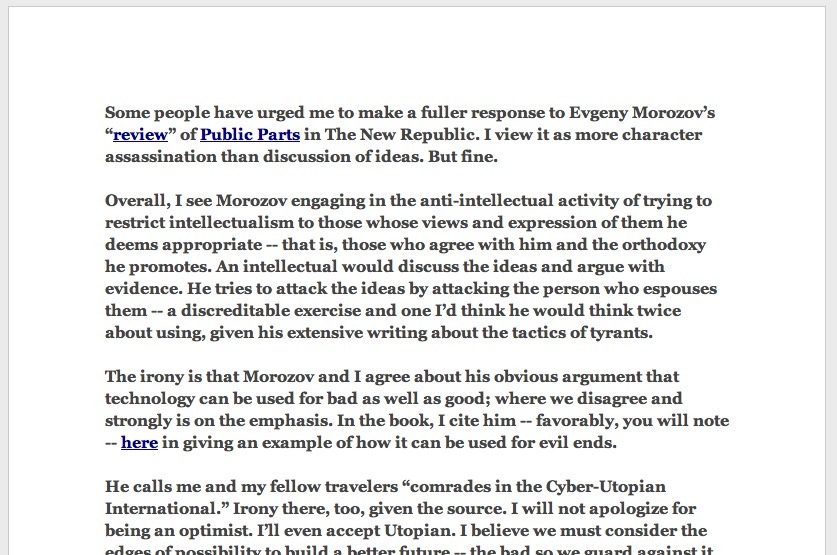
This may be the longest comment in Internet history. In this Google Docs-produced reply, Jeff Jarvis tears apart, piece-by-piece, a lengthy review Evgeny Morozov wrote of his latest book, “Public Parts: How Sharing in the Digital Age Improves the Way We Work and Live,” a buzz-building article in which Morozov pretty much tears Jarvis apart. “Had Jarvis Written his book as self-parody — as a cunning attack on the narrow-mindedness of new media academics who trade in pronouncements so pompous, ahistorical, and vacuous that even the nastiest of post-modernists appear lucid and sensible in comparison — it would have been a remarkable accomplishment,” Morozov writes. “But alas, he is serious. This is a book that should have stayed a tweet.” Total word count of Morozov’s review? 6,389 words. Total word count of Jarvis’ lengthy rebuttal (which includes Morozov’s article, by the way)? 11,605 words. As a service to our short-form readers, we’d like to cut this down to three sentences: “Guy writes book on sharing stuff. Other guy shares his opinion of the book, at length. Original guy gets in huff, responds at length.”
Posted by ShortFormBlog • Permalink
Tech: Jeff Jarvis: Craiglist's disruptor status makes it an easy target
So why are government and media going after Craigslist? The same reason, I think, that media and government in, for example, Germany are demonizing Google (even as the German people give Google its biggest market share anywhere in the world). They’re going after the disruptors, the biggest disruptors in sight.
Jeff Jarvis • Explaining his reasoning about the whole Craigslist "Adult Services" thing, which sounds like a fairly original angle on the whole thing. Craigslist has cost the newspaper industry billions in revenue by simply being able to provide a once-expensive service (classified ads) for free. With a decline in classified revenue of $13 billion across the industry, which might make the media more apt to give this controversy a little extra coverage. "I’m not suggesting conspiracy; I rarely do," Jarvis writes. "But I do see old power structures huddling together against the cold breath of technologists bringing change." Remember creative destruction? This is how oid dinosaurs can react to it, if it's necessary. source
Posted by Ernie Smith • Permalink
Biz: Jeff Jarvis: The FTC's favoring old journalism over innovation
If the FTC truly wanted to reinvent journalism, the agency would instead align itself with journalism’s disruptors. But there’s none of that here.
Journo-expert Jeff Jarvis • Regarding a recent Federal Trade Commission report on how to save journalism. He notes as sort of a key fact that the entire document only mentions the word "blog" once, despite the fact that many blogs are as "real content" as you're going to get. And the document, overall, seems skewed in favor of establishment journalism, with suggestions that could seriously damage innovation in the industry. "Here, the internet is not the salvation of news, journalism, and democracy. It’s the other side," he writes. source
Posted by Ernie Smith • Permalink
Politics: The professional god-like newspaper critic: A dying art form?
We're all critics. If I were starting Entertainment Weekly today, it wouldn't be a magazine, and it likely wouldn't hire critics.
Entertainment Weekly founder (and iPad hatah) Jeff Jarvis • Regarding the state of criticdom. With a much wider variety of voices and the decline of the newspaper industry, the importance of movie, music, food and book critics is quickly declining, and some wonder if the nuance of the art will go away. "If Roger Ebert says it, does it carry value? Yes," Jarvis notes. "But how many Roger Eberts are out there, and how many do we need?" Personally, we like Roger, but Metacritic gives a wider range. source
Posted by Ernie Smith • Permalink
