Read a little. Learn a lot. • Now Mullenweg-free! • Since 2009
☰

Tag: japan earthquake

129 posts

Mar 15 2011W

World: UPDATE: Fukushima's radiation levels drop significantly

  • 11.9 the current peak radiation count, in milli-sieverts per hour
  • 400 the peak radiation count in milli-sieverts per hour – which was hit last night
  • 300k the peak mSv/hour count at Chernobyl – to keep things in check source
  • » It's no longer at its peak, and that's a good thing: The International Atomic Energy Agency says that the decrease happened over a six-hour period. And the IAEA makes a good point that you should keep in mind. "This is a high dose-level value, but it is a local value at a single location and at a certain point in time," they say. In other words, even if you're within the 20-mile radius where radiation is likely to hit, the level will most assuredly be far lower than these peak levels. It's still high, though – one milli-sievert per hour is equal to the yearly legal limit of radiation you're supposed to get. (see our earlier posts about this topic here and here)

Posted by Ernie Smith • Permalink

Mar 15 2011W

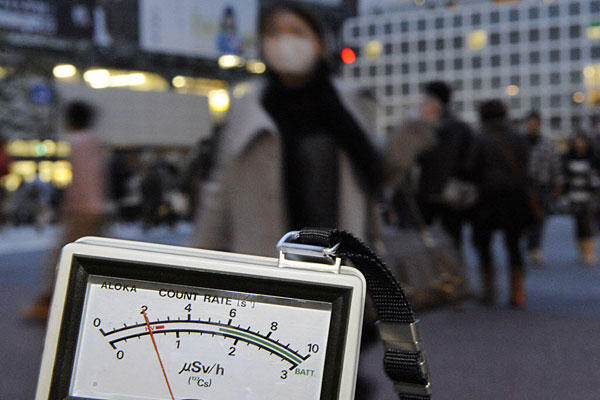
World: Tracking radiation levels in Tokyo: A minorly scary photo

  • Photo of the day: "A radiation detector marks 0.6 micro-sieverts, exceeding normal levels Tuesday, near Shibuya train station in Tokyo. Concern over possible radiation exposure has increased after a fourth reactor released radiation, Tuesday." To compare – this level is higher than average, but only a tiny percentage of what's happening at the plant. 1,000 micro-sieverts per hour equals one milli-sievert per hour. So this is high, but still minor. (Kyodo News/AP) source

Posted by Ernie Smith • Permalink

Mar 15 2011t

Last word on the Gilbert Gottfried thing before we cover actual news

laurelove:

drinkthe-koolaid:

I’m not sure how much of it is stupidity and how much of it is just a lack of empathy or sensitivity. I have a theory that may apply here, if I may be so bold.

I was just talking to my son about how the majority of people seem to forget (or not care) that their actions affect other people. I’m sure many of these people are perfectly intelligent in conversation, but you release them into the wild and they appear stupid because their actions make no sense to people who do have common courtesy. If my theory is true, then one could even say that this is probably the major problem with the world today.

Everyone is going have their own a opinion. But let me guess, BECAUSE he’s a celebrity his opinion matters?! There’s a whole blog dedicated to hating on the Japanese and saying it’s their karma. THIS ISN’T NEWS! Who cares what this one man with money and lack of acting skills has to say.

Actually, this is worthy of mentioning because he got fired from a high-profile job for being an idiot and saying edgy things about Japan. Had he not gotten fired, we would’ve ignored it. But because he did, it’s news (sorta).

Posted by ShortFormBlog • Permalink

Mar 15 2011t

If all workers do in fact leave the plant, the nuclear fuel in all three reactors is likely to melt down…

If all workers do in fact leave the plant, the nuclear fuel in all three reactors is likely to melt down, which would lead to wholesale releases of radioactive material — by far the largest accident of its kind since the Chernobyl disaster 25 years ago.

— The New York Times • In this article about the possibility of Fukushima workers leaving the plant. Scary, yes, but we refer you to this link we posted earlier. It could be bad, but it won’t be kill-us-all bad.

Posted by ShortFormBlog • Permalink

Mar 15 2011t

Japan Earthquake, Tsunami Recap (Tuesday Morning)

producermatthew:

Here is the recap for Sunday evening to Monday morning. For the previous recap, click here.

• Exclusive video: A panoramic view of tsunami damage in Japan

• Video: Dog tries to escape massive tsunami wave

• Photo: Baby examined for radiation at nuclear shelter

• Photo: Man finds car, hopes to find missing family following tsunami

• Photo: Lone man walks through destroyed village

• Photo: Body of man killed by tsunami in Iwaki Prefecture

• Photo: Severe road damage in Asahi City

• Photo: NHK says a million could be missing in Japan

• Photo: US Air Force conducts search mission over Sendai Airport

• Photo: Satellite image of damaged nuclear reactors at Fukushima

• Graphic: Nikkei sharply falls on second day of trading in Japan

• Story: Chinese journalists stranded in Japan without fuel, food

• Story: Radiation detected 280 kilometers from Fukushima nuke plant

• Story: Journalists evacuate from Fukushima nuclear power plant

Live streaming video is now available on this blog for NHK World (English), NHK Japan and TBS Japan. Updates throughout the day are also available from select blogs via the #tsunami curation page.

As always, ProducerMatthew finds the best content. Thanks again to him for posting for us overnight!

Posted by ShortFormBlog • Permalink

Mar 14 2011W

World: UPDATE: What does "400 times annual legal limit" mean?

  • 400 the amount of radiation in the air, in milli-sieverts per hour, according to the given estimate
  • 40 the amount of radiation that is, in roentgen per hour – which, don't get us wrong, is very high
  • 30k the amount of radiation in Chernnobyl had – which Fukushima doesn't touch source
  • » This is an extremely large jump: One milli-sievert per hour is the legal annual limit for radiation in a year. Our earlier estimate showed a level of 8,217 micro-sieverts. 1,000 micro-sieverts equals 1 milli-sievert. So we went from 8,000 to 400,000 in a couple of hours. This is still no Chernobyl, but this is a huge jump. If it jumps to 1,000,000 micro-sieverts, it leads to radiation sickness – and then we're in trouble.

Posted by Ernie Smith • Permalink

Mar 14 2011W

World: Some quick math: How does Fukushima compare to Chernobyl?

  • » To explain: This number comparison is to emphasize the difference between an actual going-to-kill-us-all meltdown and what's happening in Fukushima. While things could get worse from here, right now, the worst of what's happening in Fukushima is 0.002739 percent as bad as the worst of the Chernobyl disaster. 400 rontgen is enough radiation to kill you. 10,000 micro-sievert equals 1 rontgen. Chernobyl was pushing out 30,000 rontgen per hour at its core – enough to kill someone in 48 seconds. This is an important point to make – while levels are higher than normal, this is extremely minor on the scale of a real disaster. Oh, and one more thing – Fukushima only hit its 8,217 micro-sievert peak for a very short period. Chernobyl's level was sustained.

Posted by Ernie Smith • Permalink