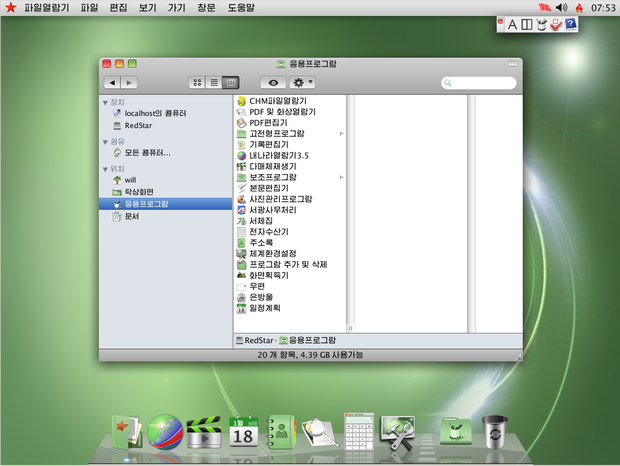
North Korea has its own homegrown operating system, RedStar, and it doesn’t look like Mac OSX in the slightest.
 ShortFormBlogRead a little. Learn a lot. • Now Mullenweg-free! • Since 2009
8 posts
North Korea has its own homegrown operating system, RedStar, and it doesn’t look like Mac OSX in the slightest.
Posted by Ernie Smith • Permalink
Posted by Ernie Smith • Permalink

I am a street photographer in New York City. Several months ago, I was approached by a representative of DKNY who asked to purchase 300 of my photos to hang in their store windows “around the world.” They offered me $15,000. A friend in the industry told me that $50 per photo was not nearly enough to receive from a company with hundreds of millions of dollars of revenue. So I asked for more money. They said “no.”
Today, a fan sent me a photo from a DKNY store in Bangkok. The window is full of my photos. These photos were used without my knowledge, and without compensation.
I don’t want any money. But please REBLOG this post if you think that DKNY should donate $100,000 on my behalf to the YMCA in Bedford-Stuyvesant, Brooklyn. That donation would sure help a lot of deserving kids go to summer camp. I’ll let you guys know if it happens.
Bad form by a giant corporation. Deserves to be called out.
EDIT: DKNY has responded.
Posted by Ernie Smith • Permalink
The premise of the Government’s forfeiture request is that Megaupload never earned a single penny that was not criminal under U.S. law — whether, say, from a non-infringing use of its service, or from use that occurred wholly outside the United States and beyond reach of U.S. law, or even from an infringing use within the United States as to which Defendants nonetheless qualify for a statutory safe harbor or lacked requisite criminal intent.
— A legal motion by the founders of Megaupload • Asking for the dismissal of the case and a return of the millions of dollars seized from them, on the premise that the government did not do their due diligence, assuming that every transaction was criminal in nature (despite “substantial non-infringing uses”), and ignoring the fact that they had no jurisdiction anyway. Among the arguments in the lengthy motion: “Megaupload was a non-U.S. company whose activities mostly occurred overseas and whose users were mostly located overseas.“ Will be fascinating to see what happens as a result of this motion.
Posted by ShortFormBlog • Permalink
Posted by ShortFormBlog • Permalink
Media Piracy in Emerging Economies, an academic report on pricing and copyright infringement in poor countries, comes to the conclusion that high media prices (as measured against the average wage in poor countries) are responsible for piracy — that is, when you control for social attitudes towards copying, enforcement differences, and so on, the largest predictor of whether a country will have rampant copyright infringement is whether the media in that country is priced high relative to peoples’ earning power.
Fun fact: A lot of media also costs too much in the first world for a lot of people. You know, for example, they could stop all piracy of Photoshop if they made it $30, and as a result would benefit from economy of scale. Apple is figuring this out too, because they’ve cut the prices of most of their pro apps as they’ve moved to the App Store model.
Posted by ShortFormBlog • Permalink
Posted by Ernie Smith • Permalink
A statement from Viacom • Regarding what they feel is a culture of copyright infringement – a statement they released after documents from a lawsuit between the two firms became public today. Viacom first sued the Google-owned company in 2007 for $1 billion. They used old statements from the founders suggesting that they knew what they were doing – ripping off copyrighted content.
YouTube Chief Counsel Zahavah Levine • Giving his take on the lawsuit and documents on the site's blog. He argues that YouTube is following the "safe harbor" provision of the Digital Millennium Copyright Act, and Viacom themselves would send employees to a Kinkos for the singular purpose of uploading content to the site, going as far as "roughing up" the video to make it seem like it's from a second-hand source. Oh, and allowing copyrighted video to just stay on the site. source
Posted by Ernie Smith • Permalink