I know this sounds absurd to say, but I think this video kind of shaped my worldview.
Dan Deacon, performing live on Savannah’s WSAV, circa 2006.
 ShortFormBlogRead a little. Learn a lot. • Now Mullenweg-free! • Since 2009
160 posts
I know this sounds absurd to say, but I think this video kind of shaped my worldview.
Dan Deacon, performing live on Savannah’s WSAV, circa 2006.
Posted by Ernie Smith • Permalink
So, I do this thing where I publish a shorter version of Tedium on different outlets like Substack and LinkedIn. I call it Lesser Tedium, and I’m going to try it here. If you like it, subscribe to Tedium here. If you think it sucks, leave an angry comment, so I feel the depth of your anger.

In the midst of the recent Writers Guild of America strike, a lot has been said about the ways that writers are paid, particularly how the rules often end up being quite confusing.
But even when the rules work out, they can be weird as heck. My case in point: The weird case of what happened to the late-’80s show Sanchez of Bel Air.
This show, which aired during the fall of 1986, was a bit of a forgotten unicorn at the time of its release. Airing on the USA Network, the show had a lot in common with a later Bel Air-based television show, Fresh Prince of Bel-Air, albeit focusing on an upwardly mobile Latino family rather than a black one. It was a sitcom when cable television was not known for airing sitcoms.
The show aired on USA at a time when representation, especially positive representation, of Latinos on television was quite limited, and the show did receive criticism for not being particularly authentic. (One potential reason for this: While its cast—with the notable exception of Bobby Sherman, for some reason—was largely Latino, its creators, Dave Hackel and April Kelly, were white.)
The show was not a hit, and disappeared after just 13 episodes. But because it appeared so early in the history of cable television, it became a bit of an unexpected landmark for completely behind-the-scenes reasons.
See, as a part of the show’s creation as one of the first sitcoms explicitly produced for the medium, it led to the development of a residual agreement about how much writers received upon re-airings of the show. The current formula breaks down as such: For the second to fifth re-airings, writers get 50 percent residuals, then it shrinks down to 6 percent on the sixth re-airing and 4 for each of the 7th and 8th re-airings. Gradually, the scale slides down until the 13th re-airing, when every future replay gets 1.5 percent each.
This formula, crazy as it sounds, is better known than Sanchez of Bel Air. It’s called the Sanchez Formula, and is generally used for scripted shows that air on cable television.
In many ways, emerging technologies shift the game for writer compensation—and the current Writers Guild of America strike highlights how, when these rates fall out of sync with the work being created, it can create serious problems. While the Sanchez formula wasn’t perfect, it worked well enough that it has stuck around for nearly 40 years.
» Wanna learn more? Check out my 2018 piece “TV’s Hidden Math,” which explains why so many shows have 13 or 65 episodes—especially if they’re syndicated.
Posted by Ernie Smith • Permalink
Is it still Myst if you can’t tell what it is? I mean, look at this thing:
You could literally put anything into the Atari 2600 and say it’s Myst. How are people even going to figure it out?
Posted by Ernie Smith • Permalink
While labor unions have already represented others who aren’t salaried employees of tech firms—ridehailing drivers and other gig economy participants, for instance—IG Metall is trying to organize a disparate group which provides a less tangible service.
— Bloomberg Opinion writer Alex Webb, discussing the support a traditional German union is giving to a group of YouTube users who want to unionize. Webb notes that the play is a natural one for a group that could be left behind by an economy shifting from traditional forms of work. “Unions are ultimately fearful that disruption from digital platforms could unravel much of the progress they’ve made in improving labor conditions over the past 150 years,” he writes.
Posted by Ernie Smith • Permalink
Don’t let the pedigree fool you. PBS NewsHour correspondents know how to cut loose. Sometimes, they even produce mockumentaries. That’s the mission of Steve Goldbloom in his new PBS Digital Studies series “Everything But the News.” (Check out the trailer above.) Based on the behind-the-scenes subject matter of the new show—a visit to the Grindr offices, at-times-awkward interviews with celebrities and startup CEOs—this little series could do a bit to bump up PBS’ cool factor. (Not that it needs it. Any publicly-funded network responsible for the rise of Jim Lehrer is obviously awesome.)
The first episode of the new web series, over this way, is a nice little meta-commentary on the idea of PBS producing a quick-cut web series. (For one thing, Goldbloom’s at VidCon trying to steal pointers from Philip DeFranco.) For the news nerds out there, check out what Goldbloom told the Columbia Journalism Review.
Posted by Ernie Smith • Permalink
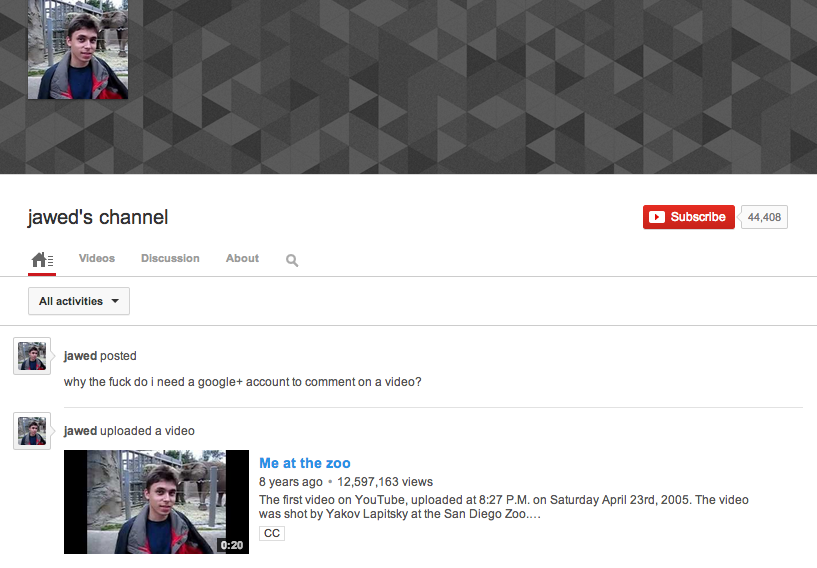
Eight years later, a man whose life was defined by a single groundbreaking video has come back to his creation only to find that he needs to register for Google+ to comment.
Posted by Ernie Smith • Permalink
[ ](http://www.underconsideration.com/brandnew/archives/new_logo_for_youtube.php?utm_source=feedburner&utm_medium=feed&utm_campaign=Feed: ucllc/brandnew (Brand New)#.Uh9Of2SY7tG)
The problem with this logo, as shown on the site’s Twitter page:

That’s right: You can barely read the type at small sizes. It’s too thin. The simplicity is nice though. Good red.
Posted by Ernie Smith • Permalink
A web series for the quarter-life-crisis set: Remember A-Ha’s epic “Take On Me” video? Pretty great visuals, right? Well, here’s the problem with that video: Those comic-book visuals only last four minutes. Fortunately, for those of you who sorta wish they had a comic-book-style thing to plow their way through, check out Official Comedy’s “Settling,” which is sort of a moving comic book for the failed twentysomething set, shot with some unique filters for the full effect. If you need another failed writer in your life, check this show out. They also have a Tumblr, which you can follow over here.
P.S.: If you watch to at least episode 10, there’s nudity.
Posted by Ernie Smith • Permalink
YouTube is now home to the ressurection of David Brent, the starring character of the original verison of The Office, a landmark British show that essentially launched Ricky Gervais’ career in television and film (as well spawning the much-beloved American version). Whether YouTube’s efforts at drawing original content for their native channels will ultimately pay off competitively is yet to be clear, but it seems a certainty that devotees of David Brent (in the interests of full disclosure, this includes at least a couple of us) will be grateful for the effort. source
Posted by ShortFormBlog • Permalink
In fact, Karp revealed, if an original piece of content is published to Tumblr, that content is on average reblogged nine times, appears in four Facebook feeds, and five Twitter feeds. So among the 80 million blogs on Tumblr, only between 10 and 15 percent of the content is deemed “original.” The remainder is reblogged — something you can either interpret as the inspiring power of the Tumblr network or the slow death of original Web content.
— Tumblr talks marketing, user franchising, and the power of the reblog | Digital Trends (via elasticself)
This is a good piece, and it explains why Tumblr has yet to go down the road of monetization for individual users. Key line: “Because YouTube is sending a check to its users at the end of every month, YouTube’s monetization structure “shapes the behavior of the community” and normalizes content creation. It motivates content creators to churn out work for the sake of generating revenue on YouTube.
Posted by Ernie Smith • Permalink