Read a little. Learn a lot. • Now Mullenweg-free! • Since 2009
☰

Tag: cable television

7 posts

Jun 26 2023t

In the midst of the recent Writers Guild of America strike,

The Formula That Shaped Cable TV 📺

So, I do this thing where I publish a shorter version of Tedium on different outlets like Substack and LinkedIn. I call it Lesser Tedium, and I’m going to try it here. If you like it, subscribe to Tedium here. If you think it sucks, leave an angry comment, so I feel the depth of your anger.
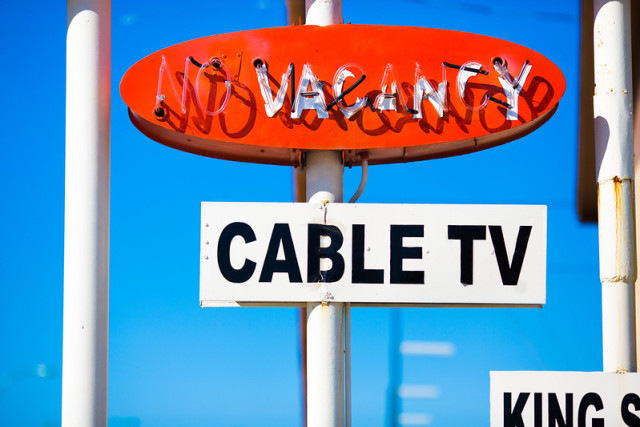
A sign for a Hotel that says “Cable TV.” By Thomas Hawk/Flickr

A forgotten TV show from the late ’80s played a massive influence on how cable television was made—so much so that the formula it spawned is better known than the show.

In the midst of the recent Writers Guild of America strike, a lot has been said about the ways that writers are paid, particularly how the rules often end up being quite confusing.

But even when the rules work out, they can be weird as heck. My case in point: The weird case of what happened to the late-’80s show Sanchez of Bel Air.

This show, which aired during the fall of 1986, was a bit of a forgotten unicorn at the time of its release. Airing on the USA Network, the show had a lot in common with a later Bel Air-based television show, Fresh Prince of Bel-Air, albeit focusing on an upwardly mobile Latino family rather than a black one. It was a sitcom when cable television was not known for airing sitcoms.

The show aired on USA at a time when representation, especially positive representation, of Latinos on television was quite limited, and the show did receive criticism for not being particularly authentic. (One potential reason for this: While its cast—with the notable exception of Bobby Sherman, for some reason—was largely Latino, its creators, Dave Hackel and April Kelly, were white.)

The show was not a hit, and disappeared after just 13 episodes. But because it appeared so early in the history of cable television, it became a bit of an unexpected landmark for completely behind-the-scenes reasons.

See, as a part of the show’s creation as one of the first sitcoms explicitly produced for the medium, it led to the development of a residual agreement about how much writers received upon re-airings of the show. The current formula breaks down as such: For the second to fifth re-airings, writers get 50 percent residuals, then it shrinks down to 6 percent on the sixth re-airing and 4 for each of the 7th and 8th re-airings. Gradually, the scale slides down until the 13th re-airing, when every future replay gets 1.5 percent each.

This formula, crazy as it sounds, is better known than Sanchez of Bel Air. It’s called the Sanchez Formula, and is generally used for scripted shows that air on cable television.

In many ways, emerging technologies shift the game for writer compensation—and the current Writers Guild of America strike highlights how, when these rates fall out of sync with the work being created, it can create serious problems. While the Sanchez formula wasn’t perfect, it worked well enough that it has stuck around for nearly 40 years.

» Wanna learn more? Check out my 2018 piece “TV’s Hidden Math,” which explains why so many shows have 13 or 65 episodes—especially if they’re syndicated.


Posted by Ernie Smith • Permalink

Jun 1 2013t

Today in the Huffington Post being the Huffington Post. (BTW: While this isn't the only article this week on…

Today in the Huffington Post being the Huffington Post. (BTW: While this isn’t the only article this week on this topic, a story brought to light by the upcoming book Slimed!: An Oral History of Nickelodeon’s Golden Age, the difference here is that those articles didn’t explicitly call the show racist, but instead raised interesting points about racial diversity in ‘90s cable television.)

(via @BuzzFeedAndrew)

Posted by Ernie Smith • Permalink

May 29 2013t

Today in satire that’s so on point

chrismohney:

theclearlydope:

Great ad campaign by PBS but I’m pretty sure they just created all the new fall programming for TLC.

popculturebrain:

NY PBS Creates Ads With Fake Reality Shows | EW

Classic problem of actuality outrunning satire, the dilemma of our age really

Today in satire that’s so on point that we’re gonna probably see these shows.

Posted by Ernie Smith • Permalink

Aug 9 2012t

Thanks NASA: Ustream tops cable news on Sunday night

  • 3.2 millionusers watched the official NASA broadcast of Curiosity’s Mars landing on UStream
  • 500,000 users tuned in during the Ustream broadcast’s peak point, via several different content streams source
  • » Those numbers were enough to beat the Nielsen ratings almost every major cable news network — including CNN, MSNBC, and CNBC — leaving Fox News as the lone out-performer with 803,000 viewers. The folks at UStream don’t seem to think it was a fluke either. “This speaks to how much more sophisticated social media tools are getting on the web,” said company spokesman Tony Riggins, adding, “Consumers are adapting technologies to get news now from sources like Ustream.”

Posted by ShortFormBlog • Permalink

Aug 2 2012t

Time Warner Cable announces major drop in cable subscribers

  • 169,000 subscribers lost last quarter source
  • » Eating a bit of crow: Only 24 hours after Time Warner CEO Jeff Bewkes told investors that people weren’t interested in cord-cutting — when it comes to cable TV — the namesake cable company, which no longer has ties to Time Warner, announced heavy cable subscription losses alongside an increase of 72,000 new business and residential high-speed internet subscribers. The company is far from having its business model disrupted though, as it did also take in a total of $5.4 billion during the same three months. (update to note they are separate companies; thanks stphn)

Posted by ShortFormBlog • Permalink

Jul 3 2011W

Politics: Looking back: Why Mark Halperin's quip is really par for the course

It would be nice to think that the rapidity of the official reaction had to do with legitimate disapproval. Actually, it is a reflex quickened by practice because what cable news now calls political journalism is set up to produce just this kind of 'television moment' and its attendant swirl of attention-getting faux controversy.

L.A. Times columnist Tim Rutten • Offering a room-clearing take on the whole situation with Mark Halperin and "Morning Joe." To put it simply, he doesn't think it's actually any sort of controversy of the real kind, but instead an opportunity to create a conversation-of-the-day moment. (Which Halperin's quip successfully did, by the way.) It's an idea that started with Fox News but has kinda expanded from there. There's even a site dedicated to this idea. And well, you know, he's right. But it makes good TV, and that's all that matters, right? source

Posted by Ernie Smith • Permalink