Read a little. Learn a lot. • Now Mullenweg-free! • Since 2009
☰

Tag: aol

54 posts

Feb 8 2013t

aatombomb: What the hell is AOL?

aatombomb:

The common refrain this morning on AOL’s good day was that advertising is leading the company back. This is true, kind of. It is true that revenue at AOL sites (like HuffPo, AOL.com, and Moviefone) is up, but profit for AOL’s online brands is actually down for the year by 34 percent. The new profit engine, not only for the quarter but also the year, has been advertising on AOL’s third-party network, the company’s ad market for other online publishers.

But it’s the old profit engine that is still driving the company. AOL’s subscription business (the evolution of that gargling symphony of squeaks and whistles from the 1990s) is still more profitable than AOL as a company.

This is good news and bad news, as Henry Blodget observes. It’s good news because the profits from subscription services can be used to smooth AOL’s transition to a modern media and advertising company, and subscription cancellations are slowing down. But it’s also bad news because any company that relies on the inertia of septuagenarians who haven’t figured out how to get Internet without paying AOL for the privilege does not sound like a magnet for the sort of talent that drives long-term growth.

“What exactly is AOL?” you might ask yourself. As a consumer product, it’s a bunch of websites. As a business strategy, it’s an ad company. As a growth business, it’s a third-party digital advertising network. And as a profitable business, it’s mostly none of those things but rather, overwhelmingly, an anachronistic online membership service. Great stock. Weird company.

Basically, AOL is a key example of a company that’s changed its focus more than a few times. So as a result, they have a lot of legacy. Which isn’t necessarily a bad thing. Even though Apple hitched its wagon on the Mac in 1984, it still sold Apple ][ models until 1992. The legacy gave way to the new business. Smaller companies do the same thing. They’re called pivots. Big companies have the benefit of being able to pivot while keeping the legacy business active. That’s why AOL can sell memberships to a service nobody has actually used earnestly since 2003.
Posted by ShortFormBlog • Permalink

Oct 23 2012t

Michael Arrington is back at TechCrunch!

Hey.

My name is Michael Arrington. For newer readers who don’t know, I founded TechCrunch back in 2005.

Last year I was fired and began writing on Uncrunched.

Today AOL unfired me.

I am a venture capitalist and have all sorts of conflicts of interest. Many of you think that conflicts of interest are inherently bad and people with them shouldn’t be writing stuff for other people to read. A lot of people would agree with you. It was the reason AOL fired me last year, after they invested in my venture fund CrunchFund.

I disagree.

AOL now also disagrees.

Before everyone starts freaking the fuck out, just hold on a second and hear me out.

We don’t know how many of you are TechCrunch readers, particularly after last year’s AOL fiasco, but today brought some good news for longtime fans of the tech news site. In an open letter, posted on TechCrunch this afternoon, founder Michael Arrington has announced plans to return to the site he created as a paid contributor. Welcome back, Mike!

Posted by ShortFormBlog • Permalink

Jun 25 2012t

Winamp really whipped the llama's ass, but AOL screwed it up

  • 4.2 megs the current size of the Mac version of old-school audio app Winamp, which was first released last year
  • 170 megs the current size of the Mac version of iTunes, Winamp’s biggest competitor which long ago ate its lunch source
  • » The first popular MP3 player: How did Winamp, which once boasted 60 million users, lose its lead? Simply put, AOL didn’t know what the heck to do with it after it bought it. Nullsoft, which AOL bought for $80-$100 million 1999, struggled to find its niche within the culture of AOL. AOL didn’t make it easy: They lumped them in with Spinner, another music product it bought at the same time, and kept bundling its apps (which its tech-savvy users, by the way, didn’t want) with the product. The company also had multiple run-ins with the app’s creator, Justin Frankel, who built multiple file-sharing networks while an employee of AOL, to the company’s bemusement. The result? Winamp was eventually left to die on the vine — until a couple years ago, when AOL realized it was sitting on a cash cow and started building it out again. It’s no iTunes, but it’s huge outside the U.S. And it just turned 15 years old. Happy anniversary, little MP3 player that could.

Posted by ShortFormBlog • Permalink

May 10 2012t

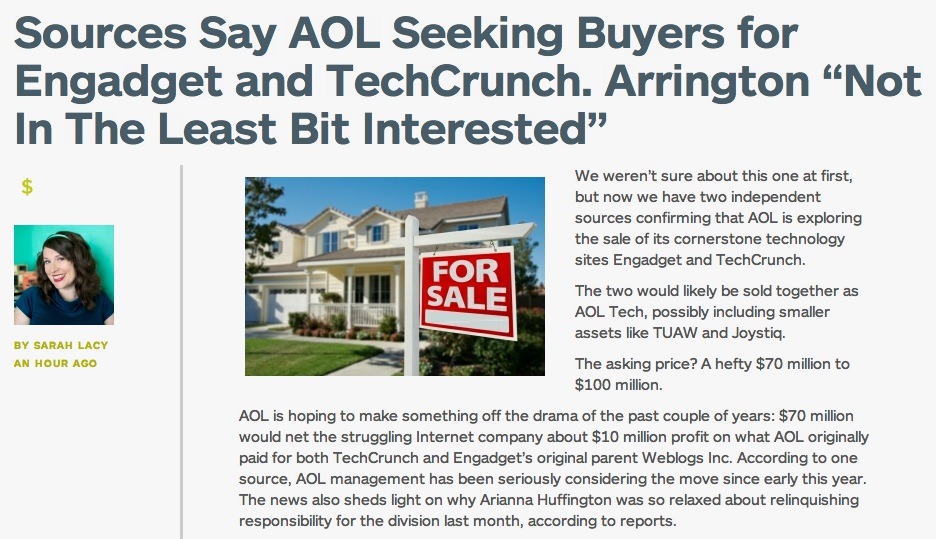
As an update to our post from last night about the possible sale of TechCrunch's parent company AOLTech, AOL…

“We don’t have any interest in selling TechCrunch or Engadget,” he said firmly. “Our number one goal basically has been to scale them up. At this point, it’s likely we’ll just end up investing ourselves.”

TechCrunch itself covered the rumors, saying that the situation was rooted in a stunted spinoff and suggesting PandoDaily, run by former TC staffer Sarah Lacy, got caught up in its own issues when reporting the story: “We figure this story got skewed because PandoDaily is going through its own troubles, and looking for a target to project its drama onto; Sometimes not wanting to seem weak makes you seem weak.”

Posted by ShortFormBlog • Permalink

Mar 16 2012t

AOL has fired 40 employees in charge of AOL Instant Messenger’s development.

theweekmagazine:

AOL has fired 40 employees in charge of AOL Instant Messenger’s development. Only basic maintenance and customer service staff will remain. AOL reassures that they “are not killing instant messenger.”But skeptics say the layoffs are the beginning of the end for AIM. If the service that gave life to LOL and BRB fades away, will anybody miss it?

Ironically, the team behind the most recent iteration of AIM was about to shut down its prior app, Brizzly.

Posted by ShortFormBlog • Permalink

Sep 17 2011t

At any other publication, Paul would have been fired long ago. And his post would be taken down. But I will…

At any other publication, Paul would have been fired long ago. And his post would be taken down. But I will let it stand. When Paul was hired, he was promised that he could write anything and it would not be censored, even if it was disparaging to TechCrunch. I will still honor that agreement.

— Erick Schonfeld responds to Paul Carr, after his resignation from TechCrunch and the ensuing fight on Twitter. We are witnessing the implosion of one of the Web’s best sites. (thanks Abbas Naqvi of Jigartronic)

Posted by ShortFormBlog • Permalink

Sep 17 2011t

parislemon: What Needs To Be Said

parislemon:

All day, I kept telling myself I shouldn’t say anything. Then I realized: what the fuck? Be honest.

I found Paul’s post tactless. And I found Erick’s response inappropriate. Perhaps both are fitting given the entire clusterfuck that is this situation. But both are also quite sad.

Many of you…

MG Siegler’s take on this whole mess ends with this poignant line: “There is exactly one person to blame for all of this — and her name is not Erick.” It’s clear what her name is. This is a good take, and very level-headed considering what’s probably going on with the site right now.

Posted by ShortFormBlog • Permalink