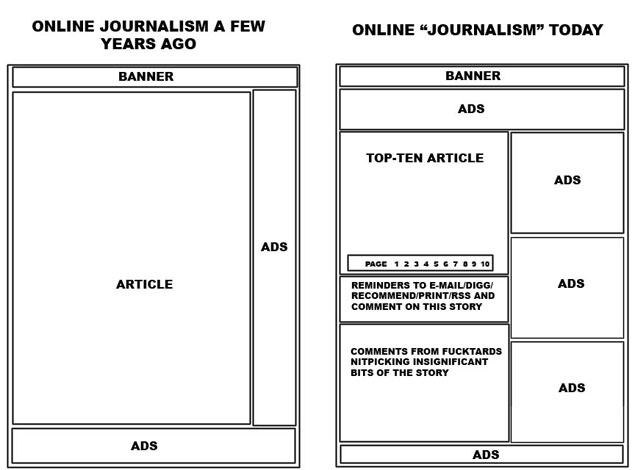
Old launch date: Monday. New launch date: Tomorrow. Today, the Ann Arbor News, a 174-year-old Michigan institution, prints its last issue. On Monday, their parent company, Newhouse, was supposed to launch a Web product to replace the newspaper, giving some overlap time for users to get used to the product. But AnnArbor.com, which will include a twice-a-week print component, wasn't ready so they didn't launch it. Which means that tomorrow's launch date leaves zero room for error and the possibility that the town will be without a primary news source if it gets delayed again. Talk about tightropes. source
The Web side Web proponents feel that newspapers are a product of an era that no longer exists – the media gatekeeper as primary news source. We're in an era where everything's decentralized. We don't need the big source of news anymore. Who needs the New York Times when you can get news from 50 bloggers in an RSS reader?
The print side One point that newspaper proponents can make pretty easily is that much of what shows up on the blogosphere originally appeared in various news sources. And there are many benefits to that whole organizational center that a newsroom provides. And newsprint is tangible in your hands in a way that a laptop isn't.
What Slate did Rather than go for the Clay Shirky-style final word, they let Web news junkies and newspaper junkies say their piece (and there are many opinions, all of which are worth reading), tested them on their knowledge, then had them debate on a podcast. It's an entertaining debate where – best of all – nothing's settled. source
Windows is screwed. Tonight, Google announced to the world that they're launching a new Web-leaning OS that will lean on netbooks at first but is also targeted towards desktop PCs. The idea is that it's a simple OS for people who largely live on the Web. They plan to open-source the software later this year and hope to have something to show for their hard work by the middle of next year.
What about Android? We know you're thinking – doesn't Google have Android already? Well, yeah. But Google doesn't mind. "While there are areas where Google Chrome OS and Android overlap," writes VP Sundar Pichai, "we believe choice will drive innovation for the benefit of everyone, including Google." So yeah. We expect Windows to go the way of IE's market share in about five years. source
In one ultra-organized corner …Google's been on top of the heap for nearly a decade, and it's a firm hold. They've built themselves around the idea that the Web's organization should be simple. Their ads are well-targeted, and their services – especially search, Gmail and News – are incredibly useful. They made $4.2 billion last year alone. However, they have one big problem: They can't convince the brands of Madison Ave. to work with them.
And in a more social one …Facebook, on the other hand, is building influence and currency on the Web. They've got critical mass, and, smartly, didn't even focus on competing with MySpace. They want to be the new Google, and have just the right arrogant CEO to pull it off. Their hyper-focused information means they can focus on advertising for brands. However, they have one big problem: They keep pissing off their customers by evolving too quickly. source
One CEO's criticism Perennial startup CEO Michael Robertson, most famously of the jerked-around MP3.com, claims that Lala's model attempts to lock users into evil major-label-supported DRM for their most popular product, ten-cent web songs. He pointed specifically to a patent they own. Robertson has a personal claim, by the way – he currently owns competitor MP3tunes.com.
Lala's defense Lala, which we use here pretty regularly (it hosts our Saturday Mixtape feature), claims that there's nothing nefarious about what's going on. "We're trying to provide a way so that users can have more access to their music than they had in the past," says CEO Geoff Ralston. It's important to note, by the way, that you can also buy MP3s of most songs available at the site. source
Take print philosophy online In this era where the Internet is quickly changing how people read and gather content, it's becoming more and more clear that you have to perk up your web skillz as a graphic designer. But that doesn't mean you have to give up your print techniques – Brian Hoff of DesignCubicle notes that they might even be an asset. (And coolgrids already exist, which should ease the pain. Whoo.)
Cool examples of print as web Obviously, The New York Times does a pretty great job approximating the print experience. But other sites, such as Jason Santa Maria's amazing personal Web site focus on doing something most sites suck at: Providing content-based design rather than forcing content into a rigid CMS. Food for thought, designers looking to switch over. You can do this. source

 ShortFormBlogRead a little. Learn a lot. • Now Mullenweg-free! • Since 2009
 Google's been on top of the heap for nearly a decade, and it's a firm hold. They've built themselves around the idea that the Web's organization should be simple. Their ads are well-targeted, and their services – especially search, Gmail and News – are incredibly useful. They made $4.2 billion last year alone. However, they have one big problem: They can't convince the brands of Madison Ave. to work with them.
 Facebook, on the other hand, is building influence and currency on the Web. They've got critical mass, and, smartly, didn't even focus on competing with MySpace. They want to be the new Google, and have just the right arrogant CEO to pull it off. Their hyper-focused information means they can focus on advertising for brands. However, they have one big problem: They keep pissing off their customers by evolving too quickly. source