Read a little. Learn a lot. • Now Mullenweg-free! • Since 2009
☰

Tag: web browsers

15 posts

Nov52013t

South Korea is stuck with Internet Explorer for online shopping because of security law

Internet Explorer’s fall has been profound enough that its own video ads have poked fun at its image as “ancient” — but it argues at its Web site “browseryoulovedtohate” that the latest versions, IE 9 and IE 10, are vastly improved and give the company a shot at “browser redemption”.

But South Koreans remain captive to laws passed 14 years ago, which — in the name of Internet security — require citizens to bank and make nearly all purchases with Internet Explorer. Three-quarters of the country’s Web usage involves Internet Explorer, according to a measurement by the Web analytics firm StatCounter — among the highest in the world. Internet Explorer is nearly as much a part of a Korean computer as the screen itself.

What happens when outdated regulations don’t keep up with the times.

Posted by Ernie Smith • Permalink

Feb132013t

The WebKit engine is already very good, and we aim to take part in making it even better. It supports the…

The WebKit engine is already very good, and we aim to take part in making it even better. It supports the standards we care about, and it has the performance we need. It makes more sense to have our experts working with the open source communities to further improve WebKit and Chromium, rather than developing our own rendering engine further. Opera will contribute to the WebKit and Chromium projects, and we have already submitted our first set of patches: to improve multi-column layout.

— Håkon Wium Lie, the CTO of Opera Software • Discussing why the company is gradually moving to Webkit, after spending years building their own engine. This is a big deal for Web designers, as it makes Webkit (already used in Chrome and Safari) an even more dominant platform. "The shift to WebKit means more of our resources can be dedicated to developing new features and the user-friendly solutions that can be expected from a company that invented so many of the features that are today being used by everyone in the browser industry,“ Wium Lie noted.

Posted by Ernie Smith • Permalink

May232012t

Yahoo is about to launch a Web browser

Yahoo is about to launch a Web browser: Axis, Yahoo’s somewhat belated attempt to get into the Web browser game, is an iOS app/desktop browser plug-in intended to take a step out of the process of searching for a Web page — rather than flooding you with links, search is directly inside the browser, creating a fully integrated experience. Yahoo appears to have announced the browser a little early — video links to the desktop launch video have been up and down (currently up), but the iOS launch video is up. The site is also down, though the launch time is rumored to be tonight. We’re curious but pretty sure this won’t replace Chrome for us.

Posted by ShortFormBlog • Permalink

May212012t

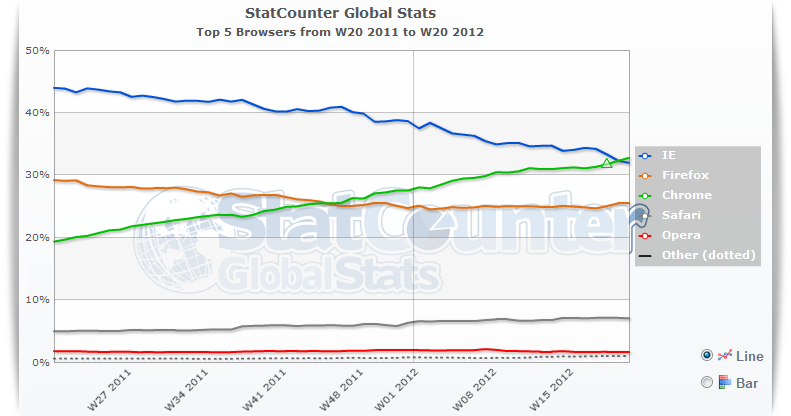
Chrome overtakes Internet Explorer as the Web’s most popular browser

futurejournalismproject:

Chrome overtakes Internet Explorer as the Web’s most popular browser

Filed under that didn’t take long. Chrome’s first public, stable release was in December 2008. The first version of Internet Explorer, 1995.

In 2002-2003, IE controlled about 95% of the browser market.

More info via The Next Web.

Image via StatCounter.

One thought on this: It seems like we’re reaching a point where we’re going to start seeing an interesting effect on browser standardization. That is, Chrome specifically (and Webkit in general) by and large has much wider suport for modern internet standards, at a deficit to other browsers that haven’t kept up as quickly. Due to the inconsistent standards, there’s been a need to create “browser prefixes” in CSS, some of which only work in Chrome. A similar effect happened around 1997, where Netscape and IE were launching feature after feature without any care as to standards. Now, while Chrome is better about implementing this, are we going to see Webkit make every other browser a second-class citizen online? (Granted, we wouldn’t be opposed to seeing every browser company adopt Webkit and work on the same open-source platform.)

Posted by ShortFormBlog • Permalink

Mar192012t

In which Microsoft tries to convince you

In which Microsoft tries to convince you that you don’t need to uninstall Internet Explorer the second you see it any … sorry, we got distracted because we spotted a rogue version of IE9 on this computer. (ht Matt)

Posted by ShortFormBlog • Permalink

Dec32011W

Tech: Could Mozilla's Firefox lose its biggest funding source: Google?

  • growth Over the years, Mozilla's open-source Firefox browser grew from nothing to provide a solid secondary option to Microsoft's once-dominant Internet Explorer. It funded itself in large part from a multi-year deal it made with Google to make their search the default, allowing Mozilla to grow quickly.
  • hindrance However, since they made the last deal in 2008, a strange thing started happening — Google created a browser of its own, Chrome, that quickly ate its own share of the market. It's now tied with or ahead of Firefox. So … will Google renew the deal with Mozilla? Do they need to? source

Posted by Ernie Smith • Permalink

Sep292011W

Tech: Amazon Silk getting privacy complaints: Why this is pretty bunk

This makes Amazon like your ISP. Every site, everything you do online [through Silk] will go through Amazon. That's a new role for someone like them, and I don't think it's at all clear that Amazon can step into that, or that it will be apparent to consumers.

Center for Democracy & Technology spokesperson Aaron Brauer-Rieke • Offering up this claim that Amazon will use Silk, which Amazon claims will help speed up Web sites on the Amazon Kindle Fire, as a tracking tool. To that, we say this: Are you guys familiar with this Web browser called Opera Mini? It's not as common as it once was, but for people using old-school phones, it was a bit of a lifesaver. It made the Motorola Razr, for example, a far more usable phone for surfing the Web, due to the way it handles content — through the company's own servers, which cleared out all the extra stuff and sped up the sites you were downloading. Sound familiar? It's exactly what Amazon Silk claims to do. Not buying this whole privacy argument. source

Posted by Ernie Smith • Permalink

Mar52011W

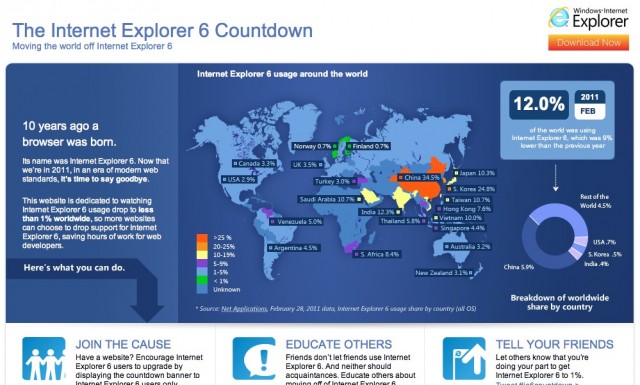
Tech: Internet Explorer 6, or why most sites look really bad in China

  • Today in reasons to be critical of the influence China has on the rest of the world, we submit to you "IE6 Countdown," a Microsoft-made site that shows why the browser remains so prevalent a full decade after its initial release. See that giant red spot, showing widespread usage? That's China. You know, beyond awareness campaigns, Microsoft could do more to get people to stop using IE6. They're not doing enough, really. source

Posted by Ernie Smith • Permalink

Feb172011W

Tech: Pixelfari: Surf the Web like Super VGA never happened

  • We were looking for a way to test our site on a Commodore 64, and we think we found it. Neven Mrgan has released onto the world the most useful Web browser in the history of the Interwebs, Pixelfari, an OSX variation on Safai that renders sites as if higher resolutions never made their way to computers. It appears we have some work to do to ensure that an Apple II can properly handle our rig. source

Posted by Ernie Smith • Permalink