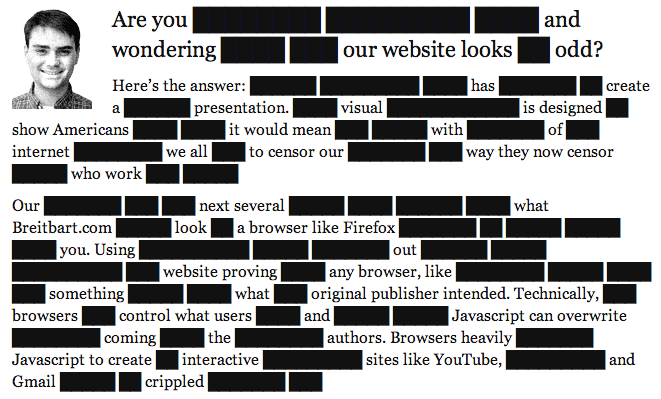
Breitbart News “censored” itself in protest of the sacking of Mozilla CEO Brendan Eich over gay rights issues. Because of course they did. Their point? “Firefox is now a company that censors.”
Firefox isn’t a company.
 ShortFormBlogRead a little. Learn a lot. • Now Mullenweg-free! • Since 2009
21 posts
Breitbart News “censored” itself in protest of the sacking of Mozilla CEO Brendan Eich over gay rights issues. Because of course they did. Their point? “Firefox is now a company that censors.”
Firefox isn’t a company.
Posted by ShortFormBlog • Permalink
Mozilla prides itself on being held to a different standard and, this past week, we didn’t live up to it. We know why people are hurt and angry, and they are right: it’s because we haven’t stayed true to ourselves.
We didn’t act like you’d expect Mozilla to act. We didn’t move fast enough to engage with people once the controversy started. We’re sorry. We must do better.
Brendan Eich has chosen to step down from his role as CEO. He’s made this decision for Mozilla and our community.
Mozilla believes both in equality and freedom of speech. Equality is necessary for meaningful speech. And you need free speech to fight for equality. Figuring out how to stand for both at the same time can be hard.
Our organizational culture reflects diversity and inclusiveness. We welcome contributions from everyone regardless of age, culture, ethnicity, gender, gender-identity, language, race, sexual orientation, geographical location and religious views. Mozilla supports equality for all.
We have employees with a wide diversity of views. Our culture of openness extends to encouraging staff and community to share their beliefs and opinions in public. This is meant to distinguish Mozilla from most organizations and hold us to a higher standard. But this time we failed to listen, to engage, and to be guided by our community.
While painful, the events of the last week show exactly why we need the web. So all of us can engage freely in the tough conversations we need to make the world better.
We need to put our focus back on protecting that Web. And doing so in a way that will make you proud to support Mozilla.
What’s next for Mozilla’s leadership is still being discussed. We want to be open about where we are in deciding the future of the organization and will have more information next week. However, our mission will always be to make the Web more open so that humanity is stronger, more inclusive and more just: that’s what it means to protect the open Web.
We will emerge from this with a renewed understanding and humility — our large, global, and diverse community is what makes Mozilla special, and what will help us fulfill our mission. We are stronger with you involved.
Thank you for sticking with us.
Mitchell Baker, Executive Chairwoman
A big deal for the org: For folks who haven’t been watching, Brendan Eich (who, point of trivia, created the Javascript programming language) has faced withering criticism over his $1,000 donation to the Prop 8 campaign in 2008, which was made on a personal basis, but had his employer’s name tied to it. When he became the CEO of the Firefox-maker, it sort of blew up from there. A little bit of backstory over this way.
Posted by Ernie Smith • Permalink
Firefox Vice President Johnathan Nightingale says that the project is going to die because it appeared that nobody was interested in using the version of Firefox made for the unpopular Windows 8 interface. This has to look like bad news for Microsoft:
In late 2012, when I started up the Firefox for Metro team (I know that’s not what Microsoft calls it anymore, but it remains how we talk about it in Mozilla), it looked like the next battleground for the Web. Windows is a massive ecosystem and Microsoft pushes its new platforms hard. At first, it looked like we would be locked out completely. We eventually broke open Metro (though never the RT line of ARM-based products) and we got to work.
In the months since, as the team built and tested and refined the product, we’ve been watching Metro’s adoption. From what we can see, it’s pretty flat. On any given day we have, for instance, millions of people testing pre-release versions of Firefox desktop, but we’ve never seen more than 1000 active daily users in the Metro environment.
Posted by Ernie Smith • Permalink
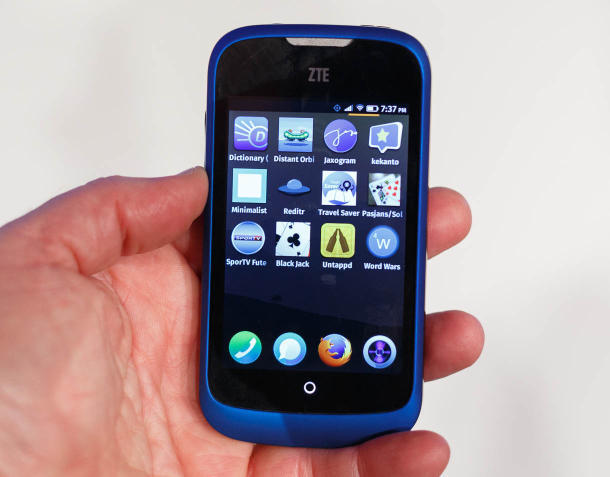
So yeah, Firefox comes on mobile phones now. But would you actually use it? Well, if you’re looking for something nice on the low end, you might, according to CNET. (photo by Stephen Shankland/CNET)
Posted by Ernie Smith • Permalink
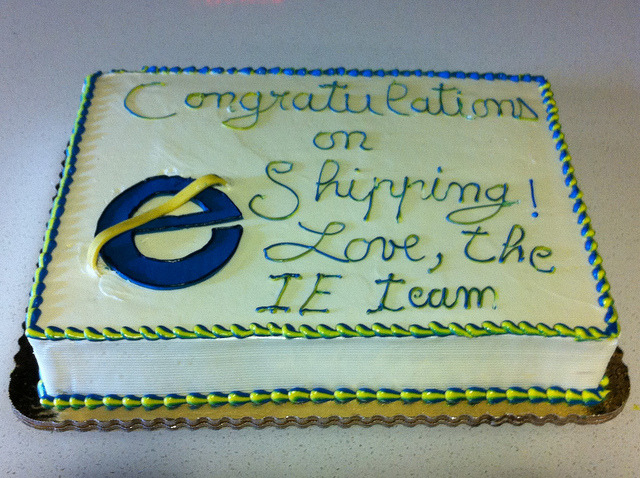

Cake Wars + Browser Wars: When Firefox ships a new version of its browser, IE sends along a cake. After the Firefox team started shipping incremental versions, Microsoft’s team started sending cupcakes instead. Now, Mozilla has returned the favor, sending the IE team a cake with a giant Firefox logo plastered on. Aww.
Posted by Ernie Smith • Permalink
We’re pleased to announce that we have negotiated a significant and mutually beneficial revenue agreement with Google. This new agreement extends our long term search relationship with Google for at least three additional years.
“Under this multi-year agreement, Google Search will continue to be the default search provider for hundreds of millions of Firefox users around the world,” said Gary Kovacs, CEO, Mozilla.
“Mozilla has been a valuable partner to Google over the years and we look forward to continuing this great partnership in the years to come,” said Alan Eustace, Senior Vice President of Search, Google.
The specific terms of this commercial agreement are subject to traditional confidentiality requirements, and we’re not at liberty to disclose them.
For a little while, the deal — which provides the Mozilla Foundation with most of its income — looked like it might not get renewed, especially since Google now has a browser that looks like it’s going to usurp Mozilla in the marketplace.
Posted by ShortFormBlog • Permalink
Posted by Ernie Smith • Permalink

Pick a site, any site, and “share” buttons are littered all over the place.
Mozilla/Firefox is asking why not bring that basic functionality up to the browser. [more]
Not sure how we feel about this. Here’s why. While browser-level functionality would be great, this feels like it could create a situation where Firefox (or Google) picks the winners, rather than letting the market decide for itself. What if, five years from now, Tumblr is as big as Twitter? Or some social networking site we’ve never even heard of usurps Facebook? (It’s happened before.) One could argue this is why Apple’s Twitter integration in iOS5 is a bad idea. At some point you create an artificial monopoly by integrating directly into the browser. And plus, from a Web designer’s perspective, they want that control. It’s their content; let them promote it. They can do A/B testing to know what works best for them. This, however, is one-size-fits-all. It would ultimately curb, not promote, sharing. Let the users decide for themselves. A good developer knows how to integrate these cleanly. Teach good design; don’t let Firefox excuse bad design.
Posted by ShortFormBlog • Permalink
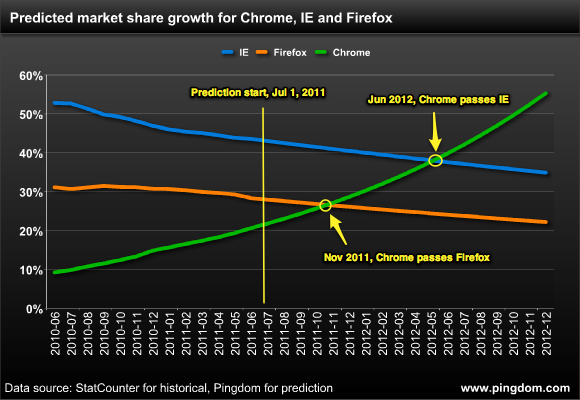
Is Chrome becoming the new IE? Perhaps it’s too soon to predict what’s going to happen, but Google Chrome has a rate of growth so impressive that Pingdom has them passing Internet Explorer by the middle of next year if they keep their current rate of growth up. And not a moment too soon. We were looking for a reason not to give a crap about Internet Explorer. They’re so bullish on Chrome that this chart doesn’t even equal 100 percent at its endpoint! (Do the math, guys.)
Posted by ShortFormBlog • Permalink
Posted by Ernie Smith • Permalink