Some schools, such as Princeton and Harvard, have fewer than five veterans in their undergraduate student bodies.
— The Ivy League has pretty much been off-limits to vets, though there are a couple nonprofits working on that.
 ShortFormBlogRead a little. Learn a lot. • Now Mullenweg-free! • Since 2009
16 posts
Some schools, such as Princeton and Harvard, have fewer than five veterans in their undergraduate student bodies.
— The Ivy League has pretty much been off-limits to vets, though there are a couple nonprofits working on that.
Posted by Ernie Smith • Permalink
The resignation of Eric Shinseki reflects something far deeper than his leadership—it reflects the systemic failings at the levels below him, the WaPo notes:
On Friday, Shinseki resigned and was replaced by his deputy.
But his departure is unlikely to solve the VA’s broader problem — a bureaucracy that had been taught, over time, to hide its problems from Washington. Indeed, as President Obama said, one of the agency’s key failings was that bad news did not reach Shinseki’s level at all.
This is an ironic development: Until recently, the VA had been seen as a Washington success story. In the 1990s, reformers had cut back on its middle management and started using performance data so managers at the top could keep abreast of problems at the bottom.
Then that success began to unravel.
Posted by Ernie Smith • Permalink

Meet Eric Shinseki. The current Secretary of Veterans Affairs is currently facing calls for his resignation from Senate Republicans. His problem? Well, a veterans hospital in Phoenix is currently under fire for having a secret wait list for medical care, a situation that led to the deaths of dozens of veterans. And that situation wasn’t unique, either—another veterans hospital in Colorado has been targeted by similar allegations.
Thus far, Obama has publicly backed Shinseki, though the pressure’s on.
Posted by Ernie Smith • Permalink
I did not hear the train at all. I did not hear the horn as it was approaching the intersection. I only heard it right about three seconds before it slammed into the back of the tractor-trailer.
— Midland, Tx. resident Joe Cobarobio • Discussing the train accident during the parade he was filming on Thursday — a Show of Support parade for veterans of war. Four people died in the accident on Thursday. A dozen of the victims in the accident — whether killed or injured — were veterans of the Iraq or Afghan Wars.
Posted by Ernie Smith • Permalink
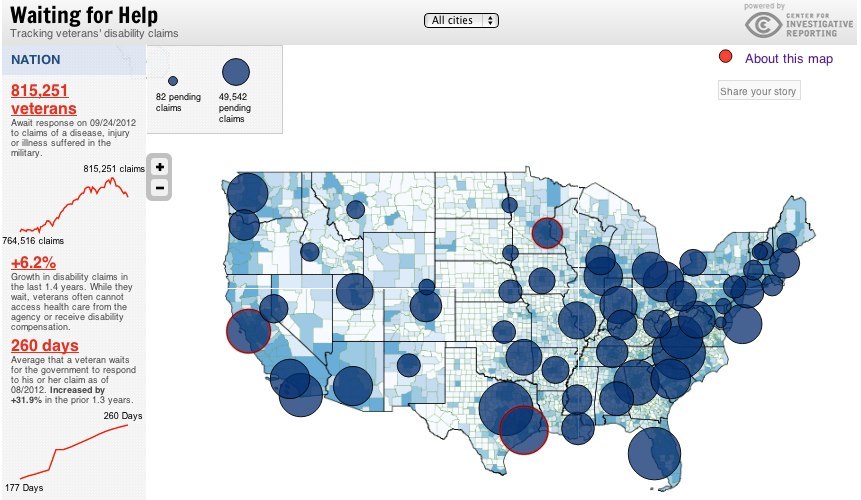
centerforinvestigativereporting:
Wait time grows for disabled veterans seeking benefits Veterans across the country are waiting an average of 260 days for a decision on a war-related disability claim – three days longer than last week and 80 days longer than in mid-2011, according to data recently released by the U.S. Department of Veterans Affairs. More than 815,000 veterans are waiting for a response from the VA this week.
Attention to the issue is growing. A new story from The New York Times underscores the extent to which some families must sacrifice as a result of their wait, and Congress addressed the backlog in a hearing on Friday, Sept. 21.
Check out our interactive map each week for a look at how wait times have changed around the country. Learn how the backlog is affecting veterans nationwide by clicking cities with pulsing red circles. We’ll be adding more veterans’ voices, along with additional coverage from our media partners, so stay tuned.
For anybody concerned with the impact of America’s wars, this should be an issue of the highest order – with individual soldiers serving more tours of duty than ever before, and shouldering a burden so disproportionate to that of the general populace, making sure things like the above don’t happen should be imperative.
Posted by ShortFormBlog • Permalink
Posted by ShortFormBlog • Permalink
Embedded media from www.msnbc.msn.com is no longer available.
Conor Friedersdorf: In Defense of Chris Hayes
Very few Americans wake up early on weekend mornings to watch public intellectuals chat. For the tiny number who do, Up With Chris Hayes, a show hosted by Chris Hayes of The Nation, has distinguished itself for its unusual success bringing thoughtful, intellectually honest conversation to cable news. The show’s producers try to cover what they judge to be important, even when more trivial topics would result in higher ratings. During the panel portion of the show, the host and most guests actually grapple with fraught issues rather than shying away from them. Straw men, ad hominem attacks, and cheap point-scoring are exceptions* rather than the rule. Partisan hackery is discouraged. And Hayes tends to highlight rather than elide complicating facts and arguments that cut against his ideological instincts, preferring to interrogate his own views and to treat positions with which he disagrees fairly (something I’m attuned to because my politics are different enough from his that we’re often at odds).
Despite all this, Hayes is suddenly under fire for weekend remarks he made about heroism, war, and politics. Our public discourse is such that anyone can find him or herself viciously denounced by complete strangers based on a single sound-byte from which everyone extrapolates wildly. This controversy is worth highlighting because Hayes’ words and the reaction to them helps explain why so few broadcasters forthrightly discuss complicated, controversial subjects. Hayes subsequently issued an apology, but it’s his critics who’ve behaved badly.
An impassioned defense of Chris Hayes. We’ve read a few in the past day or so.
Posted by ShortFormBlog • Permalink
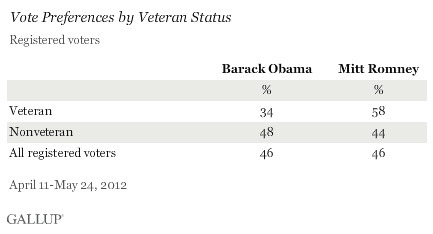
Vets prefer Mitt over Obama: As our pal Philip Bump smartly put this: “One way to say this: veterans strongly prefer Romney. Another: older white men strongly prefer Romney. Only one yields clicks.”
Posted by ShortFormBlog • Permalink
“On Sunday, in discussing the uses of the word “hero” to describe those members of the armed forces who have given their lives, I don’t think I lived up to the standards of rigor, respect and empathy for those affected by the issues we discuss that I’ve set for myself. I am deeply sorry for that.
As many have rightly pointed out, it’s very easy for me, a TV host, to opine about the people who fight our wars, having never dodged a bullet or guarded a post or walked a mile in their boots. Of course, that is true of the overwhelming majority of our nation’s citizens as a whole. One of the points made during Sunday’s show was just how removed most Americans are from the wars we fight, how small a percentage of our population is asked to shoulder the entire burden and how easy it becomes to never read the names of those who are wounded and fight and die, to not ask questions about the direction of our strategy in Afghanistan, and to assuage our own collective guilt about this disconnect with a pro-forma ritual that we observe briefly before returning to our barbecues.
But in seeking to discuss the civilian-military divide and the social distance between those who fight and those who don’t, I ended up reinforcing it, conforming to a stereotype of a removed pundit whose views are not anchored in the very real and very wrenching experience of this long decade of war. And for that I am truly sorry.”
An update to our earlier post on the matter.
Posted by ShortFormBlog • Permalink
Here’s a window into a tragedy within the American military: For every soldier killed on the battlefield this year, about 25 veterans are dying by their own hands.
— New York Times columnist Nicholas Kristof • In an opinion piece on the death of soldiers after they return home. A few other key stats — more former soldiers have committed suicide after returning home than died in combat in Afghanistan and Iraq combined, being a veteran doubles the risk of suicide, and being a veteran between ages 17 and 24 quadruples the risk. Yikes. Read up on this disturbing trend.
Posted by ShortFormBlog • Permalink