Read a little. Learn a lot. • Now Mullenweg-free! • Since 2009
☰

Tag: spending cuts

8 posts

Apr 10 2013t

On the downside, no more fancy Blue Angels

reuterspictures:

REUTERS/U.S. Navy/Mass Communication Specialist 2nd Class Andrew Johnson/Handout

Blue Angels

The U.S. Navy’s renowned flight demonstration squadron has cancelled its flying season due to federal spending cuts.

On the downside, no more fancy Blue Angels for you fans of fancy air shows. On the upside, a little peace and quiet come Fleet Week time for the rest of us.

Posted by ShortFormBlog • Permalink

Mar 3 2013t

Feels like everyone’s heads have been spinning,

pol102:

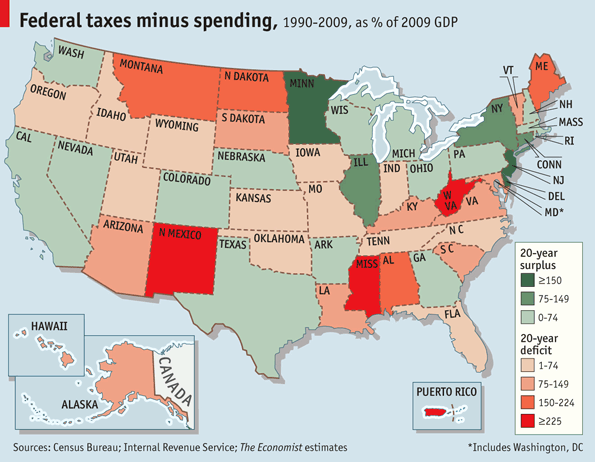
“America’s fiscal union: The red and the black” | The Economist

The sequester is here! And this map is probably a good indication of what it means for you. The “redder” your state, the most likely you’ll be negatively affected by the sequester. Why? Because “redder” states get more money from the federal government than they send back in taxes.

I currently live in Mississippi. We’re going to be hit especially hard. Because, as this map shows, Mississippi runs a 254% deficit (as of 2009) in federal transfers. The state gets an estimated $2.47 for every federal dollar sent.

Basically, think of the “redder” states as on a form of federal-to-state welfare. And since the cuts are going to all kinds of programs and services, they’ll likely hit those state hard. That means states like Mississippi will have two options: 1) Kick in more state revenue to make up for cut programs. 2) Lose the benefits of those programs. Since the many of the “redder” states are poorer than the “bluer” states (e.g. the median household income in Mississippi is $36,656 compared to $69,272 in Maryland), option #2 would simply mean falling further behind in terms of poverty, education, and health. But option #1 means collecting more taxes to make up the differences. And since states collect taxes less efficiently than the federal government, often through less progressive taxes, and will have to negotiate prices for goods and services from a weaker position, the pocketbook impact of taxes would be high.

So let’s get our sequester on! Let’s find out just how little federal government voters really want.

Feels like everyone’s heads have been spinning, to the point of fatigue, on the matter of the budget sequestration that went into effect with President Obama’s signature Friday night. It’s a nice change of pace, instead of arguing political benefits and machinations, to start getting some practical information about what sequestration will mean for the states.

Posted by ShortFormBlog • Permalink

Dec 16 2011W

Politics: Three major cuts in the shutdown-avoiding omnibus spending bill

  • one In the biggest change, the popular Pell Grant program for low-income students could run dry for as many as 100,000 students, as eligibility standards tighten.
  • two Foreign aid will decline, with a 17 percent drop in the operating budget coming to USAID. It's part of a larger $6 billion cut coming to the State Department.
  • three The GOP won a health care victory, blocking the IRS' ability to implement the Affordable Care Act's provisions in 2012. The individual mandate hits in 2014. source

Posted by Ernie Smith • Permalink

Nov 21 2011W

Politics: Obama offers tough words on debt supercommittee failure

They've still got a year to figure it out. They can still come together around a balanced plan. I believe Democrats are prepared to do so. My expect is that there are some Republicans who are interested in preventing the automatic cuts from taking place.

President Barack Obama • Discussing the failure of the supercommittee to make a deal on cuts, as required by the debt ceiling deal he made in August. The president's tone was tough — "I will veto any effort to get rid of those spending cuts," he said — but did offer some wiggle room for Congress to get their act together. The cuts — half defense, half domestic — offer a lot of pain for both sides of the aisle, so who knows? Maybe we'll see a deal — perhaps the elusive "balanced" one the president is pitching. source

Posted by Ernie Smith • Permalink

Jun 23 2011W

U.S.: Eric Cantor, Jon Kyl leave negotiations on debt limit vote

Each side came into these talks with certain orders, and as it stands the Democrats continue to insist that any deal must include tax increases. … Given this impasse, I will not be participating in today’s meeting and I believe it is time for the President to speak clearly and resolve the tax issue.

Rep. Eric Cantor • Speaking on negotiations between Democrats and Republicans on raising the U.S. debt limit. Cantor, as well as Senator Jon Kyl, have abandoned the negotiations over tax raises the Democrats insist on pairing with the spending cuts the GOP is thirsting for. Speaker Boehner says that talks could continue if tax raises are off the table, which is obvious — if the Democrats abandon what they want out of this deal, it could get done, but that's more caving than compromise. Cantor says they did find areas of compromise, though: “I believe that we have identified trillions in spending cuts, and to date, we have established a blueprint that could institute the fiscal reforms needed to start getting our fiscal house in order,” he notes. source

Posted by Chris Tognotti • Permalink

Apr 6 2011W

U.S.: Democrats, Republicans can't settle terms of spending cuts

  • $73 billion the amount of spending cuts the Democrats say they've agreed to in an effort to avoid a looming government shutdown
  • $33 billion the amount the Republicans say is actually being cut under the Democratic compromise, a number they consider unacceptable source
  • » So where'd the $40 billion go? Basically, the Democrats had agreed to cut spending by $73 billion, but that's explicitly based off the levels President Obama wanted in his budget. Since that budget hasn't passed, the Republicans are arguing that the cuts are really only $33 billion less than current spending levels (which is rather hard to argue). Notwithstanding the dispiriting accounting tomfoolery going on here, though, this is supposedly a deal between the two parties, and between position D (don't cut spending) and position R (cut tons of spending), even a $33 billion cut strikes us as an entirely reasonable compromise — both numbers are a tiny, tiny slice of the budget in any event, so the quibble seems more symbolic than functional.

Posted by Chris Tognotti • Permalink