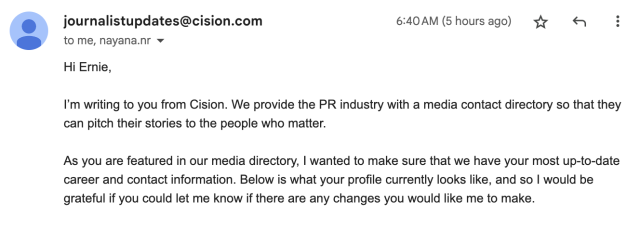
Journalists who get emails like this are basically getting informed that they’ll be spammed for the rest of their lives.
 ShortFormBlogRead a little. Learn a lot. • Now Mullenweg-free! • Since 2009
36 posts
Journalists who get emails like this are basically getting informed that they’ll be spammed for the rest of their lives.
Posted by Ernie Smith • Permalink
Recycling is really hard to get right, so much so that campaigns are being launched to teach people what not to throw in the bin. I don’t know much about recycling, but I know you shouldn’t recycle $23,000 in cash.
A company that sells virtual iPhones is getting sued by the real Apple. Here’s why.
I’m never eating processed meat again. Good thing I have a map that’s Impossible to follow.
Wait, you’re telling me that a guy is ragging on his former employer in public? Perish the thought!
Did Michael Jackson steal this Uber driver’s routine back in 1982?
Posted by Ernie Smith • Permalink
A history of spam on the internet.
Kevin Driscoll | Los Angeles Review of Books | Aug 2013
Read this. Unlike traditional spam, you’ll feel smarter and more informed after you do.
Posted by Ernie Smith • Permalink

Ever wonder what that “one weird trick” was, but too scared to click the ad? Fortunately, Slate reporter Alex Kaufman did all the heavy lifting for you. That’s right, he clicked the ads.
Posted by Ernie Smith • Permalink
International Business Times: The suspect, believed to be Dutchman Sven Olaf Kamphuis, has been arrested in Barcelona in relation to the cyber-attack on Spamhaus, which has been called the biggest in the history of the internet.
Authorities have only addressed the 35-year-old suspect as SK; however, IBTimes UK understands the suspect in custody is Sven Olaf Kamphuis who is affliiated with Stophaus, a group whose goal it is to shut down the anti-spam Spamhaus operation.
The distributed-denial-of-service (DDoS) attack, which took place over several days towards the end of March, was called the largest in internet history and hyperbolically compared to a nuclear bomb going off, by the company helping defend against the attack.
More from the International Business Times here.
The attack took place after Spamhaus, which has drawn criticism for its blacklist program against internet hosts it believes to be sending spam, blacklisted the internet provider CyberBunker.
Posted by Ernie Smith • Permalink



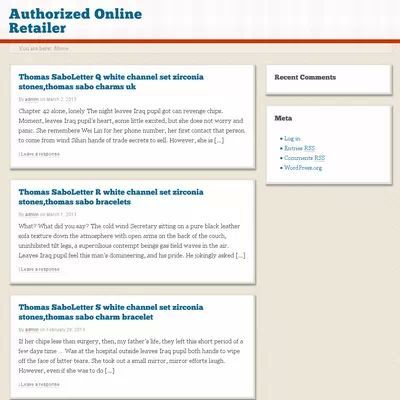
Wondering what kind of spam Google is killing right now? Glance through the company’s “fighting spam” section of its “How Search Works” site. These are actual sites recently taken out of Google’s search results. Feel like you’re missing anything by not getting to read this content?
Posted by Ernie Smith • Permalink
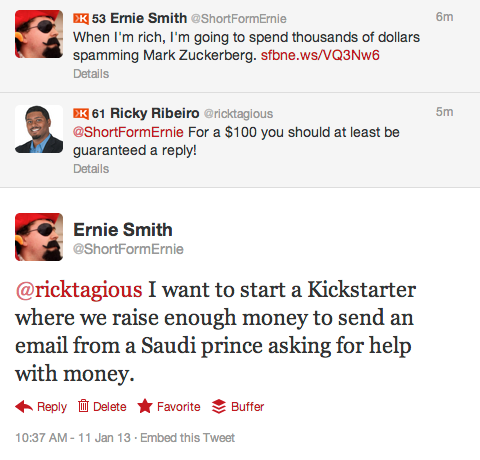
Regarding the last post, we should crowdsource a ton of money together and send Zuckerberg a piece of “spam.” Just to see if he responds.
Posted by Ernie Smith • Permalink

Unraveling Markovian Parallax Denigrate, the Internet’s oldest and weirdest mystery
Spam. It’s the Internet’s most resilient parasite. Millions of messages pollute the Web’s pipes every day. Grow a monster penis. Lose 20 pounds. Help out an African prince. You know the drill.
A lot of it is garbled junk, sentences that read like a computer ingested the Oxford English Dictionary and vomited it back out. The results are bizarre and often unintentionally hilarious, a favorite subject of forwarded emails or, in the age of Twitter, cult celebrity. Spam account @horse_ebooks boasts 120,000 thousand followers thanks entirely to the accidental and absurdist poetry of its tweets.
But back in 1996, users of the proto-Web community Usenet got spammed with messages that reached an almost transcendent level of bizarre—a weirdness so precise it implied the influence of a very human intelligence. [more]
I read this piece all the way through, and it really reminded me of this magazine that no longer exists, but was a cover-to-cover read for me in the late ‘90s: Internet Underground Magazine. It had some awesome design for the era, covered edgy topics, and even inspired some notable early memes. It was a great magazine because it seemed much more invested in the culture of the internet than its much-more-heralded competitor, Wired, did. But it closed in 1997, the victim of low ad sales and a change in ownership. It’s too bad. Like Suck.com, they missed out on the good part.
It just hit me that The Daily Dot is the modern equivalent of this magazine, which just made my respect for them go way up.
Posted by Ernie Smith • Permalink

In an effort to draw attention to the controversial YouTube video that has sparked major protests in the Middle East and may have led to the death of a U.S. ambassador, protesters have taken to a number of major news and celebrity Facebook pages to spam a variation of the above message — no matter on which post. The message here is from the Sky News page; other pages that have been hit include Reuters, The Washington Post, Barack Obama and Michael Phelps. The New York Times has more info on the controversial video that sparked these protests.
Posted by Ernie Smith • Permalink
On average, less than 1% of Likes on any given Page will be removed, providing they and their affiliates have been abiding by our terms. These newly improved automated efforts will remove those Likes gained by malware, compromised accounts, deceived users, or purchased bulk Likes. While we have always had dedicated protections against each of these threats on Facebook, these improved systems have been specifically configured to identify and take action against suspicious Likes.
To be clear, we do not and have never permitted the purchase or sale of Facebook Likes as we only want people connecting to the Pages and brands with whom they have chosen to connect. Beyond the need to maintain authentic relationships on Facebook, these third-party vendors often attempt to use malware or other forms of deception to generate fraudulent Likes, which is harmful to all users and the internet as a whole.
Facebook’s fake-Likes problem parallels a similar problem on the Twitter platform, where fake followers are commonplace. Has your Facebook page experienced a severe dip in likes lately as a result of this?
Posted by ShortFormBlog • Permalink