Read a little. Learn a lot. • Now Mullenweg-free! • Since 2009
☰

Tag: social media

203 posts

Apr 19 2012t

I was probably being an idiot then.

I was probably being an idiot then.

— David Karp, Tumblr CEO, explaining the reversal of his previous statements decrying the possibility of putting ads on Tumblr. Tumblr will begin selling ad space in May. (via tpmmedia)

What are your thoughts on Tumblr’s new monetization strategy? Think the community is overreacting, or is this the final straw?

Posted by ShortFormBlog • Permalink

Apr 18 2012t

DEVELOPING

producermatthew:

markcoatney:

joshsternberg:

producermatthew:

DEVELOPING: “Karp just announced that the Featured spot on the Tumblr dashboard is going up for sale to advertisers.”

Looks like ads are finally coming to Tumblr in at least one form. [h/t @rossneumann]

So what about all the people who don’t use the Tumblr dash but instead visit Tumblr sites? Will they see ads?

No! At least, not from Tumblr—any Tumblr blog is free to put whatever advertising they want on their own space.

CNBC’s @mcatwellons tells me the ads will be sold off in the “Radar” spot on the dashboard, not on a person’s Tumblr blog.

Of note: If ads were well-integrated into the Tumblr interface, would you mind them?

Posted by ShortFormBlog • Permalink

Apr 17 2012t

Can Twitter Replace the Newswire?

joshsternberg:

The telegraph became mainstream in the 1830s thanks to Samuel Morse and immediately changed society. The communications technology broke space and time; people no longer waited months for messages to be transmitted. The beginnings of a democratized mass media took place as the telegraph enabled newswires to exist, transmitting information instantaneously across the world. Can Twitter, the modern telegraph, upend newswires?

Traditional newswires, like the Associated Press or Reuters, provide publishing partners with short bursts of information, as well as intensive reporting where outlets are under-sourced or may not even have staff. Newswire content has long filled the gaps for newspapers. But with the advent of the 140-character social network, newswires find themselves, like many other traditional models, disrupted by the Internet, looking down the barrel of a gun. The choices seem obvious. Either adapt to the speed of real-time communication and use Twitter as a complementary tool to help with reporting or face irrelevancy as Twitter and other social networks tap into the power of the ultimate free resource, people with an Internet connection and desire to share what they see.

Click through to read the rest.

We have a tiny little thought in this. On a side note, we were playing with Prismatic today and it’s pretty good at combining philosophies on news wires and Twitter accounts.

Posted by ShortFormBlog • Permalink

Apr 3 2012t

Publishers Go Back in Time on Facebook

joshsternberg:

Digital media has long favored the young. Newer entrants didn’t have the legacies of the dinosaurs they sought to replace. But in some ways, Facebook is giving power back to legacy publishing companies, at least with its shift to Timeline for company pages.

Last week Facebook rolled out its Timeline for brands, and media properties were quick to show off how deep into archives they could go. The Timeline is meant as a better way for Facebook residents to present themselves in unique ways. Media outlets are no exception. Whether it’s taking you all the way back to when the outlet was founded or highlighting coverage from historical events, media outlets can use Facebook as a way to draw readers into their worlds.

“They have to figure it out,” said Dave Marsey, group media director at Digitas. “It’s interesting because there’s a lot of news archives for the nostalgic out there.”

Click through to see how The New York Times, The Wall Street Journal, The New Yorker, The Atlantic and one surprise candidate.

We also have something in the works. Can’t wait to show it to you guys.

Posted by ShortFormBlog • Permalink

Mar 22 2012t

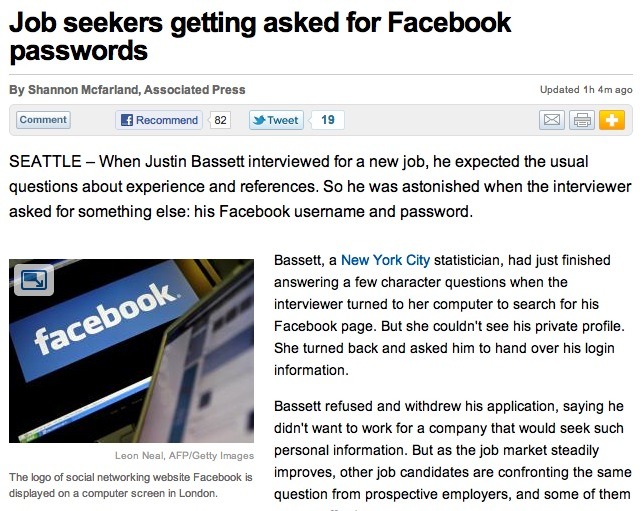
In case you wondering, the ACLU doesn't think potential employers should have the right to access your…

It’s an invasion of privacy for private employers to insist on looking at people’s private Facebook pages as a condition of employment or consideration in an application process. People are entitled to their private lives. You’d be appalled if your employer insisted on opening up your postal mail to see if there was anything of interest inside. It’s equally out of bounds for an employer to go on a fishing expedition through a person’s private social media account.

In case you missed it, we wrote a nice long rant about this a couple of days ago. Suffice it to say, we were not bullish on the idea that employers could access your Facebook account so you could get a job.

Posted by ShortFormBlog • Permalink

Mar 20 2012t

Dear potential employers

A note to potential employers who want us to give them our social media passwords in order to get a job

Dear potential employers: This is not your house. Do not ask for the keys. Do not expect, while we’re out working hard, to open up the fridge and grab out a Yuengling, kick up your feet on the couch and watch an episode of “How I Met Your Mother” on the Roku. Do not expect to take a shower in our bathroom or try on the neckties in our closet. Our guitar: Not your property to practice “Wonderwall” on — it has no jurisdiction on our ability to sort paperwork or solve complex problems. If you think it does, find someone else. And don’t even think about trying to change the thermostat. You are not allowed inside unless we let you in. And we’re not letting you in. If you’re a job-seeker, and the employer is asking for passwords to e-mail or various social media accounts, we suggest that you tell them exactly where to take that job and shove it. So potential employers who have no respect for the personal lives of employees: Shove it. (hat tip toxiedesigns)

Posted by ShortFormBlog • Permalink

Mar 19 2012t

So, how does the news industry think you read the news?

Three lessons from Pew’s “State of the News Media 2012” report

  • So, how does the news industry think you read the news? That’s a question it tries to answer answer each year, when the Pew Research Center releases its yearly “State of the News Media” report, which has long been seen as a bit of a bellwether as far as where trends are going. You can read the full report over this-a-way, but we wanted to pull out a few highlights, below:

(Photo by NS Newsflash)

Posted by ShortFormBlog • Permalink

Mar 11 2012t

jaredbkeller: The Curator’s Guide to the Galaxy That could be changing, though. This…

jaredbkeller:

The Curator’s Guide to the Galaxy

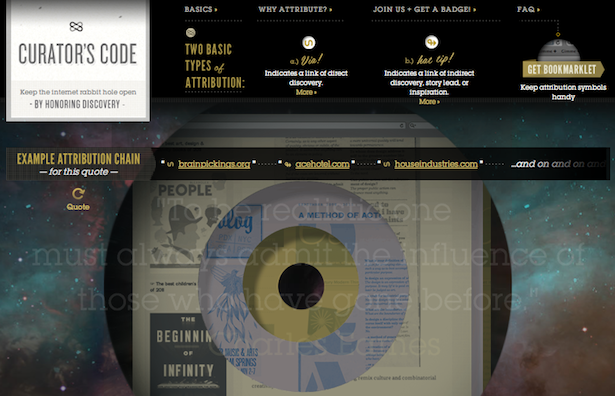
That could be changing, though. This weekend, Maria Popova (whom you may know as an Atlantic contributor, or as the author of Brainpickings, and either way as one of the web’s foremost experts on the art of curation) is launching The Curator’s Code, a system (and, she hopes, a movement) to “honor and standardize the attribution of discovery across the web.” The new project offers both a code of ethics and a common standard for borrowing and sharing. It aims to provide a framework for celebrating curation by way of formalizing it — or, as Popova describes it, of “keeping the whimsical rabbit hole of the Internet open by honoring discovery.”

How to steal other people’s ideas (without being a jerk about it).

[by Megan Garber]

Cool idea ᔥ Jared; but the real ↬ goes to Megan (ᔥ Maria of course). There are too many ways to skin this cat, and it’d be nice if everyone (or at least a majority) decided on one. But would people actually do it?

Posted by ShortFormBlog • Permalink