Read a little. Learn a lot. • Now Mullenweg-free! • Since 2009
☰

Tag: preservation

4 posts

Jun242012t

To lose a language is to lose a lot of cultural information. If we don’t preserve them, we’ll be left with…

To lose a language is to lose a lot of cultural information. If we don’t preserve them, we’ll be left with much impoverished human heritage.

— Institute for Language Information and Technology Director Anthony Aristar • Speaking in supposrt of Google’s latest project, the Endangered Languages Project. ELP went live this week; it has “text, audio and video — such as people speaking or singing in the endangered languages - and bibliographic resources” of languages like Navajo and Koro. There are thousands of languages in danger of going extinct; this project aims to help preserve as many of them as possible. source ( source • source)

Posted by ShortFormBlog • Permalink

May12012t

Happy May Day!

preservearchives:

Happy May Day!

For those of you thinking about romps around the maypole, and cute kids dressed up as May kings and queens, think again.

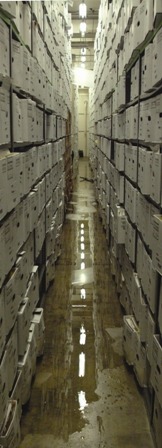
MayDay is also a day when archives, libraries, museums, and other cultural organizations participate in a national effort to prepare for disasters. MayDay encourages us to take one simple step to protect the holdings under our care.

This year, Preservation Programs has created signs to hang in the stacks that list the First Four things you need to do if you see that records are at risk.

Although these signs are designed specifically for the National Archives, the concept holds true for any institution. The main things to remember are:

• Safety First!

• Report the incident (Exactly who to report it to will depend on your situation).

• Do not move wet records. It’s safer for you and the records to wait until the situation has been stabilized.

If the event is large enough, call a reputable recovery vendor who has experience working with document recovery.

Here at NARA, we take records emergencies seriously, and we all have a role to play in protecting the nation’s records against damage from emergencies. This is why all of our facilities have records emergency plans that are updated annually.

What are you doing for MayDay 2012?

And here’s the other May Day.

Posted by ShortFormBlog • Permalink

Dec72011t

Preserving Pearl Harbor Documents

preservearchives:

Preserving Pearl Harbor Documents

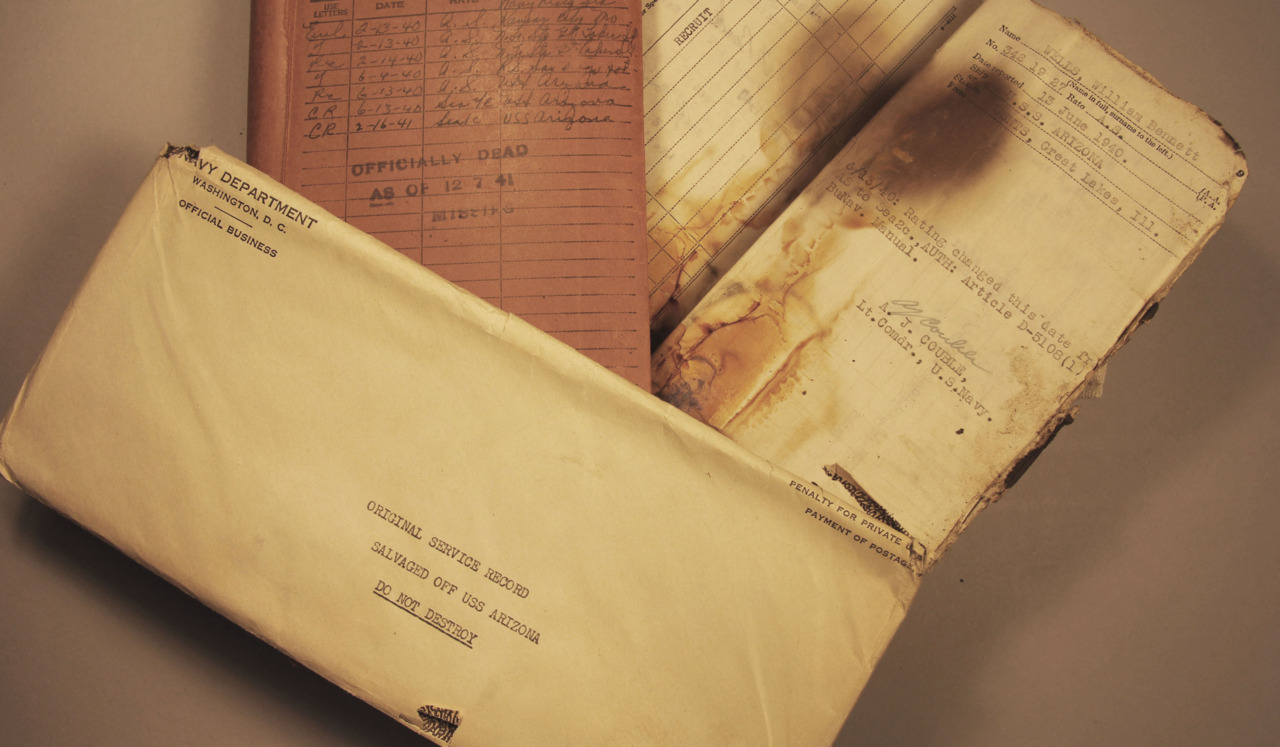
Service jacket and salvaged service record, with Navy envelope, of William Wells. Wells enlisted at Kansas City, Mo. on Jan. 1, 1940, and died Dec. 7, 1941, at Pearl Harbor after achieving the rank of Signalman 3rd class. Also lost that day was his brother, Raymond Virgil Wells. They were one of 23 sets of brothers on the Arizona who died that day.

One of the most important decisions a conservator can make is not how to complete a treatment, but when NOT to treat. An important example of this can be found in the records salvaged from the U.S.S. Arizona after it was bombed on Dec. 7, 1941. These service records, which were held one level below the main deck, were not submerged in water but were subjected to heat, fire, and high humidity. Salvaged by the Navy and sealed in envelopes which contained the damaged documents, the records came to NARA in the 1950s and are now housed at the National Personnel Records Center in St. Louis.

Note: This is the first in a series of posts on conservation of Pearl Harbor documents.

This has to be amongst the coolest Tumblrs we didn’t know about. A tumblr from the National Archives about preserving historical letters and such? That’s awesome!

Posted by ShortFormBlog • Permalink

Apr282009W

Tech: Nerds are working to preserve your crappy Geocities site

  • Yahoo's closing it, so they're working fast. Jason Scott has made it his mission, at least since Yahoo announced that they're closing Geocities, to download old pages from the site to preserve them for history. The software he's set up downloads five sites a second and has downloaded over 200,000 so far. They're grabbing as much as they can but it's a little tough to be comprehensive with such a highly-used service. And if you're curious about the overall structure of Geocities, nerdlinger, click the link, because Scott goes into it in great detail. Ah, Geocities: The pet rock of the '90s. source

Posted by Ernie Smith • Permalink