Read a little. Learn a lot. • Now Mullenweg-free! • Since 2009
☰

Tag: language

22 posts

Aug262019t

You may think that this is ‘political correctness gone mad’ and that those who have been complaining about it…

You may think that this is ‘political correctness gone mad’ and that those who have been complaining about it for more than a decade are ‘over-sensitive’, but this choice does have real-life consequences.

— The about page for theGlimpse image editor, discussing part of the reason why the project, a fork of the well-known open-source image editing program GIMP, exists. Yes, the GIMP name is controversial, and for decades people have raised issues with it. Now, it’s led to the creation of an entirely new open-source competitor that pledges to look at new design directions for the software. (Compare this statement to how GIMP handles the issue, by the way.)
Posted by Ernie Smith • Permalink

Sep222013t

And interestingly,

ericmortensen:

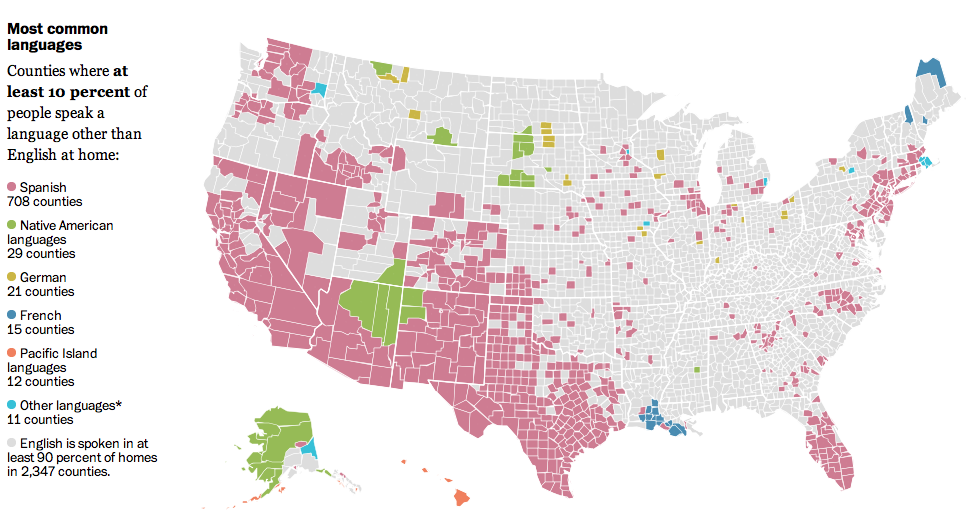
There are 21 counties in the U.S. where at least 10% of the population speaks German at home.

And interestingly, the aligning article to this image is on how the GOP party in the United States is trying to reach out to other non-English-speaking groups. The article delves into the Spanish translation of “sequester,” which means “to kidnap someone.” Oh boy. Just please give me a moment to instead geek over the photo and the info that it presents.

Posted by Patrick deHahn • Permalink

Apr242013t

Penmanship is now 'handwriting' as Washington state removes gender bias in statutes

SEATTLE (Reuters) - Washington state’s governor signed into law on Monday the final piece of a six-year effort to rewrite state laws using gender-neutral vocabulary, replacing terms such as “fisherman” and “freshman” with “fisher” and “first-year student.”

While this may not have an immediate tangible effect, words and language play a significant role in shaping how we think, and mandating gender-neutral language in state statutes is a great first step in the right direction. The article notes that some words, such as “manhole,” won’t be replaced, because legislators couldn’t think of any other alternatives (whether or not “personhole cover” will ever gain traction remains to be seen).

Posted by Seth Millstein • Permalink

Jul282012t

On language, part 35,842

aidiera says: He ‘happens to be blind’? Like, sometimes he’s not blind, but oh, today he just happened to be blind and he set a record. Choose your words wisely, shortform.

  • » SFB says: We do, but unfortunately people still attach meaning which wasn’t intended. Like, for example, there were many archers who could have set a record yesterday, but the one who did just happened to be blind, which is notable because that’s relatively rare. No offense intended. — Ernie @ SFB

Posted by ShortFormBlog • Permalink

Jun242012t

To lose a language is to lose a lot of cultural information. If we don’t preserve them, we’ll be left with…

To lose a language is to lose a lot of cultural information. If we don’t preserve them, we’ll be left with much impoverished human heritage.

— Institute for Language Information and Technology Director Anthony Aristar • Speaking in supposrt of Google’s latest project, the Endangered Languages Project. ELP went live this week; it has “text, audio and video — such as people speaking or singing in the endangered languages - and bibliographic resources” of languages like Navajo and Koro. There are thousands of languages in danger of going extinct; this project aims to help preserve as many of them as possible. source ( source • source)

Posted by ShortFormBlog • Permalink

May52012t

Should Chen Guangcheng be described as a "blind activist"?

  • for Many media outlets have referred to Chen’s blindness as a key crux of his story — which came to light as the result of a daring escape from house arrest, made even more daring because of his lack of vision. The Economist’s current cover headline goes so far as to call his story “Blind Justice.”
  • against Some media outlets, most notably NPR, have avoided the term, saying it’s not key to his story. “His blindness did not give him any particular bravery or insight,” says author Stephen Kuusisto, who has written memoirs about being blind. “It is just a factor in a much larger life.” What do you guys think? source

Posted by ShortFormBlog • Permalink

Apr182012t

Hopefully, this linguistic debate doesn't spill over the edge …

  • cause In some quarters of the grammatical world, the modern use of the word “hopefully,” which generally emphasizes the speaker’s hopes rather than the nature of the subject, is bad, bad, bad — and downright evil. This debate is a thing again because the Associated Press changed their style guide to allow the modern meaning, a change announced at the American Copy Editors’ Society conference.
  • effect A small but vocal group online freaked out over the change, angry that the AP gave into an impure modern usage. “This is an abomination,” said NU’s Dan Kennedy. The Baltimore Sun’s John McIntyre has a more level-headed take: “You don’t like it? Don’t use it. But you don’t get to conflate your idiosyncratic linguistic preferences with the Law and the Prophets." source

Posted by ShortFormBlog • Permalink

Nov42011t

Deaf Professional Arts Network

imwithkanye:

Watch as students from Deaf Professional Arts Network (D-PAN) sign to the White Stripes in a touching music video. Try not to smile, I dare you.

Jack White would be proud. What a great song. What a great idea.

Posted by ShortFormBlog • Permalink

Sep172011t

On referring to someone as acting like someone else

hollylocks said: you know that’s not ACTUALLY Adam Sandler right? Might want to make that clear….

  • » SFB says: You mean it wasn’t clear by the fact that we called him “the drunk, libertarian Adam Sandler”? Usually when you call someone “Meet the ______ Somebody Else,” it infers a comparison, not that it’s the same person. It seemed clear to us — anyone disagree? — Ernie @ SFB

Posted by ShortFormBlog • Permalink