ShortFormBlog
The legend of Paul Ryan: Kinda like Paul Bunyan, except with more budget-cutting strategies
¡Hola! Here’s the latest entry in our weekly post series, “The Pitch.” This post, written by SFB’s very own Seth Millstein, analyzes the man, the myth, and the legend: Vice presidential candidate Paul Ryan. Follow Seth on Twitter over here.
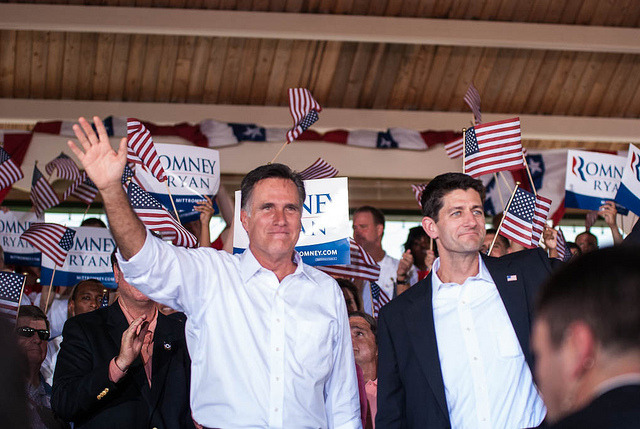
- So just who is Paul Ryan, anyway? Mitt Romney took a political risk, defied most pundits’ predictions, and delighted the conservative intelligensia last week by selecting Paul Ryan, a 42-year-old Congressman from Wisconsin, as his running mate. Ryan, who chairs the House Budget Committee, is a deeply polarizing figure. Some view him as an intelligent, non-combative policy wonk, a politician earnestly concerned with reducing the country’s deficit and unafraid to propose tough measures in order to do so. Others see Ryan a plutocratic snake-oil salesman, a GOP hardliner concerned primarily with gutting social programs and cutting taxes for the rich. So, what’s Ryan all about, and will he help or hinder Romney in November? ShortFormBlog’s Seth Millstein investigates after the jump.
(photo by monkeyz_uncle)
Paul Ryan’s backstory
- Wisconsin, born and raised: Unlike Mitt Romney, Paul Ryan wasn’t born into a political family — though he’s found his calling there, Ryan is as Wisconsin as they come, something that shows in his love of the outdoors. More about Ryan:
- early Ryan was raised in Janesville, Wisconsin. In high school, he was elected class president during his junior year. He lost his father, who died of a heart attack when he was just 16.
- middle At age 21, he became an intern in the U.S Senate in 1991, and after writing speeches for former vice presidential candidate and ardent supply-sider Jack Kemp, won a House seat in 1997.
- current Ryan, who has served in the House for seven terms, gaining a rep as a budget wonk, married the former Janna Little in 2000. They have three children. His net worth is around $4.5 million.
Early philosophical inspirations
The reason I got involved in public service, by and large, if I had to credit one thinker, one person, it would be Ayn Rand.
Paul Ryan • Speaking about the early inspirations on his own political philosophy. Among some of the other thinkers he learned about at the University of Miami (Ohio), he grew a liking to Friedrich Hayek, Milton Friedman, and Ludwig von Mises. But it was Rand who drew the strongest influence — after reading Atlas Shrugged, he was inspired to jump into politics. “I said, ‘Wow, I’ve got to check out this economics thing,’" he told The New Yorker’s Ryan Lizza. “What I liked about her novels was their devastating indictment of the fatal conceit of socialism, of too much government.”
Ryan’s record as a public official
- Ayn Rand is a major influence, but that doesn’t show up in his work: Ryan has gained a reputation as a bit of an economic hawk with libertarian leanings, but does that really hold up? Some critics disagree with that sentiment — particularly libertarian voices who were upset that he was pigeonholed with their political philosophy. So, let’s break it down. Where does he stand?
- Economic Issues Put bluntly, the characterization of Ryan as a budget hawk doesn’t show in his voting record: He’s supported many policies that drastically increased, or would have increased, the deficit. Examples include the Bush tax cuts, Medicare Part D, the repeal of the Affordable Care Act, and a 2004 proposal to privatize Social Security. Ryan also voted for TARP, supported the war in Iraq, and opposed the PayGo requirement that tax cuts be offset with spending cuts, so it’s difficult to conclude that Ryan’s ideology is guided by an anti-big-government sentiment.
- Social Issues Generally speaking, Ryan is socially conservative. He’s received a 100% rating from the National Right to Life Committee, an “A” from the NRA, and a 0% from Americans United for Separation of Church and State. He opposes the DREAM Act, supports anti-flag-burning legislation, and opposes gay marriage — yet he’s in favor extending anti-discrimination laws to cover sexual orientation. According to DW-Nominate, a statistical ranking system that attempts to quantify legislators’ ideology, Ryan is about as conservative as Michele Bachmann. source
The Ryan Plan: How Paul got his wings
- How Paul Ryan became a national figure: Ryan came to prominence around 2010 when, after debating President Obama face-to-face on health care reform, he unveiled a dramatic budget proposal dubbed “The Path to Prosperity,” which he pitched in the video above. He’s put out similar budgets every year, and the most recent incarnation has found its way into the spotlight following Romney’s VP announcement. It has several staples:
- Medicare vouchers Rather than insuring seniors directly, Ryan’s proposal would provide Medicare recipients with “vouchers” worth a certain dollar amount that they could then use to purchase private health insurance. In addition, the plan would increase the age of Medicare elligibility, from 65 to 67, by 2034.
- Tax structure The Ryan plan replaces the current income tax structure with two rates —10% and 25% (this would be a 10% cut for the highest earners), and lowering the corporate tax rate to 25%. It also proposes simplifying the tax code and eliminating unecessary tax expenditures, but doesn’t specify just how.
- Low-income programs Ryan’s budget would cut $2.17 trillion from Medicaid and related programs, as well as $750 billion from money from programs that serve to benefit the poor (like food stamps and Pell Grants). All in all, 62% of the cuts identified in Ryan’s budget come from programs aiming to benefit low-income Americans. source
- » A credible proposal? A frequent criticism of Ryan’s budget is that while it purports to reduce the deficit, this claim relies on policy details that the plan itself does not specify. The primary issue is the plan’s claim to be “revenue-neutral.” This means that although, under Ryan’s budget, tax rates would be reduced, the federal government would still collect just as much money, because the plan eliminates tax breaks and expenditures that otherwise decrease tax intake. However, Ryan doesn’t name any of the breaks or expenditures that he’d reform, and doesn’t explain how they would be modified.
Skepticism about Ryan’s plans
I’m not comfortable dismissing what Ryan says he’ll do. But I’m not comfortable assuming that he’s going to do something he’s never done before, that the Republican Party is ideologically uninterested in doing, and that would be nearly impossible to get done.
The Washington Post’s Ezra Klein • Who’s unsure of how to deal with the lack of specificity in Ryan’s budget proposal. The “something” to which he refers? Offsetting the tax cuts in his budget proposal. The plan doesn’t, in fact, name a single tax offset; it simply asserts as a premise that the new tax policy will be “revenue-neutral.” According to the the Bipartisan Policy Center, Ryan would have to eliminate every tax expenditure on the books to obtain revenue neutrality.
What about November?
- Will having Ryan on the ticket help or hurt Romney? Who knows: So much of Ryan’s effect on the race will depend on things that either can’t be measured yet (his effectiveness as a fundraiser, how his candidacy gets framed, his oratorical skills) or can’t be measured at all (how many minds in Florida are changed due to his Medicare proposals, how many Democrats turn out to vote in Wisconsin who otherwise wouldn’t have, etc). It’s worth keeping in mind that even the most polarizing VP picks don’t necessarily sway the election (many people forget that John McCain was projected to lose long before he tapped Sarah Palin for VP), so any speculation with regard to his effect on the race is dubious at best. (photo by James B. Currie)
A risk or a brave choice?
When a prudent candidate like Mitt Romney picks someone like Representative Paul D. Ryan of Wisconsin as his running mate, it suggests that he felt he held a losing position against President Obama.
FiveThirtyEight’s Nate Silver • Regarding his view on Romney’s choice. He sees Ryan as a risky pick, because now, “Mr. Obama will no longer have to stretch to evoke the specter of Congress and its 15 percent approval rating,” because “with Mr. Ryan on the opposing ticket, he will be running against a flesh-and-blood embodiment of it.” Do you think that Ryan is the change the country needs? Did Mitt make the right choice?
Seth Millstein is a writer and Journalist who has penned articles for the likes of ShortFormBlog and The Daily. Reach him at @SethMillstein.