Read a little. Learn a lot. • Now Mullenweg-free! • Since 2009
☰

Tag: npr

54 posts

Aug192019t

See you later, NPR Tumblr Fam

npr:

It’s not you… it’s us. 😭

Summer engagement intern Kelly here, reporting that my job has sadly come to an end. I hope you enjoyed the showcased NPR stories these past months.

While I’m upset that I’m leaving this team, I’ll still be with the organization in the fall. I’m super happy and excited about my next opportunity! 🤗

In other news, NPR’s Tumblr page will also be taking a break. Editors haven’t decided when it’ll be back, but you should follow our other platforms:

Twitter | Facebook | Instagram | YouTube

Lastly, shameless plug – follow my Twitter here too.

We wish you all the best! Until next time, stay safe. 💖

image

Hi, I’m a ghost of Tumblr past, and I’d like to personally request that your bosses consider coming back sooner rather than later!

We need you as a part of our community. I could write a 3,000 word essay about it, but this GIF does the job pretty well:

Posted by Ernie Smith • Permalink

Apr282014t

Johnny Kauffman at NPR

nprchives:

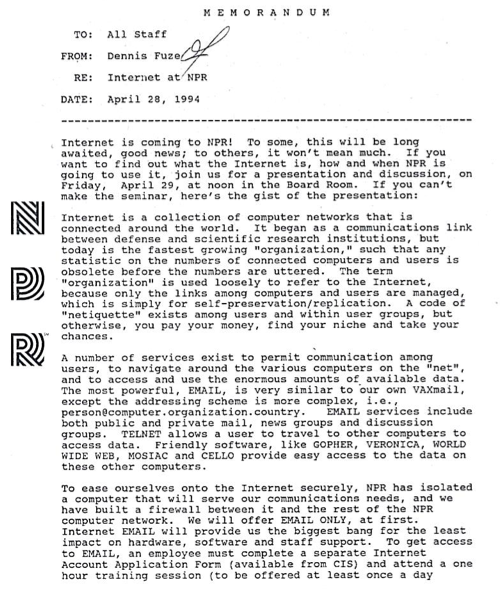
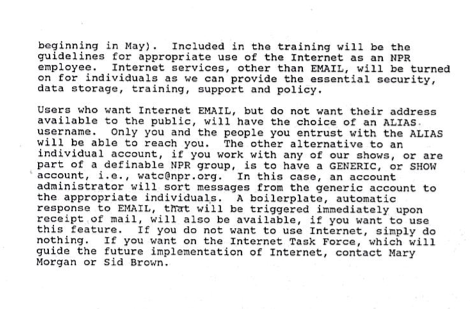
A memo from 20 years ago, today.

Key quote: “The internet is a collection of computer networks that is connected around the world…A code of ‘netiquette’ exists among users and within user groups, but otherwise, you pay your money, find your niche and take your chances.”

via Johnny Kauffman at NPR

+1 for VERONICA namedrop.

Posted by Ernie Smith • Permalink

Tags for this post

Oct22013t

“I shouldn’t have to offer [the Republicans] anything. They’re not doing me a favor by paying for things that…

I shouldn’t have to offer [the Republicans] anything. They’re not doing me a favor by paying for things that they have already approved for the government to do. That’s part of their basic function of government; that’s not doing me a favor. That’s doing what the American people sent them here to do, carrying out their responsibilities.

— President Obama to NPR’s Steve Inskeep [full transcript here] (via npr)

President Obama spoke to Inskeep yesterday, hours prior to the government shutdown. The above passage isn’t a departure from what he’s said so far — he’s been openly critical of ‘hostage-taking’ behavior by the House GOP. But the above statement represents the core standoff the President finds himself in, one that the GOP may suspect, rightly or wrongly, they can find some leverage on. Given Obama’s past willingness to wheel and deal in situations when his side can claim a high-ground of responsibility and adulthood, even liberal supporters do have feasible, credible reasons to fear an extracted compromise on delaying or weakening the ACA. If you’re taking him at his word, though, and the words are stern enough to stake his authority on, no such negotiation seems pending.

Posted by ShortFormBlog • Permalink

Jun192012t

On downloading music without consequences: David Lowery, an alt-rocker best known for his bands Camper Van…

On a personal level, I have witnessed the impoverishment of many critically acclaimed but marginally commercial artists. In particular, two dear friends: Mark Linkous (Sparklehorse) and Vic Chestnutt. Both of these artists, despite growing global popularity, saw their incomes collapse in the last decade. There is no other explanation except for the fact that “fans” made the unethical choice to take their music without compensating these artists.

Shortly before Christmas 2009, Vic took his life. He was my neighbor, and I was there as they put him in the ambulance. On March 6th, 2010, Mark Linkous shot himself in the heart. Anybody who knew either of these musicians will tell you that the pair suffered from addiction and depression. They will also tell you their situation was worsened by their financial situation. Vic was deeply in debt to hospitals and, at the time, was publicly complaining about losing his home. Mark was living in abject squalor in his remote studio in the Smokey Mountains without adequate access to the mental health care he so desperately needed.

I present these two stories to you not because I’m pointing fingers or want to shame you. I just want to illustrate that “small” personal decisions have very real consequences, particularly when millions of people make the decision not to compensate artists they supposedly “love”. And it is up to us individually to examine the consequences of our actions. It is not up to governments or corporations to make us choose to behave ethically. We have to do that ourselves.

Lowery’s pointing out of these edge cases really grabs you. His other point here revolves around the relative cost of music. Breaking down the price point of how much it’d cost to buy every song in her collection legally (read up on her collection here), he notes that while it’d be a couple thousand dollars to pay the royalties for artists, if you break it down month-to-month, it’s really not all that much. Lowery asks pointedly, “Why do we value the network and hardware that delivers music but not the music itself?” While we don’t agree with every point he makes (he points the finger at Google for making it easy to find sites like MegaUpload), clearly he speaks honestly and touches on real issues that rarely get a voice from musicians. It’s a real argument delivered with honest consideration. (thanks Bryan DeVasher)

Posted by ShortFormBlog • Permalink

Jun92012t

My brother has always been ‘work-averse.’ Now, apparently, even the one hour a week is killing him!

My brother has always been ‘work-averse.’ Now, apparently, even the one hour a week is killing him!

— Ray Magliozzi • The younger half of the Car Talk brothers (Ray is 63, Tom is 74), cracking wise at his elder brother’s expense on the matter of the pair’s impending retirement from radio. Car Talk has been a popular mainstay on National Public Radio’s member stations for the past 25 years, and Ray and Tom’s broadcasting careers go back even further — Car Talk was first broadcast in Boston back in 1977. Their final show will air in September, but the Car Talk franchise will continue on for a while even without new material from the iconic pair — NPR will keep broadcasting reassembled episodes drawn from their extensive archives. source ( source • source)

Posted by ShortFormBlog • Permalink

Mar182012t

How Mike Daisey changed his Apple stage show after fabrication claims

  • one Daisey removed parts of the play he could no longer stand behind, according to members of the audience who saw "The Agony and the Ecstasy of Steve Jobs" in the wake of the retracted “This American Life” report.
  • two However, he’s also added some lines claiming that his memory of how things happened was different from what was claimed by the translator he worked with in China — whose claims have largely unwoven his story. source

Posted by ShortFormBlog • Permalink

Mar162012t

I’m not going to say that I didn’t take a few shortcuts in my passion to be heard. My mistake, the mistake I…

I’m not going to say that I didn’t take a few shortcuts in my passion to be heard. My mistake, the mistake I truly regret, is that I had it on your show as journalism, and it’s not journalism. It’s theater.

— Monologuist Mike Daisey • Discussing his work “Mr. Daisey and the Apple Factory,” which “This American Life” aired in January and quickly became one of the public radio show’s most popular episodes and built an uproar against Apple’s labor practices in China. With claims of fabrication in the months since, the show will air an episode titled “Retraction,” which claims that Daisey’s work is at least partially fabricated. Did Daisey take his narrative journalism tale a little too far away from journalism?

Posted by ShortFormBlog • Permalink

Feb272012t

Are NPR's new ethics guidelines the way for journalism organizations to handle themselves? NYU journalism…

With these words, NPR commits itself as an organization to avoid the worst excesses of “he said, she said” journalism. It says to itself that a report characterized by false balance is a false report. It introduces a new and potentially powerful concept of fairness: being “fair to the truth,” which as we know is not always evenly distributed among the sides in a public dispute.

Maintaining the “appearance of balance” isn’t good enough, NPR says. “If the balance of evidence in a matter of controversy weighs heavily on one side…” we have to say so. When we are spun, we don’t just report it. “We tell our audience…” This is spin!

Rosen took a particular liking to lines like these: “Our goal is not to please those whom we report on or to produce stories that create the appearance of balance, but to seek the truth.” Read NPR’s ethics guidelines and consider it for yourself.

Posted by ShortFormBlog • Permalink