Read a little. Learn a lot. • Now Mullenweg-free! • Since 2009
☰

Tag: metadata

5 posts

Aug42013t

[T]wo months ago, I contacted some colleagues at NSA. We had a little meeting, and the question came up, was…

[T]wo months ago, I contacted some colleagues at NSA. We had a little meeting, and the question came up, was NSA collecting everything now? Because we kind of figured that was the goal all along. And the answer came back. It was, yes, they are collecting everything, contents word for word, everything of every domestic communication in this country.

— Russel Tice, former NSA Analyst. (via letterstomycountry)

If these claims are correct, that expands the scope from “metadata” considerably.
Posted by Ernie Smith • Permalink

Jul172013t

U.S. lawmakers say little political support for phone surveillance

Lawmakers said at a hearing of the House Judiciary Committee that they doubted the legal provision had the votes to win renewal before it is set to expire in June 2015.

The warning was the latest evidence of a backlash against U.S. surveillance programs disclosed in the Guardian and the Washington Post last month from information the newspapers were given by former U.S. spy agency contractor Edward Snowden.

One of those programs is a database of telephone “metadata,” including numbers called and the length and time of calls, going back seven years. U.S. officials said they had used the database only in limited circumstances and that it had proven essential to stopping attacks against civilians.

Out of curiosity, does anyone out there actually believe the NSA would stop monitoring the various channels of communication currently under surveillance, simply because a legal provision lapsed and/or Congress said to?

Posted by Scott Craft • Permalink

Jun242013t

Australia was considering putting together its own PRISM-like surveillance mechanism … but appears to have…

A controversial “data retention” scheme that would have required Australians’ internet and telephone activities to be stored for up to two years for law enforcement purposes has been shelved by the federal government after an inquiry that did not recommend the scheme go ahead.

The committee looking into the proposal – the most controversial among more than 40 others – as part of an inquiry into national security delivered its report on Monday.

After the report’s release, Attorney-General Mark Dreyfus said the government would not pursue data retention legislation “at this time”.

Meanwhile, it appears The Washington Post is mining the same territory that David Gregory did yesterday regarding Glenn Greenwald.

Posted by Ernie Smith • Permalink

Jun82013t

Every day, 854,000 US civil servants, military personnel and private contractors are scanned into…

Every day, 854,000 US civil servants, military personnel and private contractors are scanned into high-security government offices to do intelligence work, according to the Washington Post’s 2011 ‘Top Secret America’ report. Up to 55,000 of these work for the National Security Agency, the vast eavesdropping centre that collects 'metadata’ on billions of US domestic telephone calls. Most are data analysts. Distributed across an archipelago of high security federal buildings in Virginia, Maryland and Washington DC, they toil anonymously in might be labelled America’s data-intelligence complex. The tools and abilities are exponentially different to anything that Eisenhower could have imagined. In his day spies would tap individual phones.

— Financial Times writer Edward Luce • Discussing the scale of the “data-intelligence complex” that has led to the federal government spending $80 billion per year on intelligence alone, something he notes “is more than the defence budgets of all but a handful of countries.”

Posted by Ernie Smith • Permalink

Jun72013t

While some are claiming that the situation involving metadata

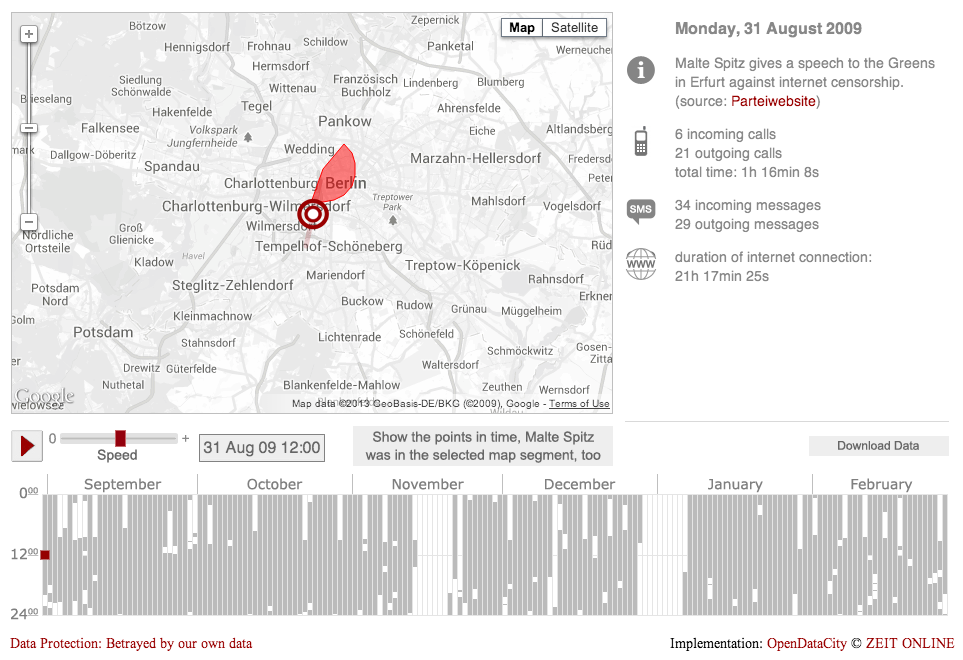
While some are claiming that the situation involving metadata that phone companies are being forced to hand over to the NSA isn’t really as bad as it seems, the truth is, when combined with other information, that metadata can say a ton. Here’s an example in the form of an interactive graphic the German newspaper Die Zeit made of a Green Party politician, Malte Spitz, who sued his phone company to release his data to the newspaper. Die Zeit used the metadata gathered and combined it with publicly available information about Spitz. The results? Well … just click the link and hit play. (thanks Jessica Binsch)

Posted by Ernie Smith • Permalink