» Harsh words for the opposition: George Papandreou, the leader of the Socialist Party, had this to say towards the opposition New Democrats in the heat of the all-important vote: “All of Europe knows that your party is responsible for the current situation.” The vote, which only one member of parliament on either side crossed lines for, means that the country will receive a $17 billion rescue plan to make it through the Summer, with a second, much larger one in the works. Meanwhile, outside parliament, large-scale protests continued unabated.
5,000police officers deployed to deal with mayhem source
» 48-hour general strike called: With Greece facing a difficult austerity vote today, protesters have shown up by the thousands outside of the country's parliament. The strike has shut down most public services, including transit. Airports and hospitals have also suffered the deep effects of the strikes. The passage of the measures, however, is key — a large loan from the European Union and the International Monetary Fund rests on their passage. If they don't get it, they risk going into default, which would be very bad.
€70billion (or more) needed to help bail out Portugal source
» Coming today — the request: Portugal's current caretaker government plans to solicit the European Union for bailout money today. However, the fact that it is a caretaker government complicates things, because some argue that they may not have the proper authority to take on such a task. To put this in perspective, Ireland's outgoing government made a similar bailout request, only to have to the new government ask for changes after they got into office — something that the people handing out the money didn't like. Gift horse, mouth, all that stuff.
In some Libyan cities, Muammar Gaddafi's security forces are nowhere to be seen. Al Jazeera is reporting that many Libyan cities, especially in the Eastern part of the country, protesters are in control. "All along the border," said correspondent Hoda Abdel-Hamid, "we didn't see one policeman, we didn't see one soldier and people here told us they [security forces] have all fled or are in hiding and that the people are now in charge, meaning all the way from the border, Tobruk, and then all the way up to Benghazi." Gaddafi still plans to quash this uprising, however, but based on reports it'll be an uphill battle at best. source
bad The violence in Libya has been extremely severe over the past few days, with hundreds dead and many more wounded. It's a nation that seriously needs help.
worse Unfortunately, organizations like the European and the Libyan Red Crescent Society say that there's a limited aid network to help the wounded. Sigh. source
issue For years, many Libyans have attempted to leave the country – illegally, mind you – on refugee boats that travel through the Mediterranean. The refugees have mostly headed to Italy.
tactic Before the current crisis, Libya and Italy had a deal where the two countries would intercept them and send them back to Libya to detention centers – which is, um, a human rights violation.
problem People are leaving in larger numbers now – 5,000 in the past week – and Libya has threatened to stop cooperating. So now, the EU is trying to figure out a way to take in the expatriates. source
Is Google acting anti-competitively? Does it use its search-engine prowess to favor its own services over those of competitors? Does the company's market share (66 percent in the U.S., 80 percent in Europe) constitute a monopoly? Do sites like Foundem, eJustice.fr and Ciao (the latter owned by Microsoft) have bad luck with Google because of crappy information-thin design that completely wastes your time and has little relevance (which we'd argue with the first two) or because there are competitive issues afoot (which seems realistic with the last one)? The European Union is asking these questions themselves as part of an antitrust trial. Seems Google's getting too big for its britches. source
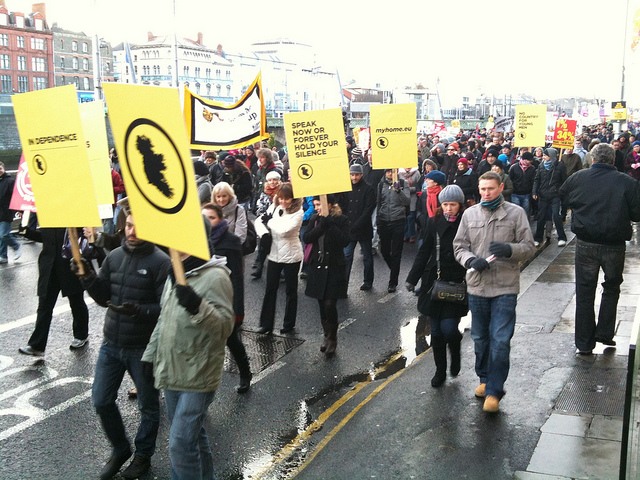
We've seen this song and dance before. First in Greece, then Belgium, then France, then in Britain, but it's still not any more frustrating to watch – especially in Ireland's case. The Irish had a solid decade of economic growth, only to see the economy go into freefall and be forced to take upon tons of bailout money in the span of about two years. So that's why these people are protesting in Dublin today. They're angry because of the insane cuts they'll be forced to swallow – the worst of any European nation so far. (Photo by Marcus Swan)source
Hey, yo, Ireland. ShortFormBlog here. We just wanted to commend you for coming to your senses and deciding to take a loan from the European Union. But there's still a problem – you're remaining way too timid about accepting help. You guys don't want to end up like Greece or Iceland, do you? While we don't know how much you'll be willing to take (all you're on the record for is saying €100 billion would be "too much"), but with that crappy housing market and contracting economy of yours, you might be wise to work on improving your economic stability with a bailout, not trying to figure out how little you can get. Again, if you don't want the bailout money, we'll take if off your hands. source
Hey, if Ireland doesn't want any of this bailout money, give it to us. For days now, the European Union – and now Britain proper – have been pushing to give Ireland lots of money to ensure its solvency. However, Ireland doesn't seem to have any interest in taking it, at least right now. So, we'd like to offer a proposal to the European Union. Give us the bailout money. We'd use the money to build our own country (tentatively titled ShortLandia) where we'd build an army of coffee shops and have dozens of bloggers working away, producing short content for the masses of other countries throughout the world. It'd be communism. Except in content farm form. And instead of eating soviet bread, we'd be drinking ShortLandia lattes. With an extra kick. So you don't fall asleep and prevent another piece of content from hitting the Intersphere. source
 ShortFormBlog