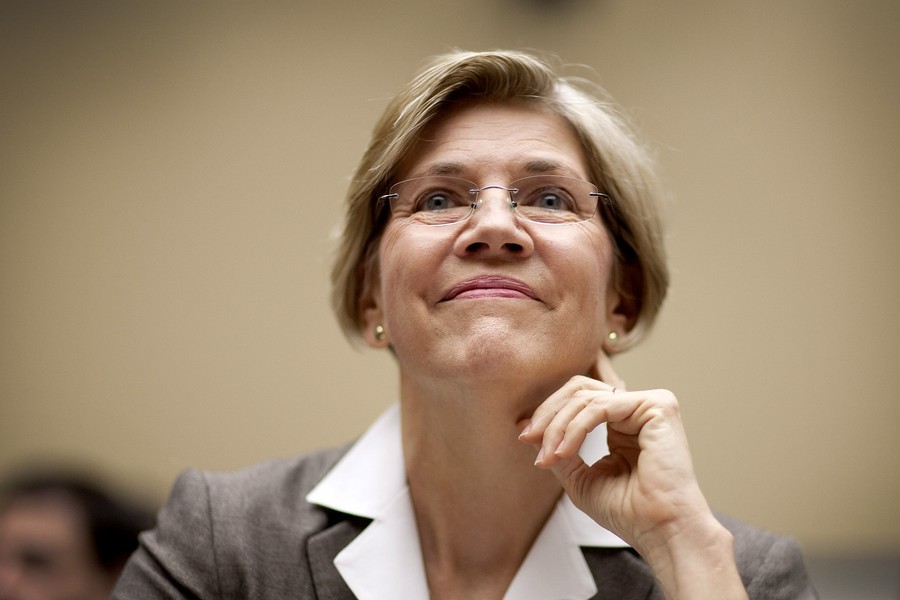
Warren to nab powerful committee seat? According to several Senate sources, Senator-elect and populist hero Elizabeth Warren has a good chance of getting a seat on the powerful Senate Banking Committee. This is a logical fit for Warren, architect of the Consumer Financial Protection Bureau, and would give her great power in her efforts to curb deceptive and unscrupulous practices on the part of financial institutions. “[G]iven her prominent work on those issues, she would certainly have a very good shot” at getting a spot on the committee, an aide tells Reuters. Having Warren on Banking is essentially the Republicans’ worst nightmare, but it’s worth noting that it’s a nightmare entirely of their own short-sited construction. source
Tag: bailout
131 posts
I keep hearing the president say he’s responsible for keeping the country out of a Great Depression. No, no…
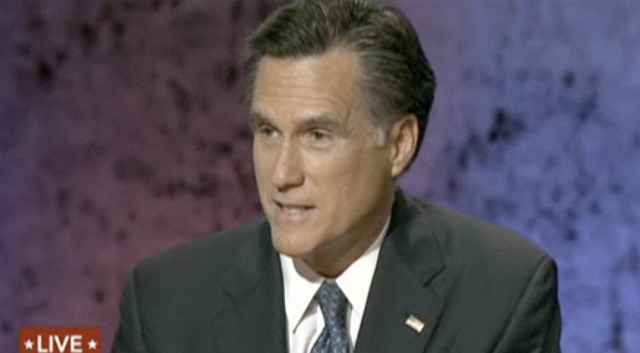
I keep hearing the president say he’s responsible for keeping the country out of a Great Depression. No, no, no, that was President George W. Bush and Hank Paulson.
— Mitt Romney • At a town hall meeting today. We’re no political strategists, but we’re wondering how helpful it is for a presidential candidate to make a statement now, in 2012, that’s both pro-George W. Bush and pro-bailout. TARP, for instance, is currently sitting with a net -13 approval rating. Not exactly a winning issue. source ( source • source)
Posted by ShortFormBlog • Permalink
Politics: Barney Frank's legacy: Three major achievements beyond Dodd-Frank
- one Barney Frank is one of the most prominent gay U.S. representatives, and as a result, he's long been a champion of gay rights; he long opposed the recently-repealed "Don't Ask, Don't Tell."
- two Frank was a lead Democrat who helped to build and implement the $700 billion bailout passed in 2008 under George W. Bush; he became a key figure of the financial crisis.
- three He also worked to end the practice of redlining, a process that banks used to place difficult lending conditions on people and businesses located in low-income neighborhoods. source
Posted by Sami Main • Permalink
Mitt Romney, when pushed,

Mitt Romney, when pushed, refused to out and out denounce the TARP bailout, which while politically toxic for a GOP candidate, he says is based on his experience in the private sector. He insisted they were necessary to keep the whole system from collapsing, though he stressed he has no interest in any further bailouts. Also, he’d try to play a bigger role in the European debt crises, particularly Greece’s.
Be sure to check out more coverage over at DC Decoder!
Posted by ShortFormBlog • Permalink
In Greece, the company's debt crisis is so bad that the Prime Minister, George Papandreou, decided to skip…
Papandreou’s office says “next week is particularly crucial” to the country’s next bailout. The debt crisis is also so bad that a guy lit himself on fire yesterday because he couldn’t renegotiate his loan.
Posted by ShortFormBlog • Permalink
U.S.: Federal Reserve slaps Wells Fargo with puny $85 million penalty
- $85 millionpaid by Wells Fargo for its role in the subprime mortgage fiasco; the penalty was issued by the Federal Reserve
- $25 billion received by Wells Fargo from the Troubled Assets Relief Program, colloquially known as the bailout source
- » This is both the largest consumer protection fine ever levied by the Fed and the first time the institution has punished a bank for nudging customers into subprime loans. There's more to come, too; in addition to the fine, the order also "requires that Wells Fargo compensate affected borrowers," although it's unclear how this will work. It's better than nothing, but $85 million just seems a bit low; as a point of comparison, the bank made $2.5 billion in the first three months of 2010 alone.
Posted by Seth Millstein • Permalink
World: The US Treasury is running low on cash
- 29 companies have more money than the United States Treasury
- 7 of those companies are based in America source
- » The American companies include: Bank of America, JPMorgan Chase, Morgan Stanley, Goldman Sachs, and Freddie Mac. Two of the top three companies on the list are Chinese. On the upside, the Treasury has as much money as Google, so that's kind of a nice consolation prize.
Posted by Seth Millstein • Permalink
U.S.: Bailouts: Remember TARP? It's almost entirely recouped, kids.
- $700B the amount the U.S. spent on the Troubled Asset Relief Program back in 2008
- $341B the amount it looked like taxpayers were going to lose on the bailout deal back in mid-2009
- $25B the amount it looks like we'll lose on TARP; this is because we gave the money to banks source
- » Not all is rosy in Bailoutville: One of the biggest issues we still face are the dual sinkholes of Fannie Mae and Freddie Mac, which have reportedly cost taxpayers $150 billion and we like to think of as dual sinkholes. And some legislators feel that the effect has set us up for having to bail out unsuccessful companies in the future.
Posted by Ernie Smith • Permalink
Biz: Did we really profit off Citi, or are we still in the danger zone?
So assuming that the banking sector doesn't suffer another crisis in the next two years, taxpayers might be okay after all. Indeed, even if there is some loss on these guarantees, the assets would have to be pretty rotten to eat up the government's entire $12 billion profit on the equity sale.
The Atlantic associate editor Daniel Indiviglio • Offering some more context on the Citi bailout numbers. While the U.S. no longer owns any shares in Citi, we do have other stakes in the company – most notably, we're still backing a lot of their debt right now due to a program called the "Temporary Liquidity Guarantee Program," which isn't as easy to acronym as TARP. But by the end of 2012 at the latest, we'll be off the hook for that. Still, though, the fact that we might make any money off of TARP is impressive. "Citi was viewed by many as the big bank with the most serious problems," Indiviglio notes, suggesting that the profit would prove that their bailout in 2008 was warranted by panic and general FUD, not "too big to fail"-type concerns. source
Posted by Ernie Smith • Permalink
Biz: The U.S. sold off its last Citi shares; how'd we do on that bailout?
- 0 the number of Citi shares the U.S. owns as of today; good riddance
- $45B the amount of money the U.S. infused in Citi during the great bailout crisis of 2008
- $57B the proceeds the U.S. made on the bailout investment (golf clap; good show, chaps)
- $12B the amount the U.S. has profited from Citi – wait, we made money on a bailout? source
Posted by Ernie Smith • Permalink
