Read a little. Learn a lot. • Now Mullenweg-free! • Since 2009
☰

Tag: economy

601 posts

Sep 8 2012t

Potential presidential debate question

thedailyfeed:

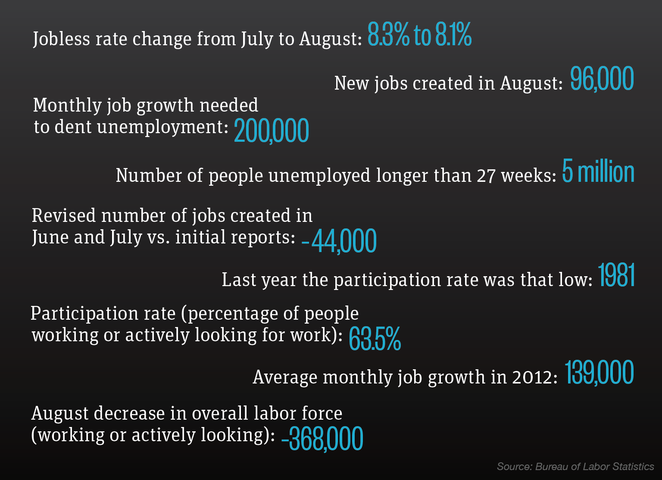
Yesterday’s dismal jobs report showed the lowest labor participation rate in 31 years.

Employers added only 96,000 workers in August, down sharply from the 141,000 in July and well below the 100,000 to 150,000 jobs needed just to keep pace with growth in the labor market.

The weak report aside, the unemployment rate still dropped — from 8.3 percent to 8.1 percent — because many of the out-of-work simply gave up. And only two out of three working-age Americans either had a job or were looking for one last month, the lowest level since Ronald Reagan took office.

“The economy is crawling up the down escalator,” said Patrick O’Keefe, head of economic research at financial consulting firm J.H. Cohn in Roseland, N.J.

Potential presidential debate question: How do we encourage people who have given up on finding work to "participate" again?
Posted by ShortFormBlog • Permalink

Aug 27 2012t

Look, the guy was dealt a difficult hand, no question about it. But he’s had three years, his policies have…

Look, the guy was dealt a difficult hand, no question about it. But he’s had three years, his policies have failed. Rather than blame others … maybe offer some fresh solutions to the problems that we face. But that’s not going to happen between now and election day.

— Former Florida Gov. Jeb Bush • Expressing disappointment that President Obama continues to point the finger at his brother, former President George W. Bush Sunday. Bush, who made the comments during an interview on “Meet The Press” on Sunday, also discussed his decision not to enter the 2012 presidential race, a move that both shocked and confused many within the GOP, citing a lack of motivation as the top reason he chose not to run for the nation’s highest office. source ( source • source)

Posted by ShortFormBlog • Permalink

Aug 3 2012t

The ballad of Knight Capital: How a company's software messed up the market

  • $440 million the amount Knight Capital lost after a trading glitch on Wednesday led the company to send erroneous orders on 140 separate stocks
  • 75% decline the fall in the company’s stock since Tuesday; the company blamed its problems on new software which suffered from glitches source
  • » As for the stocks affected: Some of the smaller stocks, like Wizzard Software (which made a dramatic leap from $3.50 to $14 as a result of the trading glitch) had their trades cancelled, with no penalties for the steep increases. Other bigger stocks, like Abercrombie & Fitch, are still being investigated. Glitches in complex software like this could be spooking smaller investors, already weary of the stock market after the financial crisis and the 2010 Flash Crash.

Posted by ShortFormBlog • Permalink

Aug 1 2012t

How should media cover this

sunfoundation:

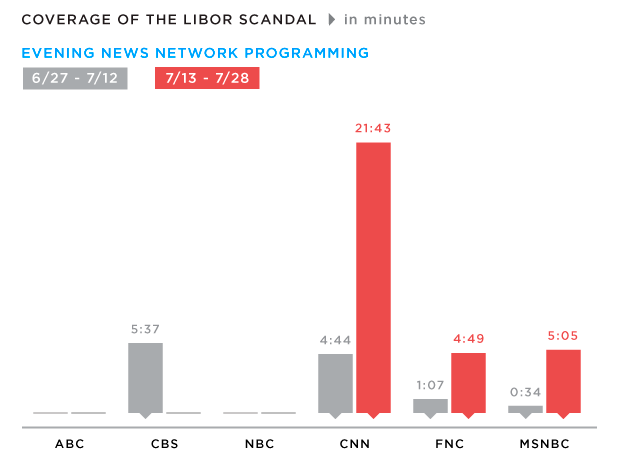
ABC, NBC Evening News Shows Ignore Massive Banking Scandal For More Than A Month

American television news outlets continue to devote sparse time to one of largest banking scandals in history. The controversy over whether major banks have been manipulating the LIBOR, a crucial interest rate that banks use to borrow money from one another, has been gathering steam for more than a month since U.S. and U.K. regulatorsfined British bank Barclays $450 million for its role in trying to rig the rate.

How should media cover this fairly complex story?

Posted by ShortFormBlog • Permalink

Jul 8 2012t

Despite educational push, high-flying science jobs hard to come by

  • push In recent years, the National Science Foundation and other major science-related groups have pushed for universities to churn out more scientists, and Obama has encouraged more science education in schools.
  • problem Unfortunately, lab-based science jobs are proving hard to come by — academic jobs are scarce, and the pharmaceutical industry has cut hundreds of thousands of jobs over the past decade. We’re talking about unemployed PhDs. source

Posted by ShortFormBlog • Permalink

Jul 6 2012t

June's unemployment rate, in one word: Unchanged

  • 8.2% unemployment rate in June (it’s unchanged)
  • 80k number of jobs created in June, according to the Bureau of Labor Statistics report
  • 77k number of jobs created in May, based on revised numbers; June was a marginal improvement
  • 100k number of jobs economists expected to be created in June; the sound of failure source
  • » Does little improvement = decline? That’s Ezra Klein’s argument on the report. “In this economy, little or no change isn’t good enough,” he says. “We added 80,000 jobs in June. That’s not enough to keep up with population growth. So, in the context of our growing workforce, the labor market lost ground last month.”

» Editor’s note: And because this comes up EVERY SINGLE MONTH, the unemployment rate above is the U3 unemployment rate, the standard that the Bureau of Labor Statistics uses. If you use the U6 unemployment rate (which includes people unemployed but not currently looking for work, or working part-time for economic reasons), it jumps to 14.9 percent, which is up from last month.

Posted by ShortFormBlog • Permalink

Jun 7 2012t

Paul Krugman vs. Estonian president: Keynesian battle royale

hipsterlibertarian:

“Let’s sh*t on East Europeans: their English is bad, won’t respond & actually do what they’ve agreed to & reelect govts that are responsible.” —

Estonian President Toomas Hendrik Ilves, going after Keynesian economist Paul Krugman on Twitter after the latter criticized Estonia’s use of austerity measures to produce a steady, though still incomplete, recovery from the recession.

Ilves sent out a series of very angry tweets in response to Krugman’s short article, and later shared a lengthy article he wrote in March explaining his support for thrifty policies in Estonia – and how well they have worked compared to the policies of many of Estonia’s European neighbors to the West and South.

The Estonian Finance Minister also followed up in a press conference, saying:

In reality, Krugman has to a great extent supported the system that created our poverty and which is now over – and which regulated and printed money according to their own interpretation of economic rules. In the US that is possible, but we cannot solve our poverty according to those recipes – by borrowing money and buying ourselves expensive things.

He’s right – except that it’s not really possible for us either.

This is one of the more entertaining arguments to happen on Twitter lately — and it will be interesting to see if Krugman has to eat his words on this one in a year.

Posted by ShortFormBlog • Permalink